
Access to Justice in Rural Areas of Pakistan

Updated: Oct 1
Access to justice is one of the fundamental pillars of a democratic society and an essential component of the rule of law. It ensures that every individual, regardless of their social status, economic condition, education, or geographic location, can seek legal protection, enforce their rights, and obtain fair remedies through lawful institutions. In Pakistan, while the legal framework provides constitutional guarantees and a well-established judicial system, access to justice remains a significant challenge for many people living in rural areas.
A large portion of Pakistan's population resides in villages and remote communities where legal institutions, professional legal services, and judicial facilities are often less accessible than in urban centers. Rural residents frequently face obstacles such as long distances to courts, limited transportation, financial constraints, low legal awareness, shortage of lawyers, delays in judicial proceedings, inadequate legal infrastructure, and administrative inefficiencies. These barriers make it difficult for many citizens to pursue legal remedies even when their rights have been violated.
The challenges of rural justice extend beyond the courtroom. Access to justice also includes obtaining legal information, resolving disputes efficiently, accessing government services, securing legal representation, protecting property rights, enforcing contracts, and benefiting from fair administrative procedures. Farmers, laborers, women, children, small business owners, tenants, and marginalized communities often face additional difficulties due to limited resources and lack of awareness regarding their legal rights.
Recognizing these challenges, Pakistan has introduced various reforms aimed at improving access to justice through judicial modernization, legal aid initiatives, digital services, alternative dispute resolution mechanisms, mobile courts in certain contexts, legal awareness programs, and improvements in local governance. Although progress has been made, continued efforts are necessary to ensure that justice is equally available to all citizens regardless of where they live.
Understanding the issue of access to justice in rural areas is important for lawyers, judges, law students, policymakers, researchers, civil society organizations, and citizens. It highlights the need for practical reforms that strengthen legal institutions, promote equality before the law, and ensure that justice reaches every community across Pakistan.
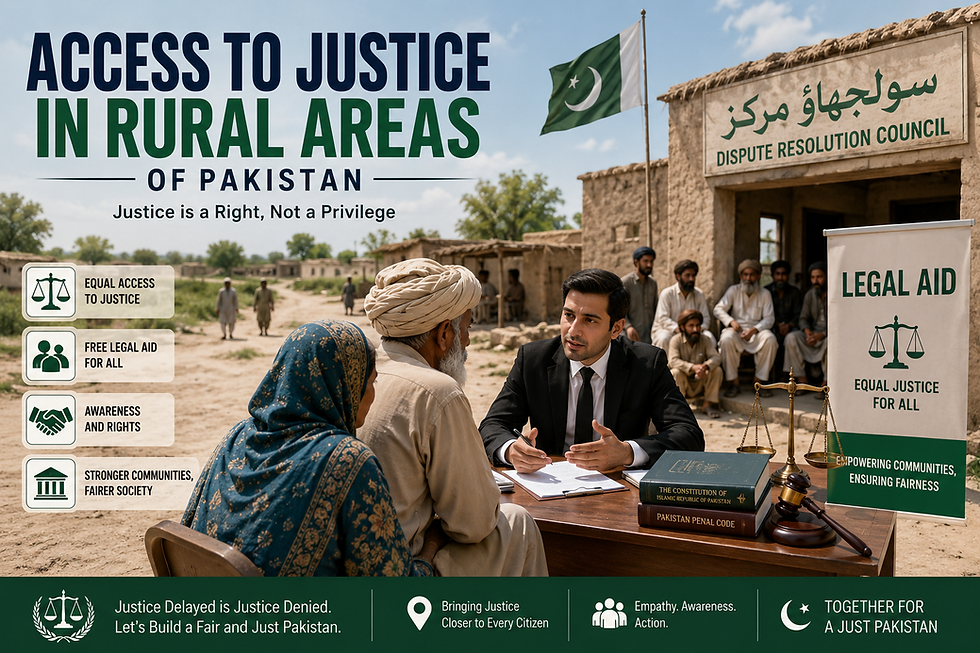
Understanding Access to Justice
Access to justice refers to the ability of individuals to seek and obtain fair, timely, and affordable legal remedies through lawful institutions.
It includes the opportunity to enforce legal rights, defend against legal claims, obtain legal advice, resolve disputes, and receive impartial decisions from competent authorities.
True access to justice requires more than the existence of courts. It also depends on affordability, accessibility, awareness, efficiency, and fairness.
An effective justice system should serve every citizen equally.
Importance of Access to Justice
Access to justice strengthens democracy, protects constitutional rights, and promotes public confidence in legal institutions.
When citizens can effectively enforce their legal rights, they are more likely to resolve disputes peacefully and respect the rule of law.
A justice system that is accessible to everyone contributes to social harmony, economic development, and institutional accountability.
Equal access remains a fundamental objective of modern legal systems.
Rural Population and Legal Needs
Rural communities depend upon the legal system for resolving numerous issues affecting everyday life.
These include property ownership, land boundaries, inheritance, tenancy, agricultural agreements, employment, family disputes, consumer rights, financial transactions, and access to government services.
Legal protection is particularly important because rural livelihoods often depend upon land, agriculture, and local business activities.
Effective legal institutions support both economic stability and community development.
Distance from Courts
One of the most significant challenges facing rural residents is the physical distance between villages and judicial institutions.
Many individuals must travel considerable distances to attend court hearings, meet lawyers, file documents, or participate in legal proceedings.
Travel costs and time away from work increase the financial burden of litigation.
Greater geographic accessibility would improve public access to justice.
Limited Transportation Facilities
Transportation difficulties often make legal proceedings even more challenging.
In remote areas, limited public transport and poor road infrastructure may delay court appearances or discourage individuals from pursuing legal claims.
Reliable transportation plays an important role in improving judicial accessibility.
Infrastructure development supports legal as well as economic progress.
Financial Barriers
The cost of legal proceedings is another important obstacle.
Court fees, transportation expenses, legal representation, documentation costs, and repeated travel can place a heavy financial burden on rural families.
Many individuals may decide not to pursue legitimate legal claims because of these expenses.
Affordable justice strengthens equality before the law.
Limited Legal Awareness
Legal awareness remains relatively low in many rural communities.
Some citizens are unfamiliar with their constitutional rights, legal remedies, court procedures, or available government services.
Lack of information may prevent individuals from reporting violations or seeking lawful solutions.
Public legal education is essential for improving access to justice.
Shortage of Legal Professionals
Many rural districts have fewer practicing lawyers and legal specialists than major cities.
This limits access to professional legal advice, document preparation, and courtroom representation.
Increasing the availability of qualified legal professionals would improve the quality of legal services in underserved communities.
Professional legal assistance strengthens procedural fairness.
Judicial Delays
Like many parts of the justice system, rural litigants may experience delays in the resolution of cases.
Long proceedings increase financial costs and create uncertainty regarding property rights, contractual obligations, family matters, and commercial activities.
Timely justice is particularly important for rural communities that rely on seasonal agricultural income.
Efficient case management benefits everyone.
Property and Land Disputes
Land remains one of the most valuable assets in rural Pakistan.
Disputes relating to ownership, inheritance, tenancy, boundaries, cultivation rights, and revenue records are common.
Resolving these disputes requires accurate documentation, efficient administration, and effective judicial mechanisms.
Modern land record systems can significantly reduce conflict.
Access to Government Services
Many legal rights depend upon access to administrative institutions.
Citizens require government services relating to identity documents, land records, taxation, registration, licenses, and public benefits.
Administrative delays or lack of nearby offices may make these services difficult to obtain.
Efficient public administration strengthens access to justice.
Women's Access to Justice
Women living in rural areas may encounter additional challenges when seeking legal remedies.
Limited mobility, financial dependence, social barriers, and lack of legal awareness can make it difficult to pursue property rights, inheritance claims, family disputes, or employment-related issues.
Improving legal literacy and institutional accessibility strengthens equal justice.
Greater inclusion benefits society as a whole.
Rights of Farmers and Agricultural Workers
Agriculture forms the foundation of many rural communities.
Farmers require effective legal protection regarding land ownership, water rights, agricultural contracts, labor arrangements, financing, and commercial transactions.
Reliable legal enforcement supports agricultural productivity and rural economic development.
Legal certainty encourages investment in agriculture.
Role of Legal Aid
Legal aid programs help individuals who cannot afford professional legal representation.
These services improve access to justice by providing legal advice, document preparation, and representation where available.
Expanding legal aid contributes to greater equality before the law.
Accessible legal assistance strengthens public confidence.
Alternative Dispute Resolution
Alternative Dispute Resolution (ADR) offers valuable opportunities for resolving disputes efficiently.
Mediation, arbitration, and conciliation may provide faster and less expensive solutions for many civil and commercial disagreements.
ADR can reduce pressure on courts while improving access to justice for rural communities.
Peaceful dispute resolution often preserves community relationships.
Digital Transformation
Technology is creating new opportunities to improve rural access to justice.
Online legal information, electronic filing systems, virtual hearings where appropriate, digital case tracking, and computerized public records reduce the need for repeated travel.
Digital services also improve transparency and administrative efficiency.
Responsible technological innovation strengthens judicial accessibility.
Importance of Legal Awareness Campaigns
Public education is one of the most effective ways to improve access to justice.
Legal awareness campaigns help citizens understand their constitutional rights, legal procedures, consumer protections, property rights, family laws, and available remedies.
Knowledge empowers individuals to protect themselves against exploitation and unlawful conduct.
Informed communities are better able to exercise their legal rights.
Institutional Reforms
Improving rural access to justice requires continuous institutional reform.
Strengthening local courts, expanding legal aid, improving transportation infrastructure, modernizing land records, increasing judicial resources, and simplifying administrative procedures all contribute to more effective legal services.
Long-term reforms require cooperation among government institutions, the judiciary, legal professionals, and civil society.
Institutional development strengthens the rule of law.
Practical Measures to Improve Access to Justice
Several practical initiatives can enhance legal accessibility in rural Pakistan:
Expand legal aid services for economically disadvantaged citizens.
Increase public legal awareness through educational programs.
Improve transportation and court infrastructure in remote areas.
Strengthen digital court services and online legal information.
Modernize land records and administrative systems.
Encourage greater use of Alternative Dispute Resolution.
Increase the availability of qualified lawyers in rural districts.
Improve coordination among courts, administrative agencies, and local authorities.
These reforms can significantly improve public confidence in the justice system.
Importance for Law Students
Studying rural access to justice helps law students understand the practical challenges faced by ordinary citizens beyond urban legal practice.
It develops awareness of constitutional rights, judicial administration, legal aid, public policy, social justice, and institutional reform.
Future legal professionals who understand rural legal needs are better equipped to contribute to meaningful improvements in Pakistan's justice system.
Conclusion
Access to justice in rural areas of Pakistan remains one of the most important challenges facing the country's legal system. Although the Constitution guarantees equality before the law and the protection of fundamental rights, practical barriers such as long distances to courts, financial constraints, limited legal awareness, shortage of legal professionals, judicial delays, administrative inefficiencies, and inadequate infrastructure continue to affect many rural communities. These challenges impact individuals seeking justice in matters involving property, family, employment, agriculture, commercial transactions, and constitutional rights.
Despite these obstacles, ongoing reforms in judicial modernization, legal aid, digital governance, alternative dispute resolution, and administrative efficiency provide valuable opportunities for improving legal accessibility. For lawyers, judges, law students, policymakers, researchers, civil society organizations, and citizens, understanding rural access to justice is essential for promoting legal equality and strengthening the rule of law. By expanding legal awareness, improving institutional capacity, embracing technology, and ensuring that justice reaches even the most remote communities, Pakistan can move closer to a legal system that serves all citizens fairly and effectively, regardless of where they live.


