
Accredited LL.B Degree Program at Pasban Law College
Updated: Oct 1
In a country where the legal profession plays a central role in shaping justice, governance, and public life, the quality and credibility of legal education institutions carries enormous significance. For aspiring lawyers in Pakistan, enrolling in an accredited law program is not merely a preference but a necessity. Accreditation ensures that the degree you earn is recognized by regulatory bodies, respected by employers, and accepted by bar councils across the country. Pasban Law College offers an accredited LL.B degree program that meets all the regulatory and academic standards required for professional legal practice in Pakistan. For students who want to build a serious and sustainable career in law, this accreditation is the foundation upon which everything else rests. Understanding what this program offers, why accreditation matters, and how Pasban Law College delivers on its promise of quality education is essential for anyone considering enrollment.
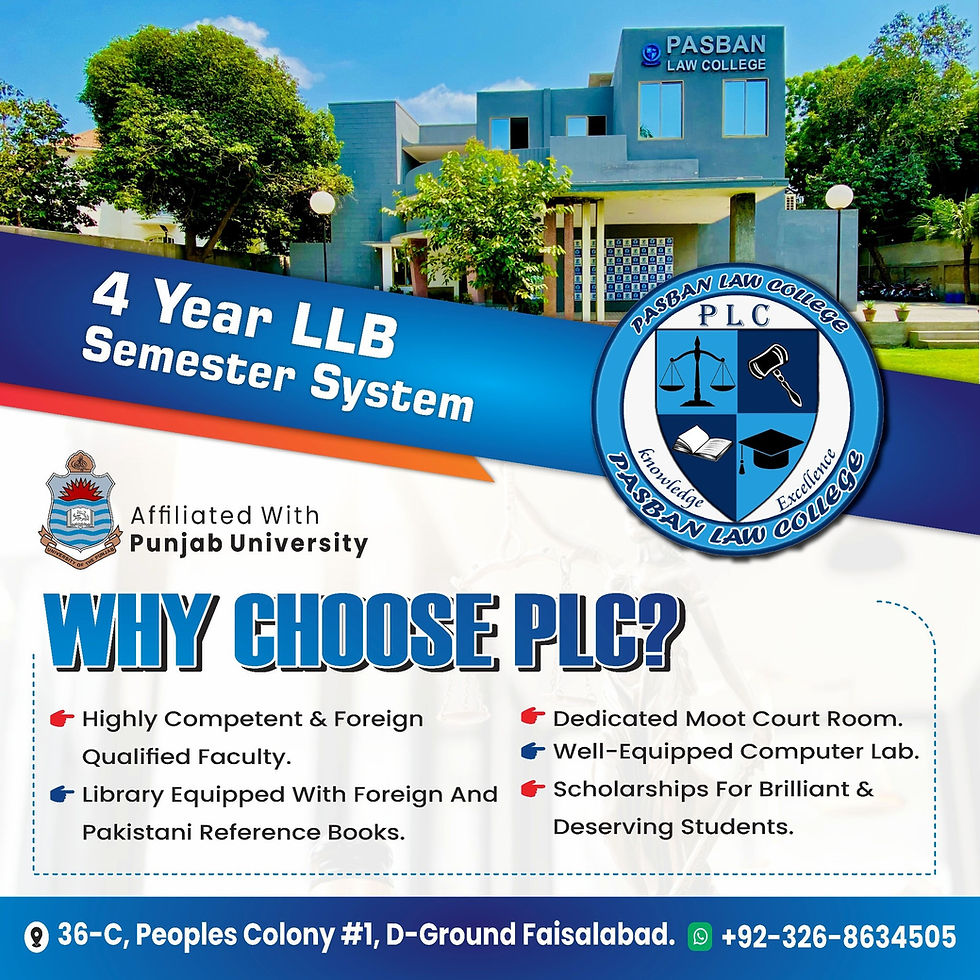
Understanding LL.B Accreditation in Pakistan
Accreditation in the context of legal education in Pakistan refers to the formal recognition of a law college and its degree program by the relevant regulatory authorities. The primary regulatory body governing legal education in Pakistan is the Pakistan Bar Council, which sets the standards for law colleges, approves their curricula, and determines the eligibility of graduates for enrollment as advocates.
In addition to the Pakistan Bar Council, law colleges must also be affiliated with a recognized university that is itself approved by the Higher Education Commission of Pakistan. This dual layer of accreditation ensures that students who complete their LL.B from an accredited institution are eligible to sit for bar examinations and practice law in courts across the country. Without this accreditation, a law degree is essentially worthless from a professional standpoint, as graduates would be unable to enroll with any provincial bar council or appear in courts as legal representatives.
Pasban Law College holds the necessary accreditations and affiliations that make its LL.B degree fully recognized and professionally valid throughout Pakistan.
Why Accreditation Matters for Your Legal Career
The importance of studying at an accredited law college cannot be overstated for anyone who is serious about a legal career. Accreditation is the first and most fundamental requirement that determines whether a law graduate can practice in Pakistan. When you graduate from an accredited institution like Pasban Law College, your degree is accepted by provincial bar councils, which allows you to register as an advocate and begin your legal career. Employers in both the public and private sectors, including law firms, corporations, government departments, and the judiciary, look specifically for candidates who hold degrees from accredited institutions. The credibility that comes with an accredited degree opens doors that would otherwise remain firmly closed. Beyond employment, accreditation also matters for students who wish to pursue postgraduate legal studies, either in Pakistan or abroad, as most universities require that applicants hold a degree from a recognized and accredited institution. Choosing an accredited program from the very beginning of your legal education is therefore one of the most important decisions you will make in your academic and professional life.

Pasban Law College Affiliation and Recognition
Pasban Law College operates under the framework established by the Pakistan Bar Council and is affiliated with a recognized university in accordance with the requirements of the Higher Education Commission of Pakistan. This affiliation ensures that the college's academic program, examination system, and degree-granting authority all conform to nationally accepted standards.
The college has maintained its accreditation status through consistent compliance with regulatory requirements and a sustained commitment to academic quality. The recognition that Pasban Law College has earned from regulatory and professional bodies is not merely administrative; it reflects the institution's track record of producing graduates who are competent, ethical, and professionally prepared. This institutional credibility is an asset that every graduate of Pasban Law College carries with them throughout their career, lending weight and authority to their professional credentials.
The LL.B Program Structure at Pasban Law College
The LL.B program at Pasban Law College is structured to provide students with a comprehensive and progressive legal education that builds knowledge and skills systematically over the course of the program. The five-year LL.B program, which is open to students entering directly after their intermediate education.
while the five-year program spans ten semesters. Each semester is carefully designed to introduce new areas of law while reinforcing and deepening the student's understanding of subjects covered in earlier semesters. The program concludes with comprehensive final examinations that test students on all the core areas of law, along with a practical training component that prepares graduates for the bar examination and the demands of professional practice. This structured and progressive approach to legal education ensures that students emerge from the program with a well-rounded and thorough grounding in law.
Core Legal Subjects in the Accredited Curriculum
The curriculum of the accredited LL.B program at Pasban Law College covers all the essential areas of law that a practicing lawyer in Pakistan needs to understand. The core subjects include constitutional law, which forms the foundation of the entire legal system and governs the relationship between the state and its citizens. Contract law covers the principles governing agreements and commercial transactions, while tort law deals with civil wrongs and remedies. Criminal law and criminal procedure address offenses, investigations, and prosecutions, equipping students to work in both defense and prosecution roles. Civil procedure covers the rules governing civil litigation in courts, and family law addresses the legal dimensions of marriage, divorce, custody, and inheritance. Property law deals with rights over land and movable assets, and company law covers the formation, governance, and regulation of corporations.
Administrative law examines the legal framework governing government action and regulatory bodies, while Islamic jurisprudence addresses the sources and principles of Islamic law and their application in the Pakistani legal context. International law rounds out the curriculum by introducing students to the legal framework governing relations between states and the growing body of international human rights and commercial law. This comprehensive subject coverage ensures that graduates are equipped to handle a wide variety of legal matters across different areas of practice.

Standards Set by the Pakistan Bar Council
The Pakistan Bar Council is the apex regulatory body for the legal profession in Pakistan, and its standards form the benchmark against which all law colleges and their programs are measured. The Bar Council sets detailed requirements for the content of LL.B curricula, the qualifications of law college faculty, the examination system, and the conditions for graduation. Law colleges that wish to produce graduates eligible for enrollment as advocates must comply with these standards in every aspect of their operations.
Pasban Law College has consistently met and maintained the standards set by the Pakistan Bar Council, which is a direct reflection of the college's commitment to providing education that is not only academically sound but professionally relevant. Compliance with Bar Council standards also means that graduates of Pasban Law College are well-prepared for the bar examination, which is the final gateway to professional practice. The college's alignment with these standards gives students the assurance that their education is preparing them for the real world of legal practice and not merely for academic exercises.
Faculty Qualifications and Professional Experience
The quality of the faculty at any educational institution is one of the most reliable indicators of the quality of education it provides. Pasban Law College takes faculty recruitment and development very seriously, ensuring that the educators who teach in its LL.B program possess both the academic qualifications and the professional experience needed to deliver high-quality instruction.
Faculty members are required to hold advanced legal degrees, and many also have years of experience in legal practice, whether as advocates, legal advisors, or judicial officers. This combination of academic expertise and practical experience is what makes the teaching at Pasban Law College particularly valuable. Faculty members are not simply transmitting textbook knowledge; they are sharing insights drawn from real legal work, real courtroom experience, and real professional challenges. This depth of expertise enriches the learning experience for students and helps them develop a more sophisticated and practical understanding of the law.
Examination System and Academic Assessment
The examination system at Pasban Law College is designed to be rigorous, fair, and aligned with the standards required by the affiliated university and the Pakistan Bar Council. Students are assessed through a combination of continuous assessment activities, including assignments, presentations, and mid-semester tests, and comprehensive end-of-semester examinations that cover the full content of each subject. The examination questions are designed to test not just recall of legal rules but the ability to analyze legal problems, apply relevant legal principles, and construct well-reasoned arguments.
This approach to assessment encourages deeper learning and better prepares students for the bar examination, which similarly tests analytical and argumentative skills. The college maintains strict standards of academic integrity in its examination system, ensuring that the results reflect genuine academic achievement and that the degrees it awards carry real weight and credibility.
Practical Training as Part of Accredited Standards
The Pakistan Bar Council's accreditation standards recognize the importance of practical training in legal education, and Pasban Law College fully embraces this requirement. The practical training component of the LL.B program includes moot court exercises, legal drafting workshops, court visits, client counseling simulations, and internship placements with law firms and other legal institutions.
These activities are not optional extras but integral parts of the accredited program, designed to ensure that graduates have the practical skills needed to function effectively as lawyers from the very beginning of their professional careers. The moot court program is particularly well-developed at Pasban Law College, giving students extensive practice in courtroom advocacy, legal argumentation, and the procedural aspects of litigation. Legal drafting workshops teach students to prepare the documents that lawyers use in their day-to-day work, including pleadings, contracts, legal opinions, and correspondence. These practical skills complement the theoretical knowledge gained in the classroom and create graduates who are genuinely ready for professional practice.
LL.B Admission Process and Eligibility
Gaining admission to the accredited LL.B program at Pasban Law College requires meeting specific eligibility criteria and completing the admission process successfully. For the five-year LL.B program, applicants must have completed their intermediate education or an equivalent qualification with a minimum percentage of marks as specified by the college and the affiliated university. The admission process involves submission of a completed application form along with certified copies of academic certificates, national identity documents, and recent photographs.
Some applicants may be required to sit for an entry test or attend an interview as part of the selection process. Admission is granted on a merit basis, ensuring that places in the program go to the most qualified and deserving candidates. Prospective students are strongly encouraged to contact the college admissions office well in advance of the application deadline to ensure they have all the necessary information and documents prepared.

Affordable Education Without Compromising Quality
One of the most compelling aspects of the accredited LL.B program at Pasban Law College is its affordability. Quality legal education should not be the exclusive privilege of students from wealthy backgrounds, and Pasban Law College has always been committed to keeping its fee structure accessible to students from a wide range of economic circumstances. The college offers competitive tuition fees that are significantly lower than those charged by many private universities and elite law schools, without making any compromises on the quality of teaching, facilities, or support services.
This commitment to affordability reflects the college's broader social mission of democratizing access to legal education and ensuring that talented and motivated students from all backgrounds have the opportunity to pursue a legal career. The college may also offer scholarship programs or financial assistance to students who demonstrate exceptional academic merit or face genuine financial hardship, and prospective students are encouraged to inquire about these opportunities during the admission process.
Subject Area | Key Focus | Importance for Legal Practice |
Constitutional Law | Structure of the state and fundamental rights | Essential for understanding governance and citizens' rights |
Contract Law | Legal agreements and commercial transactions | Important for business and corporate law |
Criminal Law | Crimes, punishments, and criminal responsibility | Required for criminal defense and prosecution |
Civil Procedure | Rules governing civil litigation | Essential for handling court cases |
Family Law | Marriage, divorce, custody, inheritance | Important for family dispute resolution |
Property Law | Ownership and property rights | Relevant for land and asset disputes |
Company Law | Corporate formation and governance | Important for corporate and commercial practice |
Administrative Law | Regulation of government actions | Important for public law and governance |
Islamic Jurisprudence | Principles of Islamic legal system | Important in Pakistan’s legal framework |
International Law | Legal relations between states | Important for global and diplomatic legal matters |
Career Pathways for LL.B Graduates
Completing an accredited LL.B degree from Pasban Law College opens up a wide range of career pathways in both the public and private sectors. The most direct career path is advocacy, where graduates enroll with a provincial bar council and begin practicing as lawyers in civil, criminal, family, corporate, or constitutional courts.
Many graduates join established law firms where they can develop their skills and build their reputation under the guidance of experienced senior lawyers before eventually establishing their own practices. The judiciary is another important career pathway, with LL.B graduates eligible to appear for judicial service examinations that can lead to positions as civil judges, magistrates, and over time, higher court judges.
Government departments, regulatory agencies, and public sector corporations regularly recruit law graduates for legal officer, legal advisor, and prosecutor positions. The corporate sector also offers significant opportunities, with banks, multinational companies, and large domestic corporations all requiring skilled in-house legal counsel. For those interested in international work, organizations working on human rights, rule of law, and international development also employ law graduates in legal and advisory roles. Academic careers in law teaching and legal research are another option for graduates who wish to contribute to the development of legal knowledge and education in Pakistan.
Postgraduate Opportunities After LL.B
For graduates of the accredited LL.B program who wish to deepen their legal expertise and enhance their career prospects, Pasban Law College provides a strong foundation for postgraduate studies. Graduates who hold an accredited LL.B are eligible to apply for LLM programs at universities in Pakistan and abroad, where they can specialize in areas such as constitutional law, international law, human rights law, commercial law, or any other field that aligns with their professional interests.
An LLM degree significantly enhances career prospects, opening doors to senior legal positions, academic appointments, and specialized legal practice that may not be accessible to lawyers with only an LL.B. Some graduates choose to pursue doctoral research in law, contributing original scholarship to the development of legal thought in Pakistan and internationally. The accreditation of the LL.B from Pasban Law College ensures that graduates are eligible for these advanced academic opportunities, as most postgraduate programs require applicants to hold a degree from a recognized and accredited institution.
The Role of Legal Ethics in the Accredited Program
Legal ethics and professional responsibility are not peripheral concerns in the practice of law; they are central to everything a lawyer does. The accredited LL.B program at Pasban Law College includes a dedicated focus on legal ethics, ensuring that students understand and internalize the professional obligations that come with being a lawyer. Students study the code of conduct governing advocates in Pakistan, including their duties to the court, to their clients, to opposing parties, and to society as a whole.
Ethical issues such as conflicts of interest, client confidentiality, the duty of candor to the court, and the responsibilities of legal representation are examined in depth through case studies and discussions. This emphasis on ethics is not just about regulatory compliance; it is about shaping graduates who will approach their professional responsibilities with integrity, honesty, and a genuine commitment to justice. The legal profession is only as trustworthy as the lawyers who practice it, and Pasban Law College takes seriously its responsibility to produce lawyers of good character as well as high competence.
Digital Skills and Legal Technology Awareness
Modern legal practice increasingly relies on technology, and the accredited LL.B program at Pasban Law College prepares students for this reality. The college incorporates instruction in legal research using digital databases and online platforms, familiarizing students with the tools they will use throughout their careers to find relevant legislation, case law, and legal scholarship.
Students are also introduced to the legal dimensions of technology, including cybercrime law, electronic contracts, data protection legislation, and intellectual property issues arising from digital content. As artificial intelligence and legal technology continue to reshape how legal services are delivered, lawyers who understand both the law and the technology are increasingly valuable. Pasban Law College's attention to digital skills and legal technology awareness ensures that its graduates are not left behind by technological change but are instead equipped to thrive in a profession that is evolving rapidly in response to new technologies.
Community and Campus Life at Pasban Law College
The experience of studying at Pasban Law College extends well beyond the lecture hall and the examination room. The college fosters a vibrant academic community where students are encouraged to engage with legal issues through debates, seminars, workshops, and extracurricular activities.
Legal debate competitions and moot court tournaments are regular features of college life, giving students opportunities to develop their advocacy skills in a competitive and stimulating environment. Guest lectures by prominent lawyers, judges, and legal academics bring real-world perspectives into the college and inspire students with examples of successful legal careers.
The diverse student body at Pasban Law College, which brings together students from different cities, provinces, and backgrounds, creates a rich social and intellectual environment that mirrors the diversity of the legal profession itself. Friendships and professional networks formed during the LL.B program often endure throughout graduates' careers, providing a source of support, collaboration, and opportunity long after graduation.
Conclusion
The accredited LL.B degree program at Pasban Law College represents a genuine and meaningful opportunity for every student who dreams of a career in law. In a profession where credentials, credibility, and competence are everything, studying at an accredited institution is not simply an advantage but an absolute necessity. Pasban Law College provides exactly the kind of legally rigorous, practically grounded, ethically informed, and professionally recognized education that aspiring lawyers need to succeed in one of the most demanding and rewarding professions in the world.
The college has built its reputation over many years through an unwavering commitment to academic excellence and professional preparation. Its faculty brings both scholarly depth and practical wisdom to the classroom. Its curriculum covers every essential area of law while remaining responsive to the evolving demands of legal practice. Its practical training programs, from moot court and legal drafting to court visits and internship placements, ensure that graduates are not just theoretically qualified but genuinely ready for the realities of professional legal work. Its examination system is rigorous and fair, producing graduates whose credentials are respected by bar councils, employers, courts, and universities across Pakistan and beyond.
What makes Pasban Law College truly distinctive, however, is not just the quality of its program but the spirit in which that program is delivered. This is an institution that genuinely cares about its students and is committed to giving every enrolled student the support, guidance, and opportunity they need to succeed. The college's affordable fee structure reflects a belief that legal education should be accessible to all who are capable and motivated, not just those who are privileged by wealth. The emphasis on ethics and professional responsibility reflects a conviction that the legal profession must be populated by lawyers of integrity and character, not just technical skill.
For students who are ready to commit to the demanding but deeply rewarding journey of legal education, Pasban Law College offers the ideal environment to begin. The accreditation, the faculty, the curriculum, the practical training, the campus community, and the career opportunities that follow graduation all combine to make this one of the best choices available to aspiring lawyers in Pakistan today. Your legal career begins with a single decision to enroll in a program that will challenge you, develop you, and ultimately transform you into a lawyer who is prepared to make a real difference. That decision, made today at Pasban Law College, could be the most important step you ever take toward the future you have always envisioned for yourself in the legal profession.


