
Behind the Scenes of a PLC Moot Court Competition

Updated: Oct 1
The courtroom may look calm when the arguments finally begin. Students stand before the bench, introduce themselves, present legal submissions, respond to questions, and carefully choose every word. To an audience, it may appear that the entire performance has been created in those few minutes.
But a moot court competition is never created in a few minutes.
Behind every argument is a much longer journey—students reading a difficult legal problem, searching for authorities, debating possible interpretations, preparing written submissions, practising oral arguments, challenging one another with difficult questions, and learning how to remain composed under pressure.
For students at Pasban Law College Faisalabad, a PLC moot court competition can become one of the most memorable parts of their legal education. It brings classroom knowledge into a practical setting and gives students an opportunity to experience how legal reasoning, research, communication, teamwork, and advocacy come together.
The most valuable part of the competition may not even be the moment when the students stand before the bench. Much of the real learning happens before that moment—behind closed doors, around study tables, during practice sessions, and in the conversations between teammates.
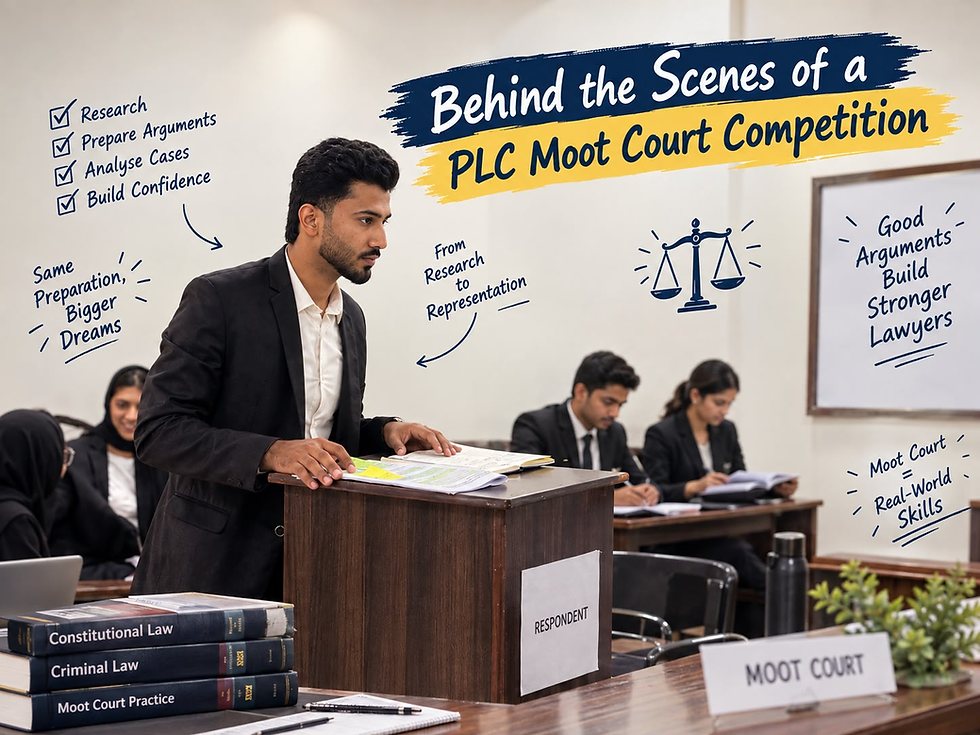
Where the Moot Court Journey Begins
Long before the first speaker approaches the bench, the team receives a legal problem that requires careful examination. At first, the problem may appear manageable. But once students begin reading the facts closely, they realise that almost every detail may have legal significance.
The first task is to understand what the problem is actually asking.
Students must identify the parties, understand the relevant facts, separate important information from unnecessary details, and determine which legal questions need to be answered. They may read the problem several times because an issue that appears minor at first can become important later.
This is often where students discover that legal education is not simply about remembering laws.
It is about asking the right questions.
What legal issue arises from these facts? Which principle applies? Could the opposing side interpret the same facts differently? What authority supports the argument? What weakness could the other side identify?
These questions begin shaping the team's strategy.
For a student participating in a moot court competition for the first time, this process can initially feel overwhelming. However, it gradually teaches an essential lesson: strong advocacy begins long before a lawyer enters a courtroom.
The Research Behind Every Strong Argument
Once the legal issues have been identified, students move into one of the most important stages of the competition: legal research.
Research may involve reading statutes, examining judicial decisions, studying legal principles, comparing interpretations, and identifying authorities that can support the team's position. Students have to go beyond finding information. They need to understand how that information applies to the specific problem.
This distinction is extremely important.
A student may find an authority that appears to support an argument, but the opposing team may use the same authority differently. The bench may ask why that case applies. A judge may identify a factual difference between the authority and the moot problem.
Therefore, students must understand the reasoning behind every authority they rely upon.
This process develops analytical thinking. Instead of asking only, “What does the law say?” students begin asking, “How does the law apply here?”
That shift is one of the most valuable aspects of practical legal education.
At Pasban Law College Faisalabad, moot court activities can give students an opportunity to connect legal concepts studied in class with practical exercises that require research, reasoning, and communication.
When the Team Starts Building Its Argument
After research comes another challenging stage: deciding what the team will actually argue.
Finding several legal authorities does not automatically create a strong submission. Students must decide which arguments are most relevant, which points should receive greater emphasis, and how the entire case should be presented logically.
This is where teamwork becomes essential.
One student may identify a strong legal principle. Another may discover a problem with the proposed argument. Someone else may suggest a different interpretation of the facts.
Disagreements are common.
However, these discussions can become valuable learning experiences. Students begin to understand that legal advocacy is not about protecting an argument simply because it was their own idea. It is about testing the argument until its strengths and weaknesses become clear.
A strong team asks difficult questions of itself before the bench has the opportunity to ask them.
What if the judge disagrees?
What if the opposing counsel relies on another interpretation?
What if the authority does not apply as strongly as expected?
What is the strongest response?
Every difficult question can make the final argument stronger.
The Work Behind the Written Submissions
The oral arguments that the audience eventually hears are supported by considerable written preparation.
Students may spend hours organising their arguments into written submissions. They need to present legal issues clearly, explain their reasoning, support important propositions, and maintain a logical structure.
Writing often exposes weaknesses that are difficult to notice during conversation.
An argument may sound convincing when discussed among teammates but appear incomplete when written down. A legal proposition may need additional authority. Two arguments may overlap. A conclusion may not connect clearly with the facts.
This is why revision becomes an important part of the process.
Students edit, reorganise, shorten, clarify, and review their submissions repeatedly. Through this process, they begin to understand that good legal writing is rarely produced in one attempt.
For law students, this experience has value beyond the competition. Lawyers regularly work with written arguments, legal opinions, applications, notices, agreements, and other professional documents. Learning how to communicate legal reasoning clearly in writing can therefore become an important part of professional development.
Practice Sessions Nobody in the Audience Sees
One of the most important parts of a moot court competition happens away from the actual competition.
Practice sessions allow students to simulate the courtroom experience before the real round begins.
A student may stand before teammates and deliver an argument while another student acts as a judge. Questions are deliberately raised. Arguments are interrupted. Weak points are challenged.
At first, this can be uncomfortable.
A student who felt confident while reading the argument may suddenly struggle when asked an unexpected question. A teammate may point out that the explanation was too long. Another may suggest that a particular argument should be presented earlier.
Then the student tries again.
This repetition is where improvement happens.
The goal is not to memorise every sentence. It is to understand the legal position well enough to explain it naturally, even when the conversation changes direction.
Students practise their introductions, submissions, responses, transitions, and conclusions. They learn how to pause, listen, answer, and return to the main argument.
The process can be demanding, but it can also become one of the most rewarding experiences of the competition.

The Final Hours Before the Moot Court Round
As the competition approaches, the atmosphere becomes more focused.
Students review their authorities again. Written submissions are checked. Team members discuss possible questions. Speakers practise their opening and closing statements. Important documents are organised so that they can be located quickly when required.
The final hours can be exciting, but they can also be stressful.
Students may begin wondering whether they have prepared enough. Some may want to change an argument at the last minute. Others may continue searching for additional authorities even after the main research is complete.
At this stage, discipline becomes important.
A team must know when to stop making unnecessary changes and trust the preparation it has already completed. The objective is not to make the argument endlessly complicated. It is to make it clear, legally sound, and easy to defend.
This final stage teaches students an important professional lesson: preparation is essential, but so is the ability to remain calm when preparation is complete.
Walking Into the Moot Court
Then comes the moment students have been preparing for.
The team enters the moot court.
The atmosphere feels different from the classroom. The students who were discussing arguments around a table are now standing before a bench. Their notes are organised, their authorities are ready, and their roles are clear.
The first speaker begins.
At this point, preparation becomes performance.
Students must demonstrate appropriate courtroom etiquette, address the bench respectfully, explain their submissions clearly, and respond to questions.
For many students, this can be the moment when they understand the difference between knowing the law and advocating the law.
A legal argument is no longer simply something written in a notebook. It becomes something that must be explained, defended, and adapted in real time.
When the Judge Interrupts With a Difficult Question
For a new mooter, a question from the bench can feel intimidating.
A speaker may have carefully planned the next several minutes of their submission, only to be interrupted by a question that takes the discussion in a completely different direction.
This is where genuine understanding becomes important.
A student who has memorised the argument word for word may struggle when the question falls outside the prepared script. A student who understands the legal reasoning has a better opportunity to pause, think, and respond.
The answer does not always need to be immediate.
A brief pause can help the student understand the question before responding. The student can acknowledge the judge's concern, address the relevant legal point, and then return to the main submission.
This experience teaches students that advocacy is not simply about speaking.
It is also about listening.
A good advocate must understand what the bench is asking and respond directly rather than simply continuing with a prepared speech.
This ability to think under pressure is one of the skills that makes moot court competitions valuable for law students.
The Team Is Still Working While One Student Speaks
Although one student may be standing before the bench, the entire team remains involved.
A teammate may be monitoring authorities. Another may be following the questions being asked. Someone may be making notes about points that need to be addressed later.
This creates shared responsibility.
The speaker may be the visible part of the team, but the performance is supported by the work of everyone behind them.
That experience teaches students to trust one another. It also shows them that professional success often depends on collaboration rather than individual effort alone.
For students at Pasban Law College Faisalabad, this teamwork can become an important part of the overall learning experience. Students work toward a common objective, learn from each other's strengths, and support one another when challenges arise.
The friendships created during these long preparation sessions can also become an important part of college life.
What Happens After the Round?
The end of the round does not mean the end of learning.
Once students leave the moot court, conversations often begin immediately.
Which question was the hardest?
Where did the speaker hesitate?
Which argument was strongest?
Did the team respond effectively?
Was an authority explained clearly?
These discussions can sometimes be more valuable than the result itself.
Winning can provide recognition and encouragement, but every round can provide lessons. A student may discover that their speaking pace needs improvement. Another may realise that their research was too broad. Someone else may learn that they need to practise responding to questions rather than simply delivering prepared submissions.
This reflection turns experience into improvement.
Students begin to understand that losing an argument does not mean losing the opportunity to learn.
The Lessons That Stay With Students
A PLC moot court competition can leave students with practical skills that remain useful throughout their legal education.
Legal research: Students learn how to find, understand, and apply relevant legal authorities.
Critical thinking: Students learn to examine facts and legal issues from different perspectives.
Legal writing: Written submissions develop clarity, structure, and precision.
Oral advocacy: Students practise presenting arguments clearly and confidently.
Teamwork: Students learn how individual contributions support a shared objective.
Composure: Difficult questions teach students how to remain focused under pressure.
Adaptability: Students learn to adjust their arguments when the discussion takes an unexpected direction.
Reflection: Reviewing performance helps students identify areas for future improvement.
These lessons extend beyond moot court. They can influence classroom presentations, legal research assignments, group discussions, academic competitions, and future professional responsibilities.
More Than a Competition
From the outside, a moot court competition may appear to be about winning a round, receiving a certificate, or achieving recognition.
For the students involved, it can mean much more.
It can be the first time a student stands before a bench and presents a legal argument. It can be the first time someone successfully responds to a difficult question without looking at their notes. It can be the moment a student realises that they are capable of handling pressure.
For students at Pasban Law College Faisalabad, the behind-the-scenes experience can be just as important as the final performance.
The research, late discussions, repeated practice, rewritten submissions, difficult questions, mistakes, corrections, and teamwork all contribute to the student's development.
The audience may only see the final round.
The students know how much work happened before it.

The Confidence Students Take Beyond the Moot Court
When the competition ends and the courtroom becomes quiet again, students take something valuable with them.
They take experience.
The student who once felt nervous about speaking may now understand how to organise an argument. The student who struggled with research may now know how to approach a difficult legal issue. The student who feared questions from the bench may now understand that questions are opportunities to demonstrate knowledge.
This confidence does not mean students will never feel nervous again.
Even experienced legal professionals prepare carefully.
The difference is that students begin learning how to manage pressure instead of allowing pressure to control them.
For students choosing an LL.B college in Faisalabad, practical opportunities such as moot court competitions can add an important dimension to traditional classroom learning. They allow students to apply legal knowledge, communicate arguments, work in teams, and experience the discipline associated with advocacy.
Why the Behind-the-Scenes Experience Matters
The most important lesson of a moot court competition may be that successful advocacy is built through consistent effort.
There is no shortcut from reading a legal problem to confidently presenting an argument before a bench. Students have to research. They have to question their own reasoning. They have to practise. They have to make mistakes. They have to listen to feedback and try again.
That process is what transforms academic knowledge into practical ability.
At Pasban Law College Faisalabad, experiences such as moot court competitions can encourage students to become active participants in their legal education. Instead of simply learning legal concepts, students can begin testing those concepts through research, discussion, writing, advocacy, and teamwork.
The competition may last for a limited time.
The skills developed through it can stay with students for much longer.
Conclusion
A PLC moot court competition is not created in the few minutes when students stand before a bench. It is built through hours of research, teamwork, written preparation, practice, questioning, correction, and determination.
For students at Pasban Law College Faisalabad, the experience can provide an opportunity to develop legal research, critical thinking, communication, advocacy, teamwork, and professional confidence.
The audience may remember the arguments presented during the final round. The students are likely to remember everything that happened before it—the difficult research, the repeated practice, the challenging questions, the mistakes, the support of teammates, and the moment when preparation finally turned into performance.
That is the real story behind a PLC moot court competition.


