
Challenges of Legal Enforcement in Pakistan

Updated: Oct 1
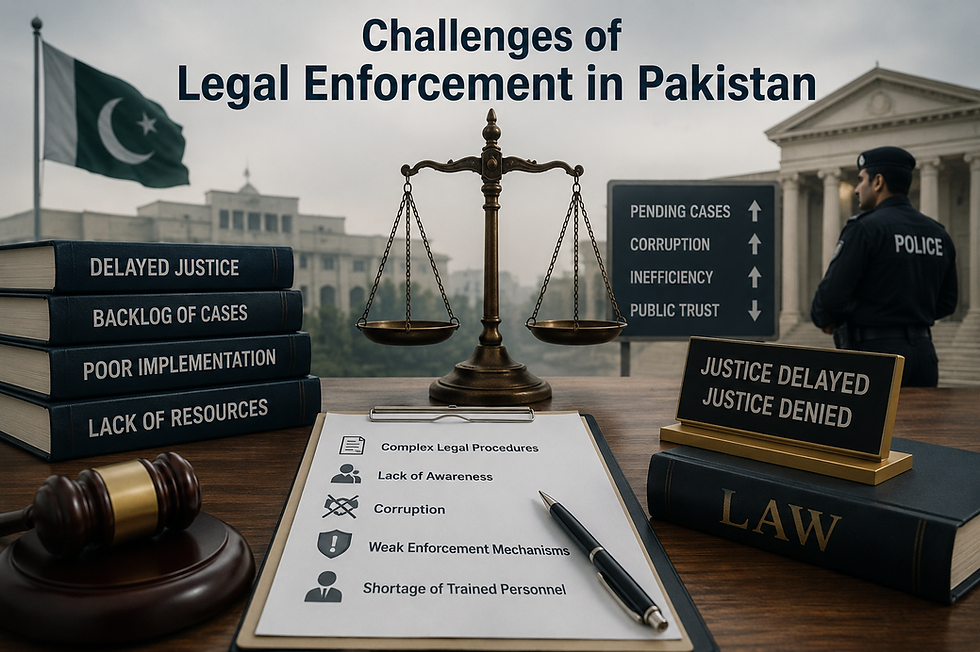
The effectiveness of any legal system depends not only on the quality of its laws but also on how efficiently those laws are enforced. A country may have comprehensive legislation, constitutional safeguards, and well-defined legal procedures, yet if enforcement mechanisms are weak, justice becomes difficult to achieve. Legal enforcement ensures that rights granted by the Constitution and statutory laws are protected, court decisions are implemented, offenders are held accountable, and public confidence in the justice system is maintained.
In Pakistan, the legal framework covers a wide range of subjects, including constitutional law, criminal justice, civil procedure, commercial regulation, consumer protection, labor rights, environmental law, property law, and digital governance. While these laws provide a strong legal foundation, practical enforcement often presents significant challenges. Citizens, businesses, investors, and public institutions may encounter obstacles in implementing legal rights due to procedural delays, administrative inefficiencies, limited resources, and institutional constraints.
Legal enforcement is a shared responsibility involving police departments, prosecutors, courts, regulatory authorities, revenue officials, local governments, and administrative agencies. Effective coordination among these institutions is essential for ensuring that laws are applied fairly and consistently. When coordination is weak or procedures become excessively complicated, legal disputes often remain unresolved for long periods, affecting public trust and economic development.
Modern legal systems also face new enforcement challenges arising from technological advancements, cybercrime, cross-border transactions, environmental protection, financial regulation, and digital evidence. As Pakistan continues to modernize its legal framework, improving enforcement mechanisms has become an important priority for strengthening the rule of law and ensuring equal access to justice.
Understanding the challenges of legal enforcement is valuable for lawyers, judges, law students, researchers, policymakers, business owners, public officials, and ordinary citizens. It highlights the practical realities of implementing legal rights while encouraging meaningful reforms aimed at improving judicial efficiency, administrative accountability, and institutional performance.
Understanding Legal Enforcement
Legal enforcement refers to the implementation of laws through authorized public institutions responsible for maintaining order, protecting legal rights, investigating violations, prosecuting offences, resolving disputes, and enforcing judicial decisions.
It extends beyond criminal justice and includes the enforcement of civil judgments, commercial obligations, administrative regulations, taxation, consumer protection measures, environmental standards, labor laws, and constitutional rights.
Effective enforcement transforms legal rights from written provisions into practical realities.
Without proper enforcement, even the most carefully drafted laws lose much of their effectiveness.
Importance of Effective Legal Enforcement
Strong legal enforcement promotes justice, public confidence, economic development, and social stability.
When laws are enforced consistently, citizens feel secure in exercising their rights, businesses operate with greater certainty, and investors gain confidence in the legal system.
Effective enforcement also discourages unlawful conduct by demonstrating that legal violations carry appropriate consequences.
A reliable enforcement system strengthens democratic governance and supports sustainable national development.
Role of Law Enforcement Agencies
Law enforcement agencies play a central role in implementing criminal laws and maintaining public order.
Their responsibilities include investigating offences, collecting evidence, protecting crime scenes, interviewing witnesses, apprehending suspects where authorized by law, and assisting prosecutors during criminal proceedings.
Professional investigations contribute significantly to fair trials and effective justice.
Law enforcement agencies must perform their duties with integrity, impartiality, and respect for constitutional rights.
Role of the Judiciary
Courts are responsible for interpreting laws, resolving disputes, protecting constitutional rights, and ensuring that justice is administered according to due process.
Judicial decisions determine legal rights and obligations, but their effectiveness depends upon timely implementation.
The judiciary also supervises the legality of executive actions and provides remedies when legal rights have been violated.
Independent courts remain essential for maintaining public confidence in legal enforcement.
Role of Regulatory Authorities
Many legal obligations are enforced by specialized regulatory bodies responsible for taxation, competition, banking, securities, environmental protection, telecommunications, labor standards, and consumer protection.
These institutions monitor compliance, investigate violations, issue regulatory decisions, and impose lawful penalties where appropriate.
Efficient regulatory enforcement contributes to fair markets and responsible governance.
Strong institutional coordination improves overall legal effectiveness.
Judicial Delays
One of the most significant challenges affecting legal enforcement in Pakistan is delay in judicial proceedings.
Civil disputes, commercial litigation, property cases, family matters, and criminal prosecutions may require considerable time before reaching final resolution.
Lengthy proceedings increase legal expenses, create uncertainty, and reduce public confidence in the justice system.
Timely justice remains an important objective of ongoing judicial reforms.
Growing Case Backlogs
Large numbers of pending cases place considerable pressure on courts throughout the country.
As new cases continue to be filed, limited judicial resources may struggle to resolve disputes efficiently.
Backlogs affect litigants waiting for justice and may delay the enforcement of legal rights.
Improved case management systems can significantly reduce this burden.
Administrative Inefficiency
Legal enforcement frequently depends upon administrative agencies responsible for licensing, registration, taxation, land administration, public records, and regulatory compliance.
Slow administrative procedures, outdated record systems, and inadequate coordination among departments often delay implementation of legal decisions.
Administrative efficiency is essential for effective governance.
Simplified procedures can improve public access to legal services.
Limited Public Awareness
Many citizens remain unfamiliar with their legal rights and responsibilities.
Lack of legal awareness may discourage individuals from reporting offences, pursuing legal remedies, preserving evidence, or complying with legal obligations.
Public legal education plays a crucial role in strengthening legal enforcement.
An informed population contributes to greater respect for the rule of law.
Resource Constraints
Courts, police departments, prosecution services, forensic laboratories, and regulatory institutions require adequate financial, technical, and human resources to perform effectively.
Shortages of trained personnel, modern equipment, technology, and infrastructure may affect the quality and speed of legal enforcement.
Investment in institutional capacity strengthens the justice system.
Modern resources improve both efficiency and accuracy.
Complex Legal Procedures
Legal proceedings often involve detailed procedural requirements, documentation, and technical legal rules.
For many citizens, navigating these procedures without professional assistance can be difficult.
Complexity may discourage individuals from seeking legal remedies.
Simplifying legal procedures while maintaining fairness improves access to justice.
Challenges in Criminal Investigations
Effective criminal enforcement depends upon professional investigation practices.
Investigators must gather reliable evidence, preserve crime scenes, interview witnesses, and comply with legal procedures.
Difficulties in evidence collection, limited forensic resources, technological challenges, and coordination problems may reduce investigative effectiveness.
Improving investigative standards strengthens criminal justice.
Enforcement of Court Judgments
Obtaining a favorable judgment does not always guarantee immediate relief.
In some cases, parties face practical difficulties in enforcing court orders, recovering financial awards, obtaining possession of property, or securing compliance with judicial decisions.
Efficient execution procedures are necessary to ensure that judicial decisions produce meaningful results.
Effective enforcement enhances confidence in the courts.
Property and Land Disputes
Property disputes frequently present enforcement challenges.
Issues involving ownership records, land registration, boundary disputes, unauthorized occupation, and overlapping claims may complicate implementation of legal decisions.
Modern land administration systems can reduce uncertainty and improve enforcement.
Accurate property records benefit both citizens and investors.
Commercial Enforcement Challenges
Businesses rely upon predictable enforcement of contracts, financial obligations, and commercial regulations.
Delayed enforcement may affect investment, commercial planning, credit arrangements, and business confidence.
Efficient commercial dispute resolution encourages entrepreneurship and economic growth.
Reliable contract enforcement remains essential for a healthy economy.
Cybercrime and Digital Enforcement
The increasing use of digital technology has introduced new legal enforcement challenges.
Cybercrime investigations require specialized technical expertise, digital evidence management, cybersecurity knowledge, and international cooperation where necessary.
Online fraud, electronic financial crimes, identity theft, and data breaches continue to expand the responsibilities of enforcement agencies.
Modern technology demands continuous legal adaptation.
Corruption and Abuse of Authority
Corruption remains one of the most serious obstacles to effective legal enforcement.
Improper influence, misuse of official authority, lack of transparency, and unethical conduct weaken public confidence in legal institutions.
Strong accountability mechanisms, transparent procedures, and professional ethics are essential for addressing these concerns.
Integrity remains fundamental to the rule of law.
Coordination Between Institutions
Successful legal enforcement requires cooperation among police, prosecutors, courts, administrative agencies, regulatory authorities, and local governments.
Poor communication or overlapping responsibilities may delay investigations and implementation of legal decisions.
Improved coordination enhances institutional efficiency.
Integrated governance strengthens public administration.
Witness Protection Issues
Witnesses provide valuable evidence in many legal proceedings.
Fear of intimidation, retaliation, or personal risk may discourage individuals from cooperating with investigators or appearing before courts.
Appropriate witness protection measures strengthen criminal justice and improve the quality of evidence.
Public confidence increases when witnesses feel secure.
Technology as a Solution
Technology offers significant opportunities for improving legal enforcement.
Electronic filing systems, online case management, digital evidence platforms, computerized land records, electronic payment systems, and virtual hearings can improve transparency and reduce delays.
Digital transformation also enhances record management and institutional accountability.
Responsible use of technology supports efficient governance.
Importance of Alternative Dispute Resolution
Alternative Dispute Resolution (ADR) provides effective mechanisms for resolving many civil and commercial disputes outside traditional litigation.
Mediation, arbitration, and conciliation reduce court workloads while offering faster and less expensive solutions.
Expanding ADR contributes to stronger overall legal enforcement by allowing courts to focus on more complex matters.
Efficient dispute resolution benefits both citizens and businesses.
How Legal Enforcement Can Be Strengthened
Several practical measures can improve the effectiveness of legal enforcement in Pakistan:
Strengthen judicial capacity and reduce case backlogs.
Modernize police investigation techniques and forensic services.
Improve coordination among public institutions.
Expand digital court services and electronic record systems.
Increase public legal awareness through education.
Simplify administrative procedures where possible.
Strengthen accountability and transparency within public institutions.
Encourage greater use of Alternative Dispute Resolution mechanisms.
Implementing these measures can significantly improve public confidence in the legal system.
Importance for Businesses
Businesses require predictable legal enforcement to protect investments, enforce contracts, recover debts, safeguard intellectual property, and comply with regulatory obligations.
Efficient legal institutions reduce commercial risk while encouraging domestic and international investment.
Strong enforcement contributes directly to economic development.
Importance for Law Students
Understanding legal enforcement challenges enables law students to appreciate the practical operation of Pakistan's legal system.
It develops knowledge of judicial administration, criminal investigations, civil procedure, regulatory governance, legal reform, and institutional accountability.
Future lawyers equipped with this understanding are better prepared to contribute to legal modernization and the effective administration of justice.
Conclusion
Legal enforcement is the bridge between written law and practical justice. In Pakistan, constitutional protections, statutory legislation, and judicial decisions can only achieve their intended purpose when they are implemented effectively through professional institutions and fair legal procedures. Challenges such as judicial delays, growing case backlogs, administrative inefficiency, limited public awareness, resource constraints, corruption, complex procedures, and evolving technological issues continue to affect the enforcement of legal rights across various sectors. Addressing these obstacles is essential for strengthening public confidence in the justice system and ensuring equal access to the protection of the law.
For lawyers, judges, law students, policymakers, businesses, researchers, public officials, and citizens, understanding the challenges of legal enforcement provides valuable insight into the practical realities of Pakistan's legal system. Continued judicial reforms, technological modernization, institutional cooperation, legal education, and improved governance can significantly enhance the implementation of laws. As Pakistan continues to strengthen its legal institutions, effective legal enforcement will remain a cornerstone of justice, accountability, economic development, and the rule of law.


