
Commercial Arbitration as a Faster Alternative to Court Litigation

Updated: Oct 1
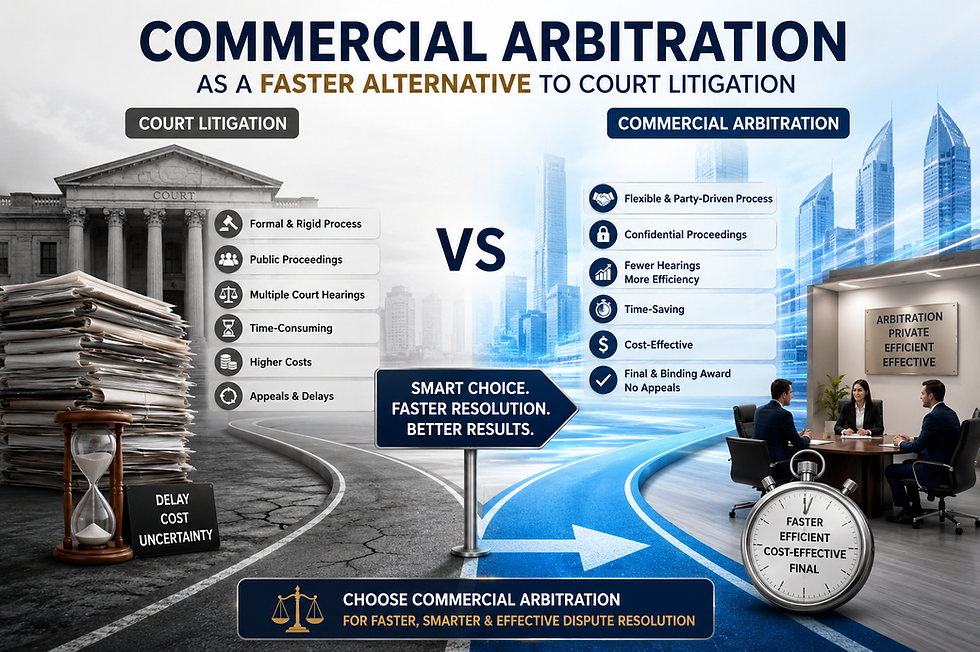
Commercial arbitration has become one of the most practical and widely accepted alternatives to traditional court litigation in resolving business disputes. In today’s fast-moving commercial environment, businesses require dispute resolution methods that are efficient, private, and enforceable across jurisdictions. Court litigation often fails to meet these expectations due to procedural delays, backlog of cases, and complex formalities.
Commercial arbitration offers a structured yet flexible mechanism where parties agree to resolve disputes outside the court system. Instead of a judge, a neutral arbitrator or panel of arbitrators decides the outcome. The decision, known as an arbitral award, is legally binding and enforceable in most jurisdictions worldwide.
This system is particularly valuable in domestic and international business transactions, where speed, confidentiality, and neutrality are essential for maintaining commercial relationships and protecting sensitive business interests.
Meaning and Legal Framework of Commercial Arbitration
Commercial arbitration refers to a private dispute resolution process governed by contractual agreements and arbitration laws. It operates within national arbitration statutes and international frameworks such as the New York Convention on the Recognition and Enforcement of Foreign Arbitral Awards.
The foundation of arbitration is the arbitration agreement, which may be included in a contract before disputes arise or signed afterward once a conflict occurs. This agreement defines how disputes will be handled, including the selection of arbitrators, governing law, and procedural rules.
Unlike court proceedings, arbitration allows parties significant autonomy. They can choose the legal framework, language of proceedings, seat of arbitration, and even procedural timelines. This flexibility makes arbitration highly adaptable to different types of commercial disputes.
Key Features of Commercial Arbitration
Commercial arbitration has several distinctive features that set it apart from litigation.
One of its core characteristics is consensual participation. Both parties must agree to arbitration, which ensures mutual acceptance of the process. Another major feature is confidentiality, meaning that hearings, evidence, and outcomes are not made public.
Arbitration is also binding, meaning that once an award is issued, it carries the same legal force as a court judgment. Additionally, arbitration promotes neutrality, especially in international disputes, where parties may choose arbitrators from neutral jurisdictions to avoid bias.
Flexibility is another defining feature, allowing customized procedures based on the complexity of the dispute. This adaptability makes arbitration especially effective in commercial matters involving technical or specialized industries.
The Arbitration Process Step by Step
The arbitration process begins when one party invokes the arbitration clause in a contract or submits a formal request for arbitration. This initiates the dispute resolution process outside the court system.
Next, arbitrators are appointed. Depending on the agreement, each party may appoint one arbitrator, or a neutral institution may appoint the tribunal. Once the tribunal is formed, preliminary hearings are conducted to establish procedural rules, timelines, and evidence requirements.
The third stage involves written submissions. Both parties present detailed statements outlining their claims, defenses, and supporting documentation. This stage is critical for building the legal foundation of each party’s case.
After written submissions, oral hearings may take place. During these hearings, parties present arguments, examine witnesses, and rely on expert testimony. The arbitrator then evaluates all evidence before issuing a final and binding award.
Advantages of Commercial Arbitration Over Court Litigation
One of the most significant advantages of arbitration is speed. Court litigation can take years due to procedural delays and overloaded judicial systems, whereas arbitration is designed to resolve disputes within months or a few years at most.
Cost efficiency is another important benefit. Although arbitration involves arbitrator and institutional fees, it often reduces long-term legal costs by avoiding prolonged court battles, repeated hearings, and multiple appeals.
Confidentiality is highly valued in arbitration. Businesses can protect sensitive financial data, trade secrets, and commercial strategies from public disclosure, which is not possible in open court proceedings.
Arbitration also allows parties to select experts in relevant industries. This ensures that technical disputes, such as construction or financial disagreements, are decided by professionals with subject-matter expertise rather than generalist judges.
Limitations and Challenges of Arbitration
Despite its advantages, arbitration has certain limitations. One of the main concerns is the limited right of appeal. Once an arbitral award is issued, it is extremely difficult to challenge, even if one party believes there has been an error in legal interpretation.
Another challenge is cost unpredictability in complex or international cases. High-profile arbitrators and institutional fees can sometimes make arbitration expensive.
There is also the issue of inconsistent decisions, as arbitrators are not strictly bound by precedent. This can occasionally lead to varying interpretations of similar legal issues.
In addition, enforcement may still require court involvement if a losing party refuses to comply voluntarily with the arbitral award.
Commercial Arbitration in International Business
Commercial arbitration plays a crucial role in international trade and cross-border transactions. Businesses operating globally face challenges due to differences in legal systems, languages, and court procedures. Arbitration provides a neutral and standardized mechanism to resolve such disputes efficiently.
International arbitration institutions such as the International Chamber of Commerce (ICC) and other regional arbitration centers provide structured rules and administrative support. These institutions ensure fairness, consistency, and procedural efficiency.
The global enforceability of arbitral awards under international conventions makes arbitration particularly valuable for multinational corporations, as awards can be recognized in many countries worldwide.
Role of Arbitration Clauses in Commercial Contracts
Arbitration clauses are essential components of modern commercial contracts. These clauses define how disputes will be resolved and help prevent uncertainty in the event of a disagreement.
A well-drafted arbitration clause typically includes the seat of arbitration, governing law, number of arbitrators, and the chosen arbitration institution. Poorly drafted clauses can lead to legal complications, delays, and jurisdictional disputes.
As a result, businesses increasingly rely on carefully structured arbitration clauses as a risk management tool to ensure smooth dispute resolution.
Institutional vs Ad Hoc Arbitration
Commercial arbitration can be conducted in two main forms: institutional and ad hoc arbitration.
Institutional arbitration is managed by professional arbitration bodies that provide rules, administrative support, and procedural guidance. This ensures a more structured and predictable process.
Ad hoc arbitration, on the other hand, is conducted without institutional support. While it offers greater flexibility and potentially lower costs, it requires parties to manage procedures independently, which can sometimes lead to inefficiencies if not properly organized.
Enforcement of Arbitral Awards
One of the strongest advantages of arbitration is the enforceability of awards. Arbitral decisions are generally recognized and enforceable in most countries under international conventions, subject to limited legal exceptions.
Courts typically uphold arbitral awards unless there are serious procedural violations, lack of jurisdiction, or public policy concerns. This makes arbitration a reliable mechanism for resolving both domestic and international disputes.
Enforcement usually involves submitting the award to a competent court, which then recognizes it as a binding judgment.
Future of Commercial Arbitration in Global Commerce
The future of commercial arbitration is evolving rapidly due to technological advancement and globalization. Virtual hearings, digital evidence submission, and online dispute resolution platforms are making arbitration faster and more accessible.
There is also a growing trend toward specialized arbitration in sectors such as technology, intellectual property, and international investment disputes. These developments reflect the increasing complexity of global commerce.
Legal reforms in many jurisdictions are also improving transparency, efficiency, and fairness in arbitration systems, making it even more attractive for businesses worldwide.
Conclusion
Commercial arbitration has firmly established itself as a highly effective alternative to traditional court litigation. Its advantages speed, confidentiality, flexibility, neutrality, and international enforceability make it particularly suitable for modern commercial disputes. While it has certain limitations, such as restricted appeal rights and potential costs in complex cases, its overall benefits significantly outweigh these drawbacks.
As global trade continues to expand and business transactions become more complex, commercial arbitration will remain a cornerstone of efficient dispute resolution, offering businesses a reliable and practical path to justice outside the traditional courtroom system.


