
Common Legal Mistakes Citizens Should Avoid

Updated: Oct 1
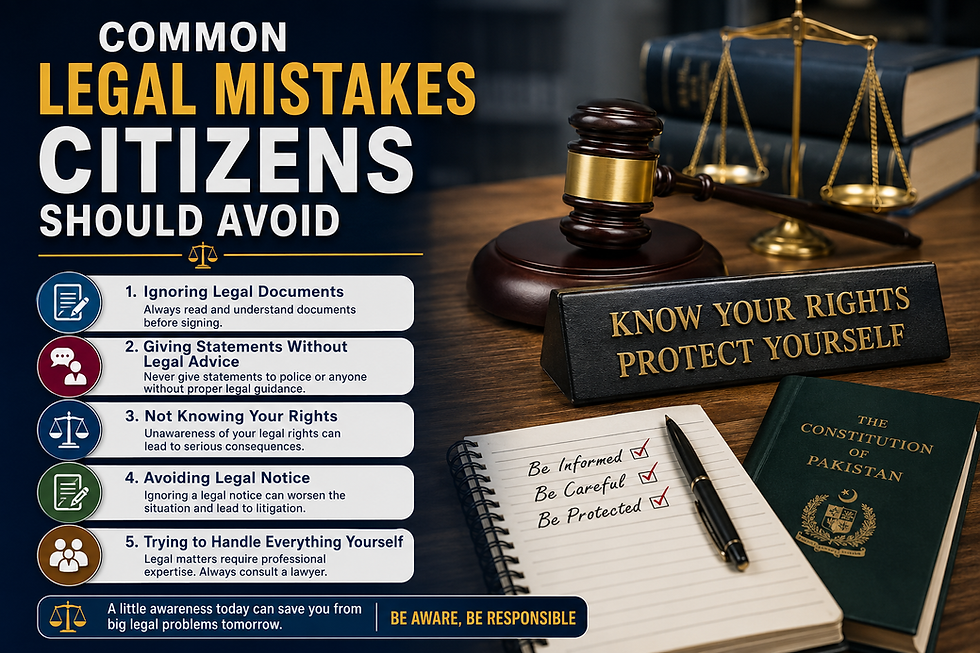
Understanding the law is not only important for lawyers and judges but also for every citizen. In daily life, people enter into contracts, buy and sell property, rent homes, use online services, operate businesses, drive vehicles, inherit family assets, and interact with government institutions. Many legal disputes arise not because individuals intentionally violate the law but because they are unaware of their legal rights and responsibilities. Simple mistakes, such as signing documents without reading them, failing to maintain proper records, or ignoring legal notices, can result in significant financial losses, lengthy litigation, or even criminal liability.
In Pakistan, citizens are protected by various constitutional, civil, criminal, commercial, family, and consumer laws. At the same time, they are expected to comply with legal obligations and exercise reasonable care in their personal and professional dealings. Legal awareness enables individuals to make informed decisions, protect their rights, and avoid unnecessary conflicts.
Modern technology has further increased the importance of legal knowledge. Digital banking, online shopping, electronic contracts, social media communication, and internet-based businesses have created new opportunities while also exposing people to risks such as fraud, identity theft, cybercrime, and contractual misunderstandings. Similarly, increasing investment in real estate, entrepreneurship, and commercial activities requires citizens to understand basic legal principles before making important decisions.
Avoiding common legal mistakes does not require specialized legal training. Rather, it involves adopting responsible habits such as verifying documents, seeking legal advice when necessary, preserving records, and respecting the rights of others. These simple practices can prevent many disputes before they arise.
This guide explains some of the most common legal mistakes citizens should avoid in Pakistan. Understanding these issues helps individuals, families, business owners, employees, landlords, tenants, investors, students, and consumers protect their legal interests while contributing to a more law-abiding society.
Why Legal Awareness Is Important
Legal awareness empowers citizens to make informed decisions and reduces the likelihood of legal disputes.
When people understand their rights and obligations, they are better equipped to protect their property, finances, employment, business interests, and personal reputation.
Legal knowledge also encourages responsible conduct and promotes respect for the rule of law.
An informed society experiences fewer avoidable legal conflicts.
Signing Documents Without Reading Them
One of the most common legal mistakes is signing documents without carefully reviewing their contents.
Many individuals sign contracts, agreements, guarantees, loan documents, tenancy agreements, or business papers without understanding the terms they contain.
Once signed, these documents may create legally enforceable obligations.
Citizens should carefully read every document, ask questions where necessary, and seek legal advice before signing important agreements.
Understanding contractual obligations prevents future disputes.
Failing to Keep Written Agreements
Verbal agreements often lead to misunderstandings because they are difficult to prove later.
Whether dealing with property transactions, loans, partnerships, employment arrangements, or rental agreements, citizens should ensure that important agreements are recorded in writing.
Written documentation provides clarity regarding the rights and responsibilities of each party.
Proper documentation also serves as valuable evidence if disagreements arise.
Ignoring Property Verification
Purchasing property without verifying ownership documents is one of the most costly legal mistakes.
Buyers should examine title documents, registration records, revenue records, approvals, and other relevant documentation before making payments.
Failure to conduct legal due diligence may result in purchasing disputed or fraudulently transferred property.
Professional legal verification protects valuable investments.
Making Cash Payments Without Proof
Many disputes arise because payments are made without receipts or documentary evidence.
Whenever money is paid for property, rent, goods, services, or business transactions, individuals should obtain written receipts or maintain reliable payment records.
Financial documentation protects both the payer and the recipient.
Proper records also simplify dispute resolution.
Ignoring Legal Notices
Some people mistakenly believe that ignoring a legal notice will make the dispute disappear.
In reality, failure to respond appropriately may weaken a person's legal position depending upon the circumstances.
Legal notices should be reviewed carefully, and professional legal advice should be obtained where necessary.
Timely communication often helps resolve disputes before litigation.
Relying Only on Verbal Promises
Business transactions, loans, partnerships, and family arrangements should not depend solely upon verbal assurances.
Important commitments should always be documented clearly.
Written agreements reduce misunderstandings and provide evidence of the parties' intentions.
Proper documentation promotes transparency and trust.
Not Seeking Legal Advice
Many individuals attempt to resolve complex legal issues without consulting a qualified legal professional.
While simple matters may not always require legal assistance, significant property transactions, business agreements, inheritance matters, employment disputes, or commercial contracts often benefit from professional advice.
Early legal consultation frequently prevents expensive mistakes.
Seeking guidance at the right time is a wise investment.
Ignoring Tax and Regulatory Obligations
Individuals and businesses should understand their legal obligations regarding taxation, licensing, registration, and regulatory compliance.
Failure to comply with applicable legal requirements may result in financial penalties, administrative action, or legal disputes.
Responsible compliance supports both personal and commercial success.
Proper record-keeping assists in meeting legal obligations.
Sharing False Information on Social Media
Social media provides powerful communication tools, but it also creates legal responsibilities.
Publishing false statements, spreading rumors, sharing defamatory content, or distributing misleading information may expose individuals to legal consequences.
Citizens should verify information before sharing it publicly.
Responsible digital communication protects both personal reputation and the rights of others.
Neglecting Personal Identification Documents
Important identification documents should be kept secure and updated where necessary.
Loss, misuse, or unauthorized access to identity documents may increase the risk of fraud or identity-related offences.
Citizens should report lost documents promptly and maintain accurate personal records.
Document security is an important aspect of legal protection.
Failing to Preserve Evidence
Many legal claims become difficult to prove because important evidence has been lost or destroyed.
Contracts, receipts, invoices, emails, messages, photographs, payment records, and official correspondence should be preserved whenever they relate to significant transactions.
Good record management strengthens legal rights.
Evidence often determines the outcome of disputes.
Ignoring Employment Documentation
Employees and employers should carefully maintain employment agreements, salary records, leave documentation, performance evaluations, and workplace communications.
Incomplete documentation frequently creates avoidable employment disputes.
Written records help clarify contractual obligations and workplace expectations.
Proper documentation benefits both employers and employees.
Using Property Without Legal Authority
Occupying, constructing upon, or altering property without lawful permission may result in serious legal consequences.
Citizens should verify ownership rights, tenancy arrangements, building approvals, and applicable regulations before using property.
Respect for property rights promotes legal certainty.
Responsible property management prevents unnecessary disputes.
Entering Business Partnerships Informally
Business partnerships should always be supported by clear written agreements.
Partners should define ownership shares, investment responsibilities, profit distribution, management authority, dispute resolution procedures, and exit arrangements.
Formal documentation protects both personal relationships and business interests.
Professional legal drafting is strongly recommended.
Ignoring Consumer Rights
Consumers sometimes accept defective goods or poor services without understanding their legal rights.
Keeping invoices, warranties, receipts, and correspondence assists consumers in protecting their interests where disputes arise.
Awareness of consumer protection laws encourages fair commercial practices.
Responsible purchasing decisions reduce financial risks.
Common Legal Habits Every Citizen Should Develop
Every citizen can reduce legal risks by adopting responsible habits such as:
Read every legal document before signing.
Keep written records of important transactions.
Preserve receipts and payment evidence.
Verify ownership before purchasing property.
Respond appropriately to legal notices.
Protect personal identification documents.
Maintain copies of contracts and official correspondence.
Seek professional legal advice when dealing with significant legal matters.
These simple practices prevent many avoidable disputes.
Role of Lawyers
Lawyers assist citizens by explaining legal rights, reviewing documents, preparing agreements, resolving disputes, conducting legal due diligence, and representing clients before courts and legal authorities.
Professional legal advice often prevents small problems from becoming major legal disputes.
Timely consultation promotes lawful decision-making.
Importance for Business Owners
Business owners face numerous legal responsibilities involving contracts, taxation, employment, intellectual property, consumer protection, and regulatory compliance.
Proper legal planning, accurate documentation, and professional legal advice strengthen business stability while reducing commercial risk.
Legal compliance also enhances business credibility.
Importance for Property Owners
Property owners should maintain complete ownership records, verify transactions carefully, register transfers properly, preserve tax records, and monitor their property regularly.
Responsible property management protects valuable assets and reduces the likelihood of litigation.
Legal awareness is essential in the real estate sector.
Importance for Law Students
Studying common legal mistakes provides law students with practical knowledge that complements theoretical legal education.
Understanding everyday legal problems helps future lawyers advise clients more effectively regarding contracts, property, employment, business, consumer rights, and dispute prevention.
Practical legal awareness is an essential professional skill.
Conclusion
Many legal disputes in Pakistan can be prevented through greater awareness, careful planning, and responsible decision-making. Mistakes such as signing documents without reading them, failing to maintain written agreements, neglecting property verification, ignoring legal notices, making undocumented payments, or relying solely on verbal promises often lead to unnecessary financial loss and lengthy legal proceedings. By understanding basic legal principles and adopting good documentation practices, citizens can significantly reduce the risk of disputes while protecting their rights and interests.
For individuals, families, business owners, employees, landlords, tenants, investors, consumers, lawyers, and law students, legal awareness is an essential part of responsible citizenship. Seeking professional legal advice when necessary, preserving important records, complying with legal obligations, and respecting the rights of others contribute to a stronger legal culture and a more transparent society. As Pakistan's legal and commercial environment continues to evolve, informed citizens will be better equipped to make sound decisions, avoid common legal pitfalls, and confidently protect their legal rights.


