Force Majeure Clauses in Commercial Agreements

Updated: Oct 1
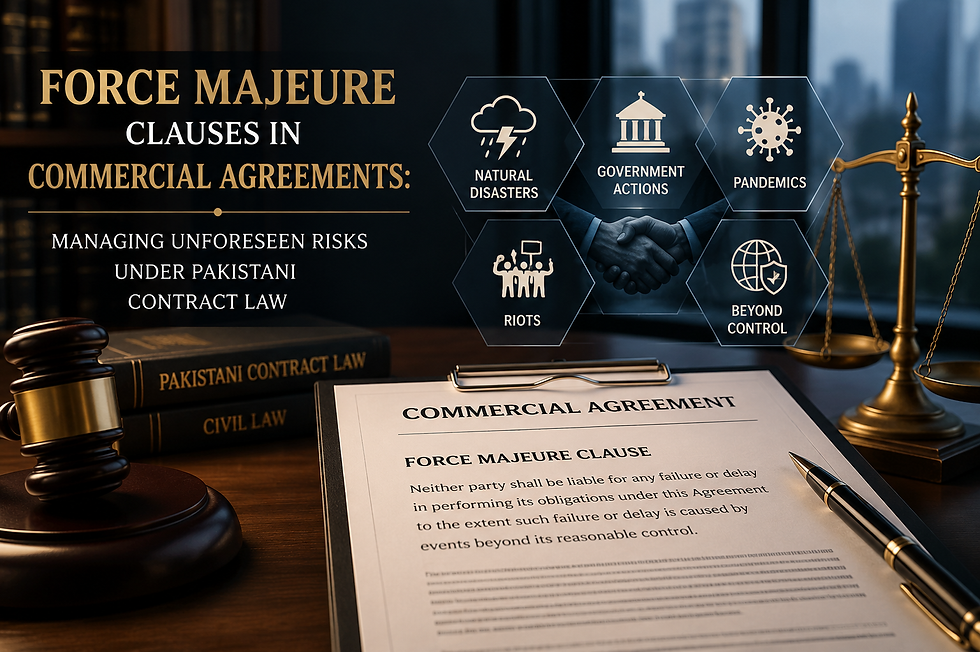
Managing Unforeseen Risks Under Pakistani Contract Law
Commercial agreements form the backbone of business relationships by defining the rights, obligations, and expectations of contracting parties. Whether the agreement relates to the sale of goods, construction projects, manufacturing, transportation, supply chains, or service contracts, every commercial arrangement is built upon the assumption that both parties will fulfil their contractual obligations. However, business operations do not always proceed as planned. Unexpected events beyond the control of contracting parties may make performance impossible, impracticable, or substantially more difficult. In such situations, force majeure clauses play a crucial role in protecting contractual relationships and allocating risk fairly.
A force majeure clause is one of the most important contractual provisions in modern commercial agreements. It provides legal protection when extraordinary events prevent one or both parties from performing their contractual obligations despite exercising reasonable care. Rather than automatically terminating a contract, a properly drafted force majeure clause establishes the legal consequences of unforeseen circumstances and outlines the rights and responsibilities of each party during periods of disruption.
In Pakistan, the significance of force majeure clauses has grown considerably as businesses increasingly operate within interconnected domestic and international markets. Commercial transactions often involve multiple parties, cross-border supply chains, complex infrastructure projects, and long-term contractual commitments. Events such as natural disasters, government restrictions, labour disruptions, public emergencies, or other uncontrollable circumstances may significantly affect contractual performance. A clear and carefully drafted force majeure clause provides certainty, minimises disputes, and helps businesses manage legal and financial risks effectively.
Understanding the legal framework governing force majeure is therefore essential for businesses, legal professionals, contract managers, investors, and commercial organisations seeking to protect their interests while maintaining strong contractual relationships.
Understanding Force Majeure in Commercial Contracts
The term force majeure refers to extraordinary events or circumstances that are beyond the reasonable control of contracting parties and prevent the performance of contractual obligations. Although the concept originated in civil law jurisdictions, it has become an essential contractual mechanism in commercial agreements throughout the world.
Unlike general contractual obligations, force majeure does not arise automatically in every contract. Its application usually depends upon the wording of the agreement itself. The clause specifies which events qualify as force majeure, the legal consequences of such events, and the procedures that parties must follow when invoking its protection.
A well-drafted force majeure clause provides certainty by defining the circumstances under which contractual obligations may be suspended, delayed, or modified without imposing liability for breach of contract.
The Importance of Force Majeure Clauses
Commercial contracts often remain in force for extended periods, making it impossible to predict every circumstance that may affect performance. Businesses may encounter disruptions arising from natural events, governmental actions, political instability, infrastructure failures, or other exceptional situations that cannot reasonably be prevented.
A force majeure clause allows contracting parties to manage these uncertainties without immediately resorting to litigation or terminating their commercial relationship. It promotes fairness by recognising that some events occur despite careful planning and responsible business conduct.
For businesses operating in competitive markets, force majeure clauses also strengthen commercial certainty by clearly allocating risks before disputes arise.
Legal Recognition Under Pakistani Contract Law
Pakistani contract law recognises the importance of contractual freedom, allowing parties to determine the terms governing their commercial relationships. Accordingly, parties may include force majeure clauses that define the events covered, establish notification requirements, and specify the legal consequences of non-performance caused by extraordinary circumstances.
Where a contract contains a clearly drafted force majeure provision, courts generally interpret the clause according to the language agreed upon by the parties. The precise wording of the agreement therefore becomes critically important because contractual rights and obligations depend largely upon its terms.
In situations where no force majeure clause exists, general principles relating to contractual performance and impossibility may become relevant. Nevertheless, expressly incorporating a comprehensive force majeure clause provides far greater certainty and reduces legal ambiguity.
Events Commonly Covered by Force Majeure Clauses
Every commercial agreement is unique, and the events covered by a force majeure clause may vary depending upon the nature of the transaction. However, most professionally drafted agreements include a broad range of extraordinary events that are genuinely beyond the control of contracting parties.
Common examples include:
Natural disasters such as floods, earthquakes, storms, or other severe environmental events.
Government actions, legal restrictions, or regulatory prohibitions affecting contractual performance.
Armed conflict, civil unrest, terrorism, or significant political disturbances.
Labour strikes or industrial actions beyond the control of the affected party.
Major infrastructure failures disrupting transportation, communication, or utilities.
Public health emergencies that significantly affect business operations.
Rather than attempting to predict every possible event, many contracts also include general language covering comparable unforeseen circumstances beyond reasonable control.
Essential Elements of an Effective Force Majeure Clause
A force majeure clause should be drafted with precision to minimise uncertainty and avoid unnecessary disputes. Ambiguous wording may create disagreement regarding whether a particular event qualifies for contractual protection.
An effective clause generally identifies the events covered, establishes notification procedures, explains the obligations of the affected party, specifies the duration of relief, and outlines the legal consequences if performance remains impossible for an extended period.
The clause should also require the affected party to take reasonable steps to minimise the impact of the disruptive event wherever possible. This encourages responsible commercial conduct while preserving fairness between contracting parties.
Notification Requirements
One of the most important aspects of a force majeure clause is the obligation to provide timely notice. A party relying upon force majeure should notify the other party promptly after becoming aware of the event affecting contractual performance.
The notice should clearly explain the nature of the event, its expected impact upon contractual obligations, and the anticipated duration of the disruption. Regular communication throughout the affected period promotes transparency and enables both parties to consider practical solutions for continuing or modifying contractual performance.
Failure to comply with contractual notification requirements may weaken a party's ability to rely upon force majeure protections.
The Duty to Mitigate Losses
Force majeure protection does not relieve parties from acting responsibly. Even where extraordinary circumstances prevent contractual performance, businesses should take reasonable steps to minimise losses and reduce disruption wherever practicable.
For example, an organisation may explore alternative suppliers, adjust delivery schedules, adopt substitute methods of performance, or implement temporary operational measures. Demonstrating reasonable mitigation efforts strengthens legal credibility and reflects good commercial practice.
Courts generally expect contracting parties to act honestly and cooperatively rather than relying upon force majeure as an excuse for avoidable non-performance.
Force Majeure and Contractual Obligations
The legal effect of force majeure depends upon the wording of the contract and the nature of the disruptive event. In many cases, contractual obligations are temporarily suspended until performance becomes possible again. Once the extraordinary event ends, parties are generally expected to resume their contractual responsibilities.
In more serious situations where performance becomes permanently impossible or commercially impracticable, the agreement may permit renegotiation or termination under clearly defined conditions.
A carefully drafted clause should specify the legal consequences applicable to different categories of force majeure events, reducing uncertainty for both parties.
Commercial Sectors Where Force Majeure Is Particularly Important
Certain industries rely heavily on force majeure provisions because their operations involve significant financial investment, long-term contractual commitments, and complex supply chains.
These sectors include:
Construction and infrastructure projects.
Energy and power generation.
Manufacturing and industrial production.
International trade and logistics.
Transportation and shipping.
Information technology and telecommunications.
Healthcare and pharmaceutical services.
In these industries, contractual certainty is essential for managing commercial risk and maintaining business continuity.
Common Legal Challenges
Despite the value of force majeure clauses, disputes frequently arise regarding their interpretation and application. Parties may disagree about whether an event falls within the contractual definition, whether reasonable mitigation efforts were undertaken, or whether performance was genuinely impossible.
Other disputes concern the duration of contractual relief, financial responsibilities during the affected period, and the circumstances permitting contract termination.
These challenges highlight the importance of drafting force majeure clauses with clear, precise, and commercially practical language.
Drafting Best Practices
Businesses should carefully negotiate force majeure provisions rather than treating them as standard contractual language. A well-drafted clause should reflect the particular risks associated with the relevant industry, commercial transaction, and operational environment.
Important drafting considerations include clearly identifying qualifying events, defining notification procedures, allocating financial responsibilities, specifying mitigation obligations, establishing timelines for suspension or termination, and providing effective dispute resolution mechanisms.
Professional legal drafting significantly reduces future uncertainty while strengthening contractual certainty.
The Role of Alternative Dispute Resolution
Even with carefully drafted agreements, disagreements concerning force majeure may still arise. Many commercial contracts therefore encourage parties to resolve disputes through negotiation, mediation, or arbitration before commencing formal litigation.
Alternative dispute resolution offers several advantages, including greater flexibility, confidentiality, reduced costs, and faster resolution of commercial disagreements. Preserving business relationships is often particularly valuable where parties expect to continue working together after the force majeure event has ended.
Including dispute resolution provisions alongside force majeure clauses strengthens the overall effectiveness of commercial agreements.
Strengthening Commercial Risk Management
Force majeure clauses should form part of a broader contractual risk management strategy. Businesses should regularly review contracts, assess operational risks, maintain appropriate insurance where available, and establish contingency plans for unexpected disruptions.
Effective risk management also involves maintaining accurate records, monitoring regulatory developments, communicating promptly with contractual partners, and obtaining professional legal advice when significant commercial events arise.
A proactive approach enables businesses to respond confidently to unforeseen circumstances while protecting their legal and commercial interests.
Conclusion
Force majeure clauses are among the most valuable provisions in modern commercial agreements because they provide a structured legal response to extraordinary events beyond the control of contracting parties. Rather than allowing unforeseen disruptions to automatically result in contractual liability or costly disputes, these clauses establish clear rules governing suspension of obligations, notification procedures, mitigation responsibilities, and the circumstances under which contractual relationships may continue, be modified, or come to an end.
Under Pakistani contract law, carefully drafted force majeure provisions enhance commercial certainty by allocating risks fairly and reducing legal ambiguity. Businesses that negotiate comprehensive force majeure clauses are better equipped to manage operational disruptions while preserving valuable commercial relationships. As commercial transactions become increasingly complex and interconnected, the importance of thoughtful contractual drafting continues to grow.
Ultimately, an effective force majeure clause is not merely a protective provision it is a vital component of responsible commercial governance. By anticipating potential risks, encouraging cooperation, and providing clear legal guidance during exceptional circumstances, force majeure clauses strengthen contractual stability, support business continuity, and contribute to a more resilient and reliable commercial environment.