
Improving Legal Accessibility Through Technology

Updated: Oct 1
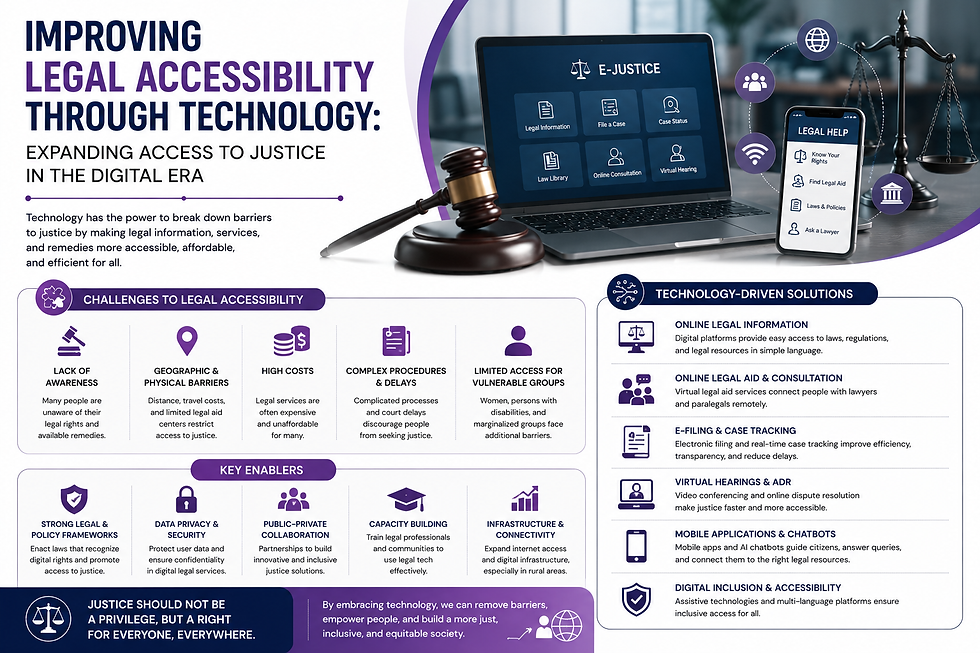
Expanding Access to Justice in the Digital Era
Access to justice is one of the most important principles underlying modern legal systems. Laws exist not merely to regulate society but to protect rights, resolve disputes, and ensure that individuals can obtain fair treatment through accessible and effective legal institutions. However, despite significant legal development across many jurisdictions, access to legal services and justice remains a continuing challenge for individuals and communities.
Barriers such as high legal costs, procedural complexity, limited legal awareness, geographical distance, administrative inefficiencies, and unequal access to professional assistance often prevent people from exercising their legal rights effectively. These challenges can reduce public confidence in legal institutions and limit the practical value of legal protections.
Technological advancement has created new opportunities to address these concerns. Digital platforms, online services, artificial intelligence tools, virtual communication systems, and automated information management are transforming how legal services are delivered and how individuals interact with legal institutions.
Technology is increasingly viewed not simply as a tool for improving efficiency but as a means of making legal systems more accessible, transparent, and responsive. Digital transformation has the potential to reduce traditional barriers and bring legal assistance closer to individuals who may otherwise struggle to access legal support.
At the same time, technology introduces important legal and ethical questions concerning fairness, accountability, digital inclusion, privacy, and procedural integrity. The challenge for modern legal systems is therefore to embrace innovation while preserving the fundamental values that define justice.
This article explores how technology can improve legal accessibility, examines the opportunities and challenges associated with digital legal services, and considers the future of technology-driven access to justice.
Understanding Legal Accessibility
Legal accessibility refers to the ability of individuals to understand, access, and effectively use legal systems and services.
Accessibility extends beyond physical access to courts and includes affordability, clarity of procedures, availability of information, and equal opportunities to seek remedies.
A legally accessible system enables individuals to:
Understand their legal rights
Obtain timely information
Navigate procedures effectively
Access legal institutions
Receive fair treatment
Improving accessibility strengthens public confidence and supports broader social inclusion.
Technology has become an increasingly important instrument for achieving these objectives.
Why Access to Justice Remains a Challenge
Despite ongoing legal reform efforts, many individuals continue to face obstacles when attempting to engage with legal systems.
Common challenges include procedural complexity, financial limitations, institutional delays, limited awareness of legal rights, and geographic barriers.
Traditional legal service models often depend heavily on in-person interaction and extensive documentation.
These requirements may disadvantage individuals with limited resources or limited proximity to legal institutions.
Addressing these challenges requires both institutional reform and innovative service delivery approaches.
Technology offers opportunities to support these changes.
Digital Legal Services and Public Access
Digital legal services have transformed how legal information and assistance are delivered.
Online platforms now allow individuals to access legal guidance, educational resources, appointment systems, and administrative services without relying entirely on physical offices.
Digital services may improve accessibility by reducing travel requirements and simplifying communication.
Technology-driven legal services support:
Greater convenience
Faster information access
Improved administrative efficiency
Expanded public engagement
Accessible digital systems can strengthen legal participation and reduce barriers to justice.
Online Dispute Resolution and Efficient Justice
Online dispute resolution has emerged as an important innovation in modern legal systems.
These mechanisms use digital platforms to facilitate communication, negotiation, mediation, and resolution processes.
Online systems may improve efficiency and reduce costs for certain categories of disputes.
Expanding Access Beyond Traditional Boundaries
Digital dispute resolution can assist individuals who face difficulties attending physical proceedings.
Remote participation may improve convenience and reduce procedural burdens.
Supporting Procedural Efficiency
Technology can improve scheduling, document management, and communication.
Efficient procedures contribute to more responsive justice systems.
Artificial Intelligence and Legal Assistance
Artificial intelligence is increasingly influencing legal service delivery.
AI-powered tools may assist with legal research, information retrieval, document organization, and administrative processes.
These technologies can support legal accessibility by simplifying access to information and reducing routine administrative burdens.
However, AI should complement rather than replace professional legal judgment.
Legal systems must ensure that technological tools operate transparently and responsibly.
Human oversight remains essential in maintaining fairness and accountability.
Digital Courts and Modern Judicial Services
Courts are increasingly adopting digital technologies to improve efficiency and accessibility.
Electronic filing systems, virtual hearings, digital case management platforms, and online communication tools are reshaping judicial administration.
Digital courts may reduce delays and simplify procedural interactions.
Benefits may include:
Reduced administrative burdens
Faster case processing
Improved access to records
Greater procedural transparency
Technology-supported courts contribute to broader justice modernization efforts.
However, implementation should remain inclusive and user-centered.
Legal Information and Public Empowerment
Access to legal information is an essential component of legal accessibility.
Many individuals face challenges simply because legal processes appear difficult to understand.
Technology allows legal institutions to provide educational resources and improve public understanding.
Accessible information supports informed decision-making and encourages active participation.
Improving legal literacy strengthens both individual rights and institutional legitimacy.
Public empowerment remains an important objective of legal innovation.
Only Bullet Section: Key Technologies Improving Legal Accessibility
Digital legal service platforms
Electronic court filing systems
Virtual hearings and remote participation tools
Artificial intelligence legal assistance systems
Online dispute resolution mechanisms
Digital document management systems
Public legal information portals
Mobile-based legal service applications
Digital Inclusion and Equality Concerns
While technology can improve accessibility, digital transformation may also create new inequalities.
Not all individuals possess equal access to internet connectivity, digital devices, or technological literacy.
Legal systems must ensure that modernization efforts do not exclude vulnerable populations.
Digital inclusion strategies should promote equitable participation and maintain alternative access channels where necessary.
Technology should reduce barriers rather than create new forms of exclusion.
Inclusive governance remains essential.
Privacy and Data Protection in Digital Legal Services
Legal systems manage sensitive personal information that requires strong protections.
Digital transformation increases the importance of privacy and data governance.
Legal institutions must establish safeguards relating to:
Confidentiality
Data security
Information management
User transparency
Responsible technology practices
Strong privacy protections strengthen trust and encourage public engagement with digital services.
Responsible governance supports long-term sustainability.
Institutional Reform and Technology Integration
Technology alone cannot solve access to justice challenges.
Successful modernization requires broader institutional reform and coordinated governance.
Legal institutions must review procedures, strengthen administrative systems, improve staff training, and support user-centered service design.
Technology should complement structural improvements rather than substitute for them.
Integrated reform strategies produce stronger outcomes.
Institutional adaptability remains central to effective implementation.
Alternative Legal Service Models
Technology has encouraged the development of more flexible legal service models.
Remote consultations, digital communication platforms, automated scheduling systems, and online support services are expanding legal access.
These innovations may improve service availability while reducing administrative burdens.
However, quality standards and accountability mechanisms remain important.
Modern legal systems increasingly recognize that accessibility requires multiple service pathways.
Flexible models support broader participation.
The Future of Legal Accessibility
The future of legal accessibility will likely involve greater integration of technology into every stage of legal service delivery.
Future developments may emphasize:
User-centered digital platforms
Expanded remote access mechanisms
Data-informed service delivery
Automated administrative support
Inclusive design principles
The objective will remain improving accessibility while protecting fairness and legal integrity.
Technology will continue shaping how legal institutions interact with society.
Conclusion
Improving legal accessibility through technology represents one of the most significant developments in modern legal governance. Digital tools are transforming how individuals access legal information, engage with courts, resolve disputes, and exercise their rights.
Technology offers opportunities to reduce traditional barriers relating to cost, complexity, distance, and administrative inefficiency. At the same time, successful implementation requires careful attention to privacy, accountability, digital inclusion, and procedural fairness.
Effective legal accessibility depends upon combining technological innovation with institutional reform and strong governance frameworks.
As legal systems continue evolving, the goal should remain clear: creating justice systems that are not only legally sound but also accessible, understandable, and responsive to the needs of all members of society.
Ultimately, technology should serve as a bridge between law and society, helping transform legal rights from theoretical protections into practical realities available to everyone.


