Law as a Catalyst for Economic Growth

Updated: Oct 1
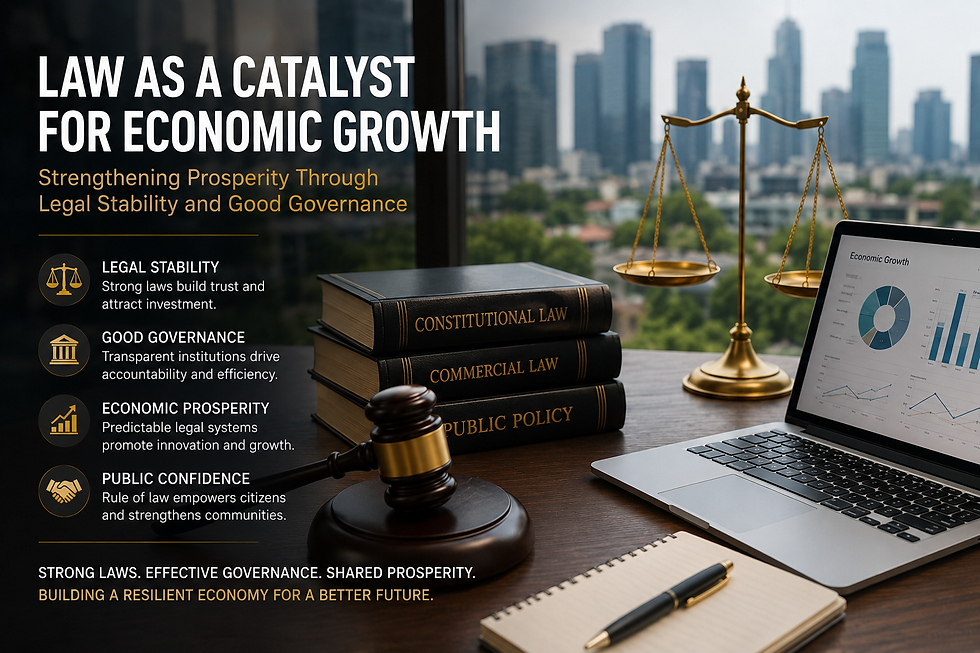
Strengthening Prosperity Through Legal Stability and Good Governance
Economic growth is often associated with factors such as investment, innovation, industrial development, technological advancement, and entrepreneurship. While these elements are undoubtedly important, one critical factor frequently operates behind the scenes: the legal system. A strong and effective legal framework serves as the foundation upon which modern economies are built, providing stability, predictability, and confidence for businesses, investors, and consumers alike.
Law plays a central role in regulating economic activities, protecting property rights, enforcing contracts, maintaining market competition, and ensuring accountability in both the public and private sectors. Without a reliable legal system, economic transactions become uncertain, investment risks increase, and commercial development is hindered. Conversely, when laws are clear, fair, and consistently enforced, they create an environment that encourages economic activity and long-term growth.
In the modern global economy, legal institutions have become increasingly important as nations compete to attract investment, foster innovation, and promote sustainable development. Governments are recognizing that legal reform is not merely a matter of governance but also a powerful tool for economic progress.
This article explores how law functions as a catalyst for economic growth, examining the relationship between legal systems and economic development, the importance of regulatory frameworks, and the role of legal institutions in creating prosperous and resilient economies.
Understanding the Relationship Between Law and Economic Growth
Law and economic growth are closely interconnected. Economic activity depends upon a stable environment where individuals and businesses can engage in transactions with confidence that their rights will be protected and obligations enforced.
Legal systems establish the rules governing economic interactions. They define ownership rights, regulate commercial relationships, provide mechanisms for dispute resolution, and create standards for market behavior. These functions reduce uncertainty and facilitate cooperation among economic actors.
A strong legal framework encourages productive economic behavior by creating incentives for investment, entrepreneurship, and innovation. Individuals are more likely to invest resources, start businesses, and enter into commercial agreements when they trust that legal institutions will protect their interests.
Economic growth is therefore not solely a product of market forces; it is also influenced by the quality and effectiveness of the legal environment in which markets operate.
The Rule of Law as an Economic Foundation
The rule of law is one of the most important legal principles supporting economic development. It requires that laws are applied fairly, consistently, and transparently to all individuals and institutions.
Under the rule of law, government actions are constrained by legal standards, reducing the risk of arbitrary decision-making and abuse of power. This predictability creates a stable environment in which businesses and investors can operate with confidence.
When the rule of law is weak, economic activity may be discouraged by uncertainty, corruption, and inconsistent enforcement. Investors are less likely to commit resources in environments where legal protections are unreliable or subject to political influence.
Strong adherence to the rule of law promotes economic stability, enhances investor confidence, and contributes to long-term development.
Property Rights and Economic Development
Secure property rights are among the most important legal foundations of economic growth. Property rights provide individuals and businesses with legal recognition and protection of their assets.
When ownership rights are clearly defined and enforceable, people have greater incentives to invest in property, improve productive resources, and engage in commercial activities. Secure ownership encourages long-term planning and economic productivity.
Property rights also facilitate access to credit. Financial institutions are more willing to provide loans when borrowers can offer legally protected assets as collateral.
In contrast, weak property rights create uncertainty and discourage investment. Individuals may be reluctant to develop assets if ownership is vulnerable to disputes or unlawful interference.
Strong legal protections for property rights therefore contribute directly to economic expansion and wealth creation.
Contract Enforcement and Commercial Confidence
Modern economies rely heavily on contractual relationships. Businesses enter into agreements with suppliers, customers, employees, investors, and service providers on a daily basis.
Contracts provide certainty by establishing legally enforceable rights and obligations. However, contracts are only effective if legal institutions can enforce them when disputes arise.
The Importance of Reliable Enforcement
Effective contract enforcement reduces transaction risks and encourages commercial activity. Parties are more likely to enter agreements when they trust that courts or dispute resolution mechanisms will uphold contractual obligations.
Reliable enforcement promotes business confidence and facilitates complex economic relationships.
Reducing Transaction Costs
Strong legal systems reduce the costs associated with negotiating and enforcing agreements. Businesses can operate more efficiently when they spend less time and resources managing legal uncertainty.
By lowering transaction costs, effective contract enforcement contributes to economic productivity and market growth.
Business Regulation and Market Stability
Regulation plays a vital role in ensuring that markets function fairly and efficiently. While excessive regulation can hinder economic activity, appropriate legal oversight is essential for maintaining stability and protecting public interests.
Business regulations establish standards relating to corporate governance, consumer protection, labour practices, environmental responsibility, and financial reporting.
Well-designed regulatory frameworks create predictable operating environments that encourage investment and competition.
Effective regulation also helps prevent market failures, fraud, and anti-competitive behavior, thereby promoting sustainable economic development.
Investment Climate and Legal Certainty
Domestic and foreign investors consider legal stability when making investment decisions. A predictable legal environment reduces risks and enhances confidence in economic opportunities.
Investors typically seek jurisdictions that provide:
Strong property rights protection
Independent judicial systems
Transparent regulatory frameworks
Effective dispute resolution mechanisms
Consistent enforcement of laws
Legal certainty allows investors to assess risks more accurately and make long-term commitments.
Countries with strong legal institutions often attract higher levels of investment because businesses view them as safer and more reliable environments for economic activity.
Corporate Governance and Economic Performance
Corporate governance refers to the systems and processes through which companies are directed and controlled. Strong governance frameworks contribute to economic growth by promoting accountability, transparency, and responsible management.
Effective corporate governance enhances investor confidence, improves access to capital, and reduces the likelihood of financial misconduct.
Legal rules governing corporate behavior help protect shareholders, employees, creditors, and consumers while encouraging sustainable business practices.
As economies become increasingly interconnected, corporate governance has emerged as a key factor influencing economic competitiveness and long-term development.
Innovation, Intellectual Property, and Economic Progress
Innovation is a major driver of economic growth, and intellectual property law plays a crucial role in encouraging creative and technological advancement.
Intellectual property protections provide legal rights to inventors, creators, and businesses, allowing them to benefit from their innovations.
Encouraging Research and Development
Patents, copyrights, trademarks, and trade secrets create incentives for investment in research and development by offering protection against unauthorized use.
These protections encourage businesses and individuals to develop new technologies, products, and services.
Supporting Knowledge-Based Economies
Modern economies increasingly rely on knowledge, technology, and innovation. Strong intellectual property frameworks help foster dynamic and competitive markets capable of generating sustained economic growth.
By protecting innovation, legal systems contribute to economic modernization and technological progress.
Access to Justice and Economic Participation
Economic growth depends upon broad participation in commercial activities. Access to justice ensures that individuals and businesses can protect their rights, resolve disputes, and enforce legal obligations.
Efficient courts and dispute resolution mechanisms reduce uncertainty and promote confidence in economic transactions.
When legal remedies are inaccessible, costly, or excessively delayed, economic activity may be discouraged. Businesses may hesitate to enter agreements if they doubt their ability to enforce rights effectively.
Improving access to justice therefore contributes to economic development by strengthening trust in legal institutions and facilitating market participation.
Only Bullet Section: Key Legal Factors That Promote Economic Growth
Strong protection of property rights
Reliable contract enforcement mechanisms
Independent and efficient judicial institutions
Transparent regulatory frameworks
Effective corporate governance standards
Robust intellectual property protections
Fair competition and antitrust laws
Accessible dispute resolution systems
Combating Corruption Through Legal Reform
Corruption represents a significant obstacle to economic growth. It increases transaction costs, distorts markets, discourages investment, and undermines public trust.
Legal reforms aimed at promoting transparency, accountability, and anti-corruption enforcement can significantly improve economic performance.
Strong anti-corruption laws help ensure that economic opportunities are allocated fairly rather than based on personal connections or improper influence.
By reducing corruption, legal systems create more competitive and efficient markets that support sustainable development.
Technology, Digital Law, and Economic Transformation
Technology is reshaping economies around the world, creating new opportunities for growth and innovation. Legal systems must adapt to support digital transformation while addressing associated risks.
Digital commerce, electronic transactions, data protection, cybersecurity, and artificial intelligence all require appropriate legal frameworks.
Modern legal systems increasingly focus on creating rules that facilitate technological innovation while protecting consumers and maintaining market integrity.
The ability of law to adapt to technological change will play a crucial role in determining future economic competitiveness.
Globalization and International Economic Law
Globalization has increased the importance of international legal frameworks governing trade, investment, and cross-border commerce.
Businesses now operate within interconnected global markets where legal certainty and regulatory cooperation are essential.
International economic law facilitates trade by establishing common standards and dispute resolution mechanisms. These frameworks help reduce barriers to commerce and promote economic integration.
Countries that align their legal systems with international best practices often enjoy greater participation in global markets and increased economic opportunities.
Challenges in Using Law as a Tool for Economic Growth
Despite its importance, law alone cannot guarantee economic prosperity. Legal reforms must be accompanied by effective implementation, institutional capacity, and political commitment.
Challenges may include:
Weak enforcement mechanisms
Judicial delays
Regulatory complexity
Corruption and administrative inefficiency
Limited access to legal services
Addressing these challenges requires ongoing investment in legal institutions and continuous evaluation of regulatory frameworks.
Economic growth is most effectively supported when laws are not only well-designed but also consistently enforced.
The Future of Law and Economic Development
The future relationship between law and economic growth will be shaped by technological innovation, globalization, sustainability concerns, and evolving business models.
Legal systems will need to become more adaptable and responsive to changing economic conditions. Policymakers will increasingly focus on creating frameworks that encourage innovation while maintaining fairness and accountability.
Emerging areas such as digital regulation, artificial intelligence governance, environmental law, and sustainable development will play increasingly important roles in shaping economic outcomes.
As economies continue to evolve, the importance of strong legal institutions will remain fundamental to long-term prosperity.
Conclusion
Law serves as a powerful catalyst for economic growth by creating the stability, predictability, and trust necessary for productive economic activity. Through the protection of property rights, enforcement of contracts, promotion of fair competition, and regulation of commercial conduct, legal systems provide the foundation upon which modern economies are built.
Strong legal institutions encourage investment, foster innovation, support entrepreneurship, and facilitate efficient market operations. They reduce uncertainty, enhance accountability, and create opportunities for individuals and businesses to participate confidently in economic life.
While economic growth depends on many factors, the quality of a nation's legal framework remains one of the most important determinants of long-term development and prosperity. Effective laws not only regulate economic activity but also enable it by creating an environment where innovation, investment, and enterprise can flourish.
Ultimately, societies that prioritize the rule of law, good governance, and legal reform are better positioned to achieve sustainable economic growth, attract investment, and build resilient economies capable of meeting the challenges of the future.