

Law Officer and Public Prosecutor Posts in Punjab: Eligibility and Preparation

Law students often start thinking about a government legal post in their final year. A public prosecutor's office, a department's legal wing or the civil judiciary can look steadier than private practice. These posts are real options, but almost none of them can be applied for straight after the LL.B degree.
This guide explains the main government legal posts a young lawyer in Punjab can aim for and what recent advertisements have asked for. It also covers how selection usually works and how to prepare while you build your practice years. Recruitment details change with every advertisement, so treat this as a map and confirm the specifics before you apply.
The main government legal posts in Punjab
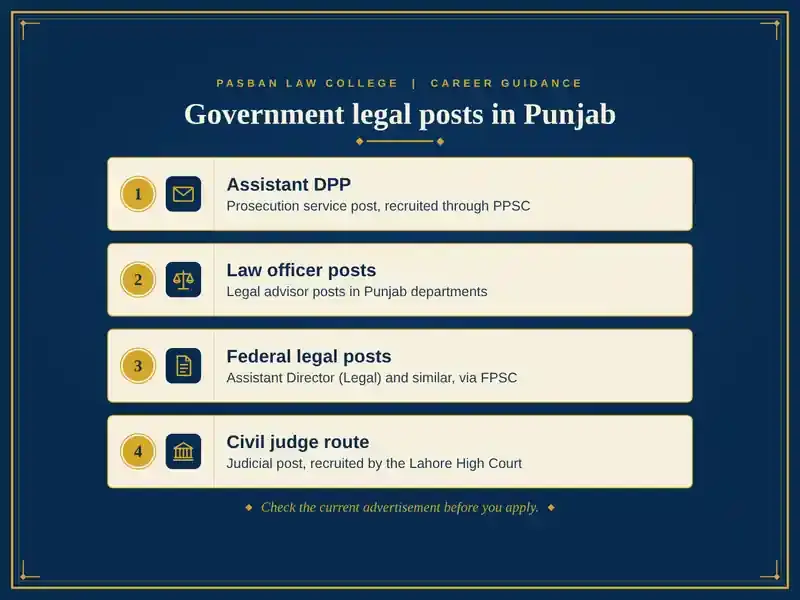
For a junior advocate in Punjab, four routes are worth knowing. They differ in who recruits, what the work involves and how much practice they expect.
Assistant District Public Prosecutor. The entry post in the Punjab Criminal Prosecution Service, recruited through the Punjab Public Service Commission (PPSC).
Departmental law officers. Legal advisor and law officer posts in Punjab government departments, advertised by PPSC from time to time.
Federal legal posts. Posts such as Assistant Director (Legal) in federal agencies, advertised by the Federal Public Service Commission (FPSC).
Civil Judge-cum-Magistrate. The entry post in the Punjab judiciary, recruited by the Lahore High Court rather than PPSC.
How the prosecution service is set up
The Punjab Criminal Prosecution Service (Constitution, Functions and Powers) Act, 2006 created the service. Under section 4, it consists of the Prosecutor General, Additional and Deputy Prosecutors General, District Public Prosecutors, Deputy District Public Prosecutors and Assistant District Public Prosecutors.
Section 8 says that direct recruitment on a regular basis to the prosecutor posts, including Assistant District Public Prosecutor, is made only on the recommendation of PPSC. Section 16 says members of the service are appointed and governed under the Punjab Civil Servants Act, 1974. In other words, an ADPP is a provincial civil servant, not a lawyer on a retainer.
What an ADPP actually does
The Act gives prosecutors a defined role in every criminal case. Under section 9, prosecutors conduct the prosecution on behalf of the Government. A police report under section 173 of the Code of Criminal Procedure, 1898, including a cancellation report or a request to discharge an accused, goes to court through the prosecutor.
The prosecutor scrutinizes that report first. If it is defective, it can be returned to the police within three days for the defects to be removed. If it is fit, the prosecutor files it before the competent court and may give the court a written view of the evidence and the offenses that apply.
Day to day, that means reading police files closely, examining prosecution witnesses and taking a position on bail that the record justifies. Withdrawing from a prosecution needs the court's consent and prior approval from a higher level, which depends on the punishment for the offense. Section 13 requires an independent file for each case. It also requires a prosecutor to act fairly, honestly, with due diligence, in the public interest and to uphold justice.
Eligibility: what recent advertisements asked for
The Act leaves qualifications for posts below Prosecutor General to rules and advertisements, so the advertisement is the document that decides your eligibility. In PPSC Advertisement No. 42/2025, the basic requirement for Assistant District Public Prosecutor was an LL.B degree, two years' practice as an advocate and valid bar membership.
Deputy District Public Prosecutor posts in the same advertisement asked for much longer practice. The advertisement also set age limits, with relaxations for some categories, and explained how practice must be proved. Read those parts word by word, because one missed detail can make an otherwise strong application ineligible.
Departmental and federal legal posts vary more. An FPSC advertisement for Assistant Director (Legal) in the Federal Investigation Agency in 2026 asked for at least a second class or grade C LL.B degree and two years' post-qualification experience in legal practice or prosecution. Other legal advisor posts may ask for different degrees, more experience or a specific domicile, so never assume one post's rules apply to another.
The common thread is practice. Two years as an advocate begins only after you are enrolled, which is why Punjab Bar Council enrollment is the first real step toward any of these posts.
How civil judge recruitment differs
The Civil Judge-cum-Magistrate route is a judicial post, not a prosecution or advisory one. In Punjab, the Lahore High Court runs this recruitment itself, not PPSC.
Recent Lahore High Court advertisements have also required enrolled advocates with at least two years' practice, along with their own age limits. The process has usually involved a screening test, written papers and an interview. Its syllabus and format are separate from PPSC's, so prepare for it on its own terms and check the High Court's current advertisement.
The written test and how to prepare
The ADPP written stage tests the law a criminal practitioner uses every day. In the 2021 and 2025 PPSC recruitments, as published, it had four papers: criminal procedure, substantive criminal law, the law of evidence and English. Papers combined objective and subjective parts, followed by a psychological assessment and an interview. The papers and marks can change, so download the syllabus attached to the current advertisement.
Read the core statutes in bare text. The Code of Criminal Procedure, 1898, the Pakistan Penal Code, 1860 and the Qanun-e-Shahadat Order, 1984 are the heart of the test.
Master evidence properly. Admissions, confessions, burden of proof, witnesses and documentary evidence come up again and again, and the site's guide to evidence law under the Qanun-e-Shahadat Order is a good refresher.
Link sections to courtroom stages. Arrest, bail, the police report, charge, trial and appeal are easier to remember as a sequence than as numbers.
Practice written answers. Subjective parts reward clear headings, the correct section and a short application to facts.
Keep English in practice. Write a short note or summary every day, since English is tested in its own paper.
Cover general knowledge where listed. Some legal posts include general knowledge or current affairs, so follow the syllabus for the post you are applying for.
Preparing for the interview
The interview usually tests whether you can apply law, not just recite it. Expect questions on cases from your own practice, criminal procedure in real situations and how you would handle pressure from police, complainants or the accused.
Prepare a short, honest account of the work you have done. Know the basic structure of the service you are joining, including who supervises an ADPP and what a prosecutor's duty to the court means.
Using your practice years well
The two years of practice are not just a requirement to tick off. They are your best preparation, especially if you spend them in criminal courts.
Work that gives you real exposure to criminal practice, bail and the sessions courts teaches you how police files are built, where they break down and how witnesses behave under cross-examination. Keep a record of the cases you assisted in, the stages you saw and the orders you noted. It helps in the interview and in proving your practice.
Pros and cons of a government legal post
A government legal post suits some people far better than others. Weigh both sides honestly before you plan your legal career after LL.B around one.
Pro: structured career. Prosecutors are civil servants with a service structure and promotion under prescribed rules.
Pro: trial court work from the start. An ADPP's work centers on criminal trials, so courtroom experience begins on day one.
Pro: public service. The work carries a clear duty to the public and to justice, not to a paying client.
Con: transfers and supervision. Postings and transfers follow the service rules, and the work runs under supervision and reporting duties.
Con: caseload pressure. Heavy cause lists and incomplete police files are part of the job.
Con: no private clients. A government post is a different path from building your own chambers, so think about where you want to be in ten years.
Common mistakes
Applying without reading the eligibility clause. Practice length, degree class and age cut-off dates decide eligibility before the test does.
Counting practice from the wrong date. Advertisements explain how practice is counted, so check before you assume you qualify.
Relying on old syllabi. Use the syllabus attached to the current advertisement, not a copy shared in a group.
Preparing only MCQs. Subjective answers and the interview need writing and reasoning practice.
Ignoring the practice years. A candidate with real criminal court exposure is better prepared for both the test and the job.
Frequently asked questions
Can I apply for Assistant District Public Prosecutor right after my LL.B?
No. In PPSC Advertisement No. 42/2025, the post required an LL.B degree, two years' practice as an advocate and valid bar membership. Check the current advertisement, because requirements can change.
Which subjects are in the ADPP written test in Punjab?
In the 2021 and 2025 PPSC recruitments, as published, the written stage covered criminal procedure, substantive criminal law, the law of evidence and English. A psychological assessment and an interview followed. Always confirm the papers in the syllabus attached to the current advertisement.
Is civil judge recruitment in Punjab done by PPSC?
No. Civil Judge-cum-Magistrate recruitment in Punjab is run by the Lahore High Court. Recent advertisements have required enrolled advocates with at least two years' practice, with their own age limits and test format.
For a junior advocate in Faisalabad or anywhere in Punjab, a government legal post is a realistic goal if you plan for it early. Get enrolled, spend your practice years in real courtrooms and prepare from the current syllabus, not from rumors.
About this guide: This guide was checked in October 2026 against the Punjab Criminal Prosecution Service (Constitution, Functions and Powers) Act, 2006, published details of PPSC Advertisement No. 42/2025 for Assistant District Public Prosecutor posts, published details of FPSC's 2026 advertisement for Assistant Director (Legal) in the Federal Investigation Agency, recent Lahore High Court civil judge advertisements, and Pakistan Code listings of the Code of Criminal Procedure, 1898, the Pakistan Penal Code, 1860 and the Qanun-e-Shahadat Order, 1984. Recruitment rules, age limits and syllabi change with each advertisement, so confirm current requirements with PPSC, FPSC, the Lahore High Court or your senior before you apply.


