
Marriage Laws in Pakistan

Updated: Oct 1
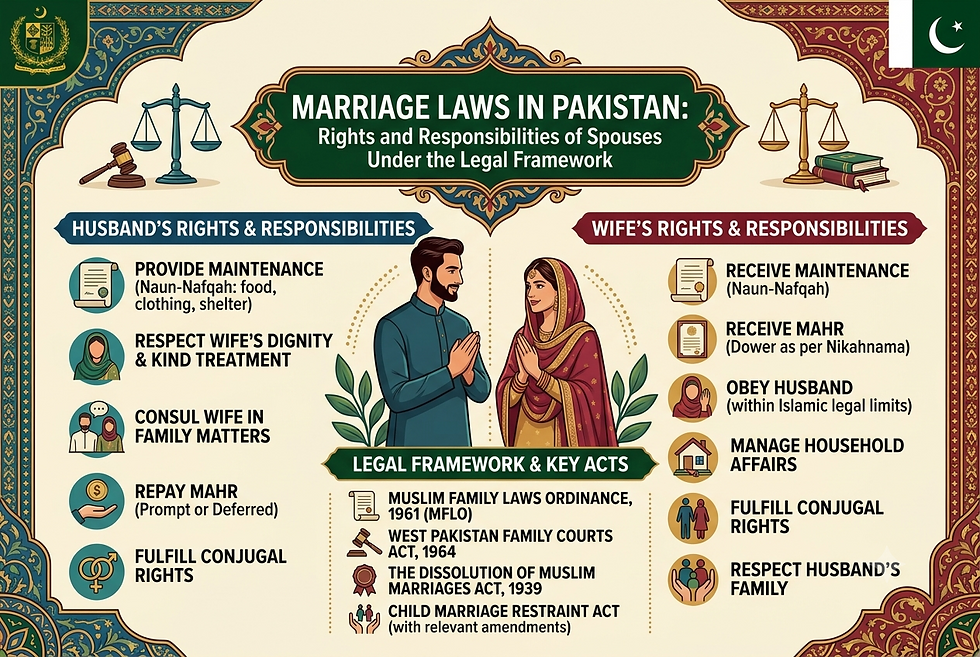
Rights and Responsibilities of Spouses Under the Legal Framework
Marriage is one of the most significant legal and social institutions in Pakistan. It establishes a lawful relationship between spouses while creating a framework of mutual rights, responsibilities, and obligations recognized under Islamic law and the country's legal system. Beyond its personal and religious significance, marriage also carries important legal consequences relating to financial support, inheritance, family welfare, child custody, and the protection of individual rights.
Pakistan's marriage laws are primarily based on Islamic principles, supported by statutory legislation and judicial interpretation. These laws aim to promote family stability, protect the dignity of spouses, safeguard the welfare of children, and provide legal remedies when disputes arise. While the legal framework recognizes the importance of preserving the family institution, it also ensures that both spouses possess enforceable rights and responsibilities throughout the marital relationship.
Over the years, legal reforms and judicial decisions have strengthened procedural safeguards relating to marriage registration, maintenance, dissolution of marriage, and family dispute resolution. Institutions such as Family Courts and Union Councils play an important role in implementing these laws and facilitating the peaceful resolution of family matters.
Modern family law in Pakistan seeks to balance religious values with contemporary legal requirements. It emphasizes mutual respect, legal accountability, and fairness while ensuring that marriage remains a partnership founded upon trust, cooperation, and shared responsibility.
This article explores the legal framework governing marriage in Pakistan, examines the rights and responsibilities of spouses, and discusses the importance of legal compliance in strengthening family relationships and promoting social stability.
The Legal Nature of Marriage in Pakistan
Under Pakistani law, marriage is recognized as a lawful civil contract performed in accordance with Islamic principles and applicable legal requirements.
A valid marriage creates legally enforceable rights and obligations for both spouses. These legal consequences extend beyond the marriage ceremony itself and influence matters relating to financial support, inheritance, property rights, parental responsibilities, and family welfare.
Marriage therefore represents both a personal commitment and a legally recognized institution.
Legal certainty strengthens family stability.
Proper documentation protects the rights of both spouses.
The Legal Framework Governing Marriage
Marriage in Pakistan is regulated through a combination of Islamic jurisprudence and statutory legislation. The Muslim Family Laws Ordinance, 1961, the Family Courts Act, 1964, and other applicable laws provide the principal legal framework governing marriage, family disputes, maintenance, and related matters.
Marriage registration serves as an important legal safeguard by creating official evidence of the marital relationship and protecting the legal rights of both spouses.
The legal framework promotes transparency and accountability.
Effective regulation strengthens family law administration.
Rights of Spouses in Marriage
Marriage creates reciprocal legal rights for both husband and wife.
These rights include mutual respect, lawful companionship, financial rights recognized by law, inheritance rights where applicable, and access to legal remedies through the courts when disputes arise.
Both spouses are entitled to the protection of the law and may seek judicial relief where their legal rights have been violated.
Equality before the law strengthens family justice.
Legal protection promotes mutual confidence.
Financial Responsibilities Within Marriage
Financial responsibility represents an important aspect of the marital relationship.
Under Pakistani family law and Islamic legal principles, spouses have financial rights and obligations that contribute to the welfare and stability of the family.
Responsible financial management, transparency, and mutual cooperation help strengthen family relationships while reducing the likelihood of legal disputes.
Economic responsibility supports family security.
Financial fairness promotes long-term stability.
Marriage Registration and Legal Protection
Marriage registration is an essential legal requirement that provides formal recognition of the marital relationship.
A properly registered marriage facilitates the protection of legal rights relating to maintenance, inheritance, succession, child legitimacy, and family dispute resolution.
Official documentation also assists courts and administrative authorities when resolving family-related legal issues.
Registration strengthens legal certainty.
Accurate records protect future rights.
Mutual Duties and Responsibilities
Marriage is founded upon cooperation, mutual respect, trust, and shared responsibility.
Both spouses are expected to contribute to the stability of the family through responsible conduct, respect for legal obligations, and commitment to family welfare.
The legal framework encourages harmonious relationships while providing remedies where serious disputes arise.
Responsible conduct benefits the entire family.
Shared obligations strengthen marital relationships.
Family Courts and Dispute Resolution
Family Courts play a central role in resolving disputes arising from marriage and other family relationships.
These courts hear matters involving maintenance, dissolution of marriage, custody, guardianship, dower, recovery of marital rights, and other issues falling within family law.
The objective is to provide specialized judicial procedures that promote fair, efficient, and legally consistent outcomes.
Judicial oversight protects family rights.
Efficient dispute resolution supports access to justice.
Only Bullet Section: Key Rights and Responsibilities of Spouses
Entering into a lawful and properly registered marriage
Respecting the legal rights and dignity of each spouse
Fulfilling financial obligations recognized by law
Promoting the welfare and stability of the family
Protecting the interests and upbringing of children
Resolving disputes through lawful and peaceful legal mechanisms
Maintenance and Financial Support
Maintenance is an important component of family law in Pakistan.
The legal framework provides mechanisms through which eligible spouses may seek financial support where required under applicable legal principles.
Family Courts consider the relevant circumstances of each case while ensuring that legal obligations are fulfilled fairly and consistently.
Financial support promotes family welfare.
Judicial protection strengthens legal rights.
Dissolution of Marriage and Legal Remedies
While marriage is intended to provide a stable family relationship, the law also recognizes that certain circumstances may require its dissolution.
Pakistan's legal system provides lawful procedures for divorce, khula, annulment, and other family law remedies through the appropriate judicial and administrative processes.
These procedures seek to protect the rights of both spouses while promoting fairness and legal certainty.
Lawful remedies strengthen confidence in family justice.
Procedural safeguards ensure balanced outcomes.
The Role of Technology in Family Law Administration
Technology is increasingly improving the administration of family law through digital record management, electronic documentation, and improved access to legal information.
Modernization contributes to greater efficiency in maintaining marriage records, managing court proceedings, and providing public access to legal services.
Digital innovation should continue supporting transparency and institutional effectiveness.
Technology enhances legal accessibility.
Modern administration improves public service.
Challenges in Marriage Law
Despite an established legal framework, challenges remain in ensuring consistent compliance with marriage registration requirements, public legal awareness, timely dispute resolution, and effective enforcement of family court decisions.
Addressing these issues requires legal education, institutional strengthening, and continued modernization of family justice systems.
Legal awareness empowers families.
Institutional development improves access to justice.
The Future of Marriage Laws in Pakistan
Marriage laws in Pakistan are expected to continue evolving in response to changing social conditions, technological advancement, and judicial development.
Future reforms may focus on improving administrative efficiency, strengthening family dispute resolution mechanisms, increasing legal awareness, and enhancing access to family justice.
The objective will remain protecting family stability while ensuring that the legal rights of both spouses are effectively safeguarded.
Modern family law must balance tradition with legal progress.
Conclusion
Marriage laws in Pakistan provide a comprehensive legal framework that protects the rights and responsibilities of spouses while promoting family stability and social harmony. By recognizing marriage as both a lawful contract and an important social institution, the legal system ensures that spouses have enforceable rights relating to financial support, legal protection, family welfare, and access to justice.
Marriage registration, responsible conduct, and effective dispute resolution mechanisms contribute to stronger legal certainty and greater public confidence in family law.
As Pakistan continues strengthening its legal institutions and modernizing family justice, marriage laws will remain essential in protecting families, safeguarding individual rights, and reinforcing the principles of fairness, dignity, and the rule of law.


