
Rights of Women After Divorce in Pakistan

Updated: Oct 1
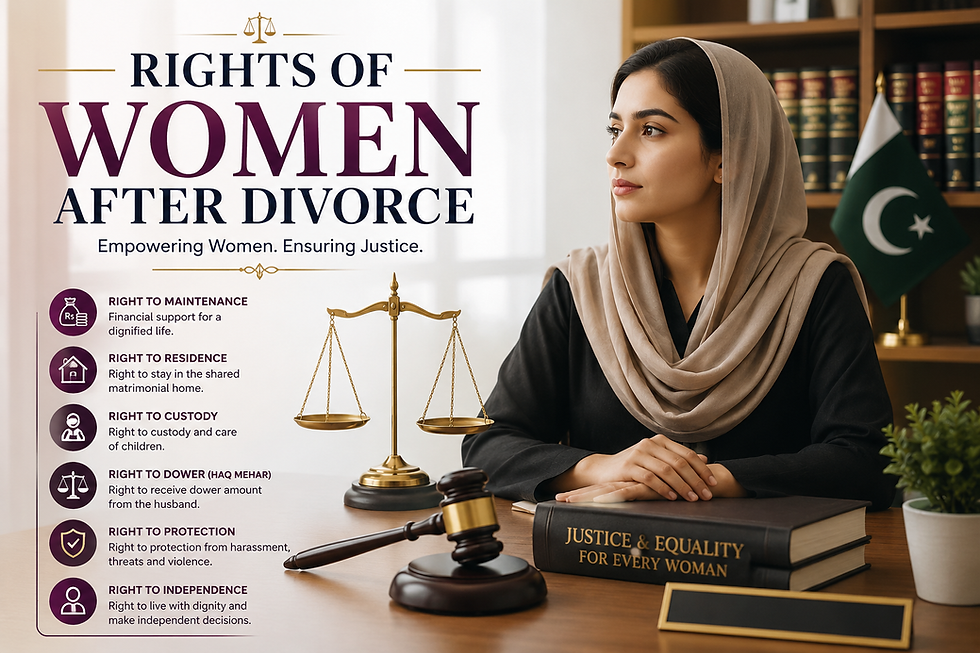
Divorce is not only the legal dissolution of a marriage; it can also create important questions concerning financial security, dower, maintenance, children, custody, inheritance, property, and personal dignity. For women in Pakistan, understanding their legal rights after divorce is particularly important because the end of a marriage does not automatically eliminate every right that arose during the marriage or as a result of its dissolution.
The legal rights available to a divorced woman depend upon several factors, including the type of marriage, the circumstances of divorce, the terms of the Nikahnama, whether dower has been paid, whether there are children, and the applicable personal and statutory law. Family Courts play an important role in determining many disputes involving dissolution of marriage, dower, maintenance, custody, and guardianship.
Pakistani family law is influenced by statutory legislation as well as Islamic principles. The Family Courts Act, 1964, the Muslim Family Laws Ordinance, 1961, the Dissolution of Muslim Marriages Act, 1939, and other relevant laws provide an important legal framework for family disputes. The exact rights of a woman, however, depend upon the facts of her individual case.
This article explains some of the major legal rights of women after divorce in Pakistan and highlights the issues that divorced women should understand when protecting their legal and financial interests.
Right to Receive Unpaid Dower or Haq Mehr
One of the most important financial rights connected with marriage is dower, commonly known as Haq Mehr.
Dower is a financial obligation arising from the marriage contract. The amount and terms of dower are generally recorded in the Nikahnama. Depending upon the terms of the marriage contract, dower may be payable immediately or may be deferred.
If a woman is divorced and her dower remains unpaid, she may have a legal right to claim the amount due to her.
The fact that the marriage has ended does not, by itself, mean that an unpaid dower obligation automatically disappears. A woman may approach the appropriate legal forum to recover dower that is legally due to her.
The Nikahnama is particularly important in such cases because it may contain evidence regarding the amount of dower, whether it was prompt or deferred, and other relevant terms.
A divorced woman should therefore keep her original Nikahnama or a certified copy and other documents relating to the marriage.
Right to Maintenance
Maintenance is another important issue after divorce.
The right to maintenance depends upon the circumstances of the case and the applicable law. A woman's entitlement to maintenance after divorce may differ from her entitlement during the marriage.
In cases involving dissolution of marriage, questions may arise concerning maintenance for the period during which the woman is legally entitled to support, including the relevant waiting period or Iddat.
The exact legal position can depend upon the manner in which the marriage was dissolved, the applicable personal law, and the facts of the case.
A woman should therefore not assume that divorce automatically settles all financial obligations between the parties. If maintenance remains disputed, she may need to seek an appropriate legal remedy before the competent Family Court.
Maintenance During Iddat
Under Muslim family law principles, the period of Iddat following divorce has legal significance.
A divorced Muslim woman may have a claim to maintenance during the applicable Iddat period, subject to the circumstances and applicable law.
The purpose of Iddat includes various legal and religious considerations associated with the dissolution of marriage.
Where a former husband fails to provide the maintenance legally due during the relevant period, the woman may seek appropriate relief through the competent legal forum.
The exact calculation of maintenance depends upon the circumstances of the case and the applicable legal principles.
Right to Claim Child Maintenance
Divorce does not end a parent's responsibility toward their children.
A divorced mother may seek maintenance for her children from the father where the law places responsibility for their support upon him.
Child maintenance can include expenses related to food, clothing, education, healthcare, and other reasonable needs.
The amount of maintenance may depend upon the child's needs and the financial circumstances of the person responsible for providing support.
The Family Court may consider available evidence regarding the father's income, financial capacity, standard of living, and the needs of the children.
Right to Seek Custody of Children
A divorced woman does not automatically lose her right to seek custody of her children.
Custody disputes are generally decided according to the welfare and best interests of the child.
The court may consider the child's age, needs, education, health, emotional well-being, and relationship with each parent.
A mother may have a strong claim to physical custody in appropriate circumstances, but custody is not determined solely on the basis of the mother's status as a woman.
The central principle is the welfare of the child.
Therefore, a divorced mother should understand that divorce itself does not necessarily prevent her from continuing to care for her children.
Right to Seek Guardianship
Custody and guardianship are different legal concepts.
A mother may have physical custody of a child while questions concerning legal guardianship remain separate.
Guardianship may involve legal authority concerning the person or property of a minor.
Where guardianship is disputed, the court considers the welfare of the child and other factors prescribed by applicable law.
A divorced woman may therefore seek appropriate legal relief regarding custody or guardianship depending upon the circumstances of her case.
Right to Visitation With Children
Where children are living with one parent, the other parent may seek visitation or access.
A divorced mother who does not have physical custody may still have a right to maintain an appropriate relationship with her children, subject to the child's welfare and any court orders.
Similarly, a mother who has custody may need to facilitate reasonable access for the father where the court considers it appropriate.
The purpose of visitation arrangements is generally to protect the child's relationship with both parents while ensuring that the child's welfare remains the primary consideration.
Right to Her Personal Property
Divorce does not automatically transfer a woman's personal property to her former husband.
Property belonging to a woman remains hers unless there is a valid legal basis for another person to claim it.
This may include personal belongings, jewelry, documents, gifts, and other property that legally belongs to her.
Disputes can sometimes arise regarding bridal gifts or property given to a woman at the time of marriage.
The legal treatment of particular items depends upon their nature, ownership, and the evidence available.
A woman should preserve receipts, photographs, lists, or other evidence concerning valuable property where a dispute is possible.
Right to Recover Bridal Gifts
Bridal gifts and other property given to a woman in connection with marriage can become a source of dispute after divorce.
The legal position depends upon the nature of the gift and the circumstances in which it was given.
If property legally belongs to the woman and is wrongfully retained by another person, she may have a legal remedy to seek its recovery.
Evidence can be important in such cases.
A woman should maintain records of valuable gifts and personal property where possible, particularly when there is a risk of a dispute.
Right to Return of Personal Documents
A divorced woman has the right to possess and control her personal identification and important documents.
These may include identity documents, educational certificates, passports, medical records, bank documents, and other personal papers.
If a former spouse or another person unlawfully retains such documents, the woman may need to seek appropriate legal assistance or contact the relevant authority.
Keeping control of personal documents is particularly important after divorce because they may be required for employment, education, travel, banking, or other legal purposes.
Right to Protect Her Financial Interests
Divorce can have significant financial consequences.
A woman should carefully identify the financial rights arising from her marriage and divorce.
These may include unpaid dower, legally recoverable maintenance, child maintenance, personal property, and other lawful claims.
It is important to distinguish between property owned jointly by spouses and property that belongs exclusively to one spouse.
Pakistan does not generally operate under a universal automatic community-property system in which all property acquired during marriage is automatically divided equally upon divorce.
The ownership of a particular asset may therefore depend upon its legal title, the source of funds, contractual arrangements, gifts, and other relevant evidence.
Right to Seek Legal Remedy Through Family Court
A divorced woman who believes that her legal rights have been violated may approach the appropriate court for relief.
Family Courts have jurisdiction over various family matters, including claims involving dower, maintenance, custody, and other matters within their statutory jurisdiction.
The correct legal remedy depends upon the nature of the dispute.
For example, a woman seeking unpaid dower may pursue a claim for recovery, while a mother seeking custody may need to bring appropriate custody proceedings.
A qualified family lawyer can help identify the correct legal forum and remedy.
Right to Appeal or Challenge an Unfavorable Decision
If a woman receives an unfavorable decision from a Family Court, she may have the right to challenge it through an appeal or another appropriate legal remedy, depending upon the nature of the decision.
The availability of an appeal and the relevant procedure depend upon the applicable law.
Limitation periods can also apply.
For this reason, a person who wishes to challenge a judgment should seek legal advice without unnecessary delay.
Right to Remarry
A divorced woman may have the legal right to remarry after the dissolution of her previous marriage, subject to the applicable law and completion of any required waiting period.
The completion of the relevant Iddat period is an important consideration under Muslim personal law.
Once the marriage has been legally dissolved and the relevant requirements have been satisfied, a woman is not permanently prohibited from entering into another lawful marriage.
Her former husband does not retain a general legal right to prevent her from remarrying after divorce.
Right to Maintain Her Own Identity
Divorce does not eliminate a woman's legal identity.
A divorced woman remains an independent legal person with the right to work, study, own property, enter into contracts, operate bank accounts, and participate in social and professional life according to law.
She is not required to surrender her personal identity simply because her marriage has ended.
Her official documents should accurately reflect her legal status, and she should maintain control over her personal records.
Right to Work and Earn Income
A divorced woman has the right to pursue lawful employment or business activities.
Divorce does not remove her capacity to earn income or manage her own finances.
A woman may work in the public or private sector, establish a business, continue her education, or pursue professional opportunities according to applicable law.
Her financial independence can also be important when rebuilding her life after divorce.
However, the fact that a woman has an income does not automatically eliminate every financial right she may have under family law. Each legal claim must be assessed according to the applicable circumstances.
Right to Own and Manage Property
A divorced woman retains the right to own, possess, and manage property that legally belongs to her.
She may purchase property, sell property, inherit assets, receive gifts, or manage financial resources according to law.
Her former husband does not automatically acquire ownership of her property simply because they were married.
Where property ownership is disputed, the parties may need to establish their respective claims through documentary evidence and legal proceedings.
Right to Inherit From Her Own Family
Divorce does not generally remove a woman's right to inherit from her parents or other relatives where she is otherwise entitled to inherit under the applicable succession law.
A woman's marital status does not automatically cancel her inheritance rights.
Similarly, a divorced woman may have inheritance rights from other relatives depending upon the applicable personal law and family circumstances.
Inheritance is a separate legal issue from divorce and should be considered independently.
Inheritance Rights After the Death of a Former Husband
The legal consequences of divorce for inheritance depend upon the status of the marriage at the time of the former husband's death and the applicable law.
If the marriage has been legally and finally dissolved, a former wife generally does not inherit from her former husband merely because she was previously married to him.
However, the legal position can become more complicated in cases involving revocable divorce, Iddat, or other circumstances recognized by applicable law.
Because inheritance questions can be highly fact-specific, legal advice should be obtained where a dispute exists.
Right to Respect and Dignity
A divorced woman continues to have the right to personal dignity and protection under the Constitution and applicable laws.
Divorce does not give a former spouse the right to harass, threaten, intimidate, defame, or abuse the woman.
Where a divorced woman faces harassment, violence, threats, or other unlawful conduct, she may have remedies under criminal law and other protective legislation.
The appropriate remedy depends upon the nature of the conduct.
Protection From Harassment and Violence
A woman may seek legal protection if she faces domestic violence, harassment, intimidation, or threats after divorce.
The applicable legal remedy may depend upon the nature of the conduct and the province in which the woman resides.
In appropriate cases, the matter may involve criminal proceedings, protective orders, or proceedings under relevant provincial domestic violence laws.
A divorced woman should not assume that divorce eliminates the possibility of legal protection. The law may provide remedies against unlawful conduct regardless of the parties' marital status.
Right to Make Decisions About Her Children
A mother who has lawful custody of her children may participate in decisions concerning their upbringing, education, and healthcare, subject to applicable custody and guardianship orders.
However, where a court has issued specific directions concerning custody or guardianship, those orders must be followed.
Parents should avoid using children as tools in disputes with former spouses.
The child's welfare should remain the central consideration.
Right to Seek Modification of Custody Arrangements
Custody arrangements are not necessarily permanent in every circumstance.
If circumstances significantly change, a parent may seek appropriate modification of an existing custody arrangement.
For example, changes in the child's needs, education, health, safety, or living conditions may become relevant.
The court will generally focus on what is best for the child rather than treating custody as an irrevocable right of either parent.
Right to Legal Notice and Due Process
A woman involved in family litigation has the right to be informed of legal proceedings affecting her rights.
She should have an opportunity to present her case and respond to allegations.
Similarly, a former husband or other party also has procedural rights.
The principles of fair hearing and due process are important in family litigation, even though Family Courts follow specialized procedures.
Important Documents a Divorced Woman Should Preserve
After divorce, it is advisable for a woman to maintain copies of important legal and personal documents.
These may include:
Nikahnama and marriage registration documents.
Divorce documents or court decree.
Records relating to dower or Haq Mehr.
Children's birth certificates and identity documents.
Court orders concerning custody or maintenance.
Evidence of maintenance payments or non-payment.
Documents relating to personal property.
Relevant financial records and correspondence.
Keeping proper records can be extremely helpful if a dispute arises later.
Common Legal Mistakes Women Should Avoid After Divorce
Many legal difficulties can be reduced through careful planning and timely action.
A woman should avoid signing documents that she does not understand, particularly documents that may waive financial claims or property rights.
She should also avoid assuming that verbal promises are sufficient to protect her legal interests.
Other common mistakes include failing to preserve the Nikahnama, ignoring court notices, delaying enforcement of maintenance orders, and failing to obtain proper documentation concerning divorce or custody.
Where substantial financial or family rights are involved, professional legal advice can be valuable.
Role of Family Courts in Protecting Women's Rights
Family Courts provide an important legal forum for women seeking remedies after divorce.
A woman may approach the court regarding unpaid dower, maintenance, child support, custody, guardianship, or other matters falling within the court's jurisdiction.
The court considers the evidence and applicable law before deciding the dispute.
The Family Court system is particularly important because many family rights cannot be effectively protected without a formal legal mechanism for enforcement.
Why Legal Advice Is Important After Divorce
Every divorce case is different.
The legal rights of one woman may differ from those of another depending upon the type of divorce, the terms of the Nikahnama, the existence of children, the payment of dower, property ownership, and other circumstances.
A qualified family lawyer can review the relevant documents and explain the legal remedies available.
Legal advice may be particularly important when a woman is facing disputes concerning unpaid dower, maintenance, child custody, property, or harassment.
Conclusion
The end of a marriage does not mean that a woman loses all legal rights. In Pakistan, a divorced woman may have important rights relating to dower, maintenance, child support, custody, guardianship, personal property, inheritance, and legal protection. The exact scope of these rights depends upon the circumstances of the marriage, the manner of divorce, the terms of the Nikahnama, the existence of children, and the applicable law.
One of the most important financial rights is the right to claim unpaid dower or Haq Mehr where it remains legally due. A woman may also have a claim for maintenance during the legally relevant period following divorce, while children may continue to have a right to financial support from the responsible parent.
Divorce also does not automatically deprive a mother of custody of her children. Custody disputes are generally determined according to the welfare and best interests of the child. The child's education, health, emotional development, safety, and relationship with each parent may all be relevant considerations.
A divorced woman also retains control over property that legally belongs to her. She may own and manage assets, work, operate a business, pursue education, and make independent decisions about her life. Divorce does not eliminate her separate legal identity or her rights as a citizen.
At the same time, women should understand that Pakistani law does not generally provide an automatic division of all marital assets simply because a marriage ends. Property rights depend upon ownership, title, gifts, contractual arrangements, and other relevant legal factors. This makes proper documentation particularly important.
Women should also remember that legal rights are most effective when they are properly asserted and enforced. Keeping the Nikahnama, divorce documents, court orders, financial records, and property documents can make a significant difference when pursuing a legal claim.
Family Courts provide an important avenue for resolving many disputes following divorce. However, the appropriate legal remedy depends upon the specific circumstances of each case. A woman facing issues concerning dower, maintenance, custody, property, or harassment should seek advice from a qualified legal professional to understand the remedies available to her.
Ultimately, knowledge of legal rights can help divorced women protect their financial security, maintain meaningful relationships with their children, and move forward with greater confidence and independence. Understanding the law is an important first step toward ensuring that the rights arising from marriage and its dissolution are properly recognized and protected.


