
Structure and Main Features of Pakistan Penal Code

Updated: Oct 1
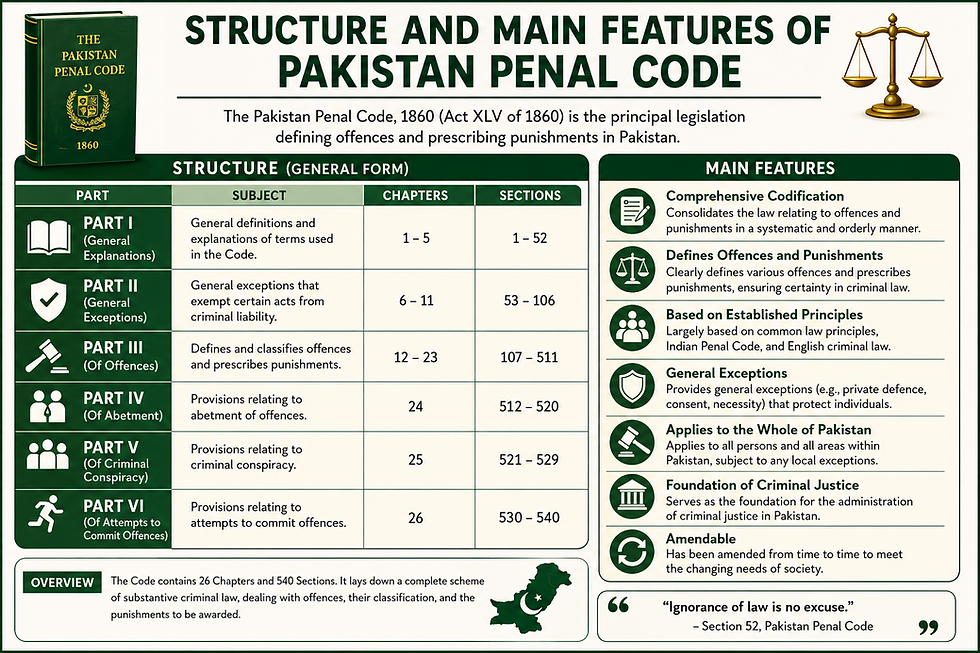
The Pakistan Penal Code (PPC) is one of the most important criminal laws in Pakistan. It provides a complete framework for defining crimes and prescribing punishments for offenders. The PPC serves as the backbone of the criminal justice system and helps maintain law and order in society. It outlines various offenses against individuals, property, public order, and the state. Without the Pakistan Penal Code, the administration of justice in criminal matters would become difficult and disorganized.
The Pakistan Penal Code was originally drafted during the British colonial period and was enforced in the subcontinent in 1860. After the creation of Pakistan in 1947, the code continued to operate with several amendments according to the needs of Pakistani society and Islamic principles. Over time, many changes have been introduced to improve the effectiveness of criminal law and to ensure justice for the people.
The PPC not only defines criminal acts but also explains legal concepts such as intention, negligence, abetment, conspiracy, and punishment. It provides legal certainty and guides judges, lawyers, police officers, and citizens regarding criminal liability and legal consequences.
This blog explains the structure and major features of the Pakistan Penal Code in a professional and detailed manner.
Historical Background of Pakistan Penal Code
The Pakistan Penal Code has its roots in the Indian Penal Code drafted by Lord Macaulay in 1837. The code was officially enacted in 1860 during British rule in the Indian subcontinent. After independence, Pakistan adopted the same legal code with certain modifications.
Several amendments were later introduced to align the law with Islamic teachings and modern social requirements. Important changes were made during the Islamization process in the 1980s, including laws relating to Hudood offenses and Qisas and Diyat.
The PPC remains one of the oldest and most comprehensive criminal statutes in Pakistan and continues to play a significant role in maintaining peace and justice.
Meaning and Purpose of Pakistan Penal Code
The Pakistan Penal Code is a comprehensive criminal law statute that defines offenses and prescribes punishments for criminal acts committed within Pakistan.
Main Purposes of PPC
To maintain law and public order
To protect life, property, and honor of citizens
To prevent criminal activities
To punish offenders according to law
To ensure justice and fairness
To create fear of legal consequences among criminals
To establish uniformity in criminal law throughout Pakistan
The PPC ensures that no individual is punished arbitrarily and that all criminal proceedings are conducted according to established legal principles.
Structure of Pakistan Penal Code
The Pakistan Penal Code is systematically arranged into chapters and sections. It contains detailed provisions regarding different kinds of crimes and punishments.
Total Chapters and Sections
The PPC consists of:
23 chapters
More than 500 sections
Each chapter deals with a specific category of offenses. This organized structure helps legal professionals and courts understand and apply the law effectively.
Important Chapters of Pakistan Penal Code
Chapter I – Introduction
This chapter contains the title and extent of the code. It explains that the law applies throughout Pakistan.
Chapter II – General Explanations
This chapter defines important legal terms used throughout the PPC.
Some important terms include:
Person
Public servant
Fraudulently
Dishonestly
Injury
Movable property
These definitions help avoid confusion and ensure consistency in interpretation.
Chapter III – Punishments
This chapter explains various punishments that may be imposed on offenders.
Kinds of Punishments under PPC
Death penalty
Imprisonment for life
Rigorous imprisonment
Simple imprisonment
Fine
Forfeiture of property
The court determines punishment according to the nature and seriousness of the offense.
Chapter IV – General Exceptions
This chapter provides situations where a person may not be held criminally liable.
Examples of General Exceptions
Unsoundness of mind
Infancy
Accident
Necessity
Self-defense
Consent
These exceptions are essential because they protect innocent individuals from unjust punishment.
Chapter V – Abetment
Abetment means encouraging, aiding, or instigating another person to commit a crime.
Forms of Abetment
Instigation
Conspiracy
Intentional aid
A person who assists in the commission of a crime can also be punished under PPC.
Chapter VA – Criminal Conspiracy
Criminal conspiracy occurs when two or more persons agree to commit an illegal act.
Essential Elements
Agreement between two or more persons
Intention to commit an unlawful act
Participation in the conspiracy
This provision helps authorities prevent crimes before they are actually committed.
Chapter VI – Offenses Against the State
This chapter protects the sovereignty and integrity of Pakistan.
Examples of Offenses
Waging war against Pakistan
Sedition
Terrorist activities
Assisting enemies of the state
These offenses carry severe punishments because they threaten national security.
Chapter VIII – Offenses Against Public Tranquility
Public tranquility means peace and order in society.
Examples
Rioting
Unlawful assembly
Affray
These provisions aim to maintain social peace and prevent violence.
Chapter IX – Offenses by Public Servants
Public officials are expected to perform duties honestly and fairly.
Examples of Offenses
Corruption
Abuse of authority
Disobedience of law
This chapter ensures accountability of government officials.
Chapter X – Contempt of Lawful Authority
This chapter deals with acts that obstruct public servants in performing lawful duties.
Examples
Refusing lawful orders
Escaping from custody
Obstructing police officers
Such acts weaken the authority of law enforcement agencies.
Chapter XI – False Evidence and Public Justice
This chapter aims to protect the judicial process.
Examples
Giving false evidence
Fabricating evidence
False claims in court
Punishment for these offenses preserves the integrity of courts and legal proceedings.
Chapter XII – Offenses Relating to Coins and Government Stamps
This chapter prevents forgery and counterfeiting.
Examples
Counterfeit currency
Fake government stamps
Forged seals
Such offenses harm the economy and public trust.
Chapter XVI – Offenses Affecting Human Body
This is one of the most important chapters in PPC.
Examples of Offenses
Murder
Hurt
Assault
Kidnapping
Wrongful confinement
The chapter protects human life and physical safety.
Qisas and Diyat Laws
Pakistan introduced Islamic criminal principles through Qisas and Diyat laws.
Qisas
Qisas means equal retaliation. For example, punishment similar to the injury caused.
Diyat
Diyat refers to financial compensation paid to the victim or heirs.
Importance of Qisas and Diyat
Promotes reconciliation
Provides compensation to victims
Reflects Islamic teachings
Encourages settlement in certain cases
These laws significantly changed criminal jurisprudence in Pakistan.
Chapter XVII – Offenses Against Property
This chapter protects ownership and property rights.
Examples
Theft
Robbery
Dacoity
Criminal breach of trust
Cheating
Mischief
Property offenses are common crimes that affect individuals and businesses.
Chapter XVIII – Offenses Relating to Documents and Property Marks
This chapter deals with forgery and falsification.
Examples
Forged documents
Fake signatures
Counterfeit trademarks
Forgery can cause serious financial and legal damage.
Chapter XX – Offenses Relating to Marriage
This chapter protects family structure and marriage relationships.
Examples
Bigamy
Fraudulent marriage
Adultery-related provisions
Family stability is considered essential for social order.
Chapter XXI – Defamation
Defamation means harming someone’s reputation through false statements.
Forms of Defamation
Written statements
Spoken words
Published content
The law protects individual dignity and social reputation.
Main Features of Pakistan Penal Code
The Pakistan Penal Code possesses several important features that make it an effective criminal law system.
Comprehensive Nature
The PPC covers almost every major criminal offense.
It Includes
Crimes against individuals
Crimes against property
Crimes against the state
Economic offenses
Public order offenses
Its comprehensive structure makes it a complete criminal law framework.
Codified Criminal Law
The PPC is a codified law, meaning all criminal rules are written in a systematic form.
Advantages of Codification
Easy understanding
Uniform application
Legal certainty
Reduced confusion
Codification promotes consistency in judicial decisions.
Uniform Application
The PPC applies equally to all citizens regardless of status, religion, or profession.
Importance
Promotes equality before law
Prevents discrimination
Strengthens rule of law
No person is above the law under the PPC framework.
Defined Punishments
Every offense under PPC has a specified punishment.
Benefits
Prevents arbitrary punishment
Guides courts in sentencing
Creates fear among criminals
Defined punishments ensure fairness and predictability.
Recognition of Criminal Intention
The PPC gives great importance to criminal intention, also known as mens rea.
Examples
Intention
Knowledge
Negligence
Recklessness
A person is generally punished only when criminal intent is proven.
Protection of Human Rights
The PPC recognizes various protections for accused persons.
Examples
Right of private defense
Protection against false accusations
General exceptions
Fair trial principles
These protections help maintain justice and prevent misuse of law.
Islamic Principles
The PPC includes several Islamic concepts after legal reforms.
Examples
Qisas
Diyat
Forgiveness by heirs
Compensation mechanisms
This feature reflects Pakistan’s constitutional and religious identity.
Deterrent Function
One major purpose of the PPC is deterrence.
How PPC Creates Deterrence
Strict punishments
Fear of imprisonment
Financial penalties
Social consequences
Deterrence discourages criminal behavior in society.
Flexibility Through Amendments
The PPC has been amended several times to address modern challenges.
Recent Areas of Reform
Cybercrime-related provisions
Anti-terrorism measures
Women protection laws
Child protection laws
Flexibility helps the law remain relevant in changing social conditions.
Importance of Pakistan Penal Code
The Pakistan Penal Code is extremely important for the administration of justice.
Importance in Society
Maintains peace and order
Protects citizens from harm
Ensures legal accountability
Prevents criminal activities
Strengthens public confidence in law
Without criminal law, society would face chaos and insecurity.
Role of Courts Under PPC
Courts play a central role in implementing the Pakistan Penal Code.
Functions of Courts
Interpreting legal provisions
Conducting criminal trials
Awarding punishments
Protecting rights of accused and victims
Judicial interpretation helps clarify ambiguous legal provisions.
Role of Police Under PPC
Police officers investigate crimes and enforce the provisions of PPC.
Responsibilities of Police
Registration of FIRs
Collection of evidence
Arrest of accused persons
Assistance during trials
Effective policing is necessary for proper implementation of criminal law.
Challenges in Implementation of PPC
Although the PPC is comprehensive, certain challenges affect its effectiveness.
Major Challenges
Delay in criminal trials
Corruption
Weak investigation system
Lack of legal awareness
Misuse of criminal provisions
Legal reforms and institutional improvements are necessary to overcome these issues.
Modern Reforms in Pakistan Penal Code
The government has introduced several reforms to modernize criminal law.
Examples of Reforms
Laws against cyber harassment
Protection of women and children
Anti-terrorism amendments
Digital evidence recognition
Modern reforms aim to address contemporary crimes effectively.
Difference Between PPC and Criminal Procedure Code
The Pakistan Penal Code and Criminal Procedure Code are different laws.
Pakistan Penal Code (PPC)
Defines crimes
Specifies punishments
Criminal Procedure Code (CrPC)
Explains criminal trial procedure
Regulates investigation and court process
Both laws work together in the criminal justice system.
Conclusion
The Pakistan Penal Code is the foundation of criminal law in Pakistan. It provides a complete legal framework for identifying crimes, protecting citizens, maintaining public order, and punishing offenders. Its organized structure, comprehensive coverage, and detailed provisions make it one of the most important legal statutes in the country.
The PPC contains various chapters dealing with offenses against the state, property, human body, public tranquility, and administration of justice. It also includes essential legal principles such as criminal intention, abetment, conspiracy, and general exceptions. The incorporation of Islamic principles like Qisas and Diyat further reflects the constitutional values of Pakistan.
Despite certain implementation challenges, the Pakistan Penal Code continues to serve as a vital instrument for maintaining peace, justice, and legal discipline in society. Continuous reforms and proper enforcement can further strengthen its effectiveness and ensure protection of the rights and security of all citizens.


