

Setting Up a Study Space at Home in a Busy Household

In many Faisalabad homes, a student does not have a room of their own. You might share a bedroom with siblings, read in the same room where the television runs every evening, or live in a joint family where cousins, guests and elders move through the house all day. When there is no spare table and no quiet hour, setting up a study space for law students at home can feel impossible.
The short answer is that you do not need a separate room. You need a fixed spot, a small kit you can set up in two minutes, and a few clear agreements with your family. A good study space for law students at home is less about furniture and more about routine: the same place, the same time and fewer interruptions, which matters a lot once LL.B reading lists get long.
How to choose a study corner when every room is shared
Walk through your house at the times you actually study, not when it looks quiet. A corner that is peaceful at 11 a.m. may be the busiest place in the house at 7 p.m. when everyone comes home.
A good corner usually has most of these:
Away from the main door and the TV, so guests and family traffic do not pass behind you.
A wall behind or beside you, which cuts visual distraction and gives you a place for a small shelf.
A plug point nearby, for a lamp, a charger or a rechargeable light.
Some air flow, close to a fan or a window that can be opened in summer.
A surface that stays yours, even if it is only half of a table.
Common choices in Pakistani homes include one end of the dining table, a corner of a shared bedroom, the landing near the roof stairs, or part of the drawing room that is used only when guests arrive. Any of these works if the family knows it is your spot during certain hours.
If there is truly no corner
Some students live in two or three rooms with six or more people. If that is your situation, you are not at a disadvantage for good; you simply need a portable space. Keep everything in one box or bag: the book you are reading, a notebook, pens, a clip file and a small light.
When you sit down, open the box; when you finish, everything goes back in. Opening the same box in the same place still tells your mind it is time to study, even if the place is the floor of a shared room with a cushion against the wall.
A low-cost desk and lighting setup
You do not need to buy a study table to begin. A folding table, a lap desk, or a wooden board placed across a low cabinet can work. What matters more is posture: your book should be at a height where you are not bending your neck for hours, and your chair or cushion should let you sit with your back supported.
Lighting is where most students should spend their small budget. Reading statutes and case extracts means long hours of small print, and a dim tube light on the far side of the room makes that harder. A simple LED desk lamp placed to one side, opposite your writing hand so your hand does not cast a shadow, helps a lot.
The American Academy of Ophthalmology notes that eyes can strain when a screen is brighter than its surroundings, so if you read on a laptop or phone, keep the room light on as well. It also recommends the easy 20-20-20 habit: every 20 minutes, look at something about 20 feet away for 20 seconds.
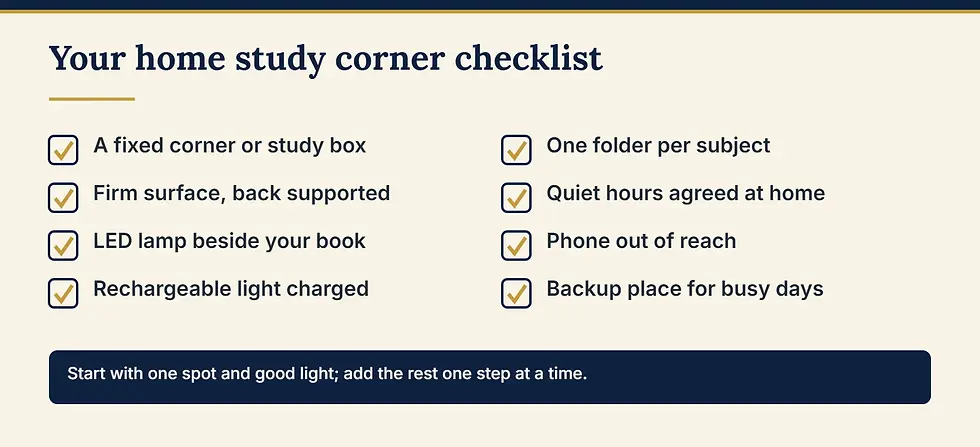
A useful starter kit:
A firm surface at a comfortable height, such as a folding table, lap desk or board
A chair, or a firm cushion with your back against a wall
An LED desk lamp, plus a rechargeable light for load-shedding
A small shelf, rack or box for books
A clip file or document folder for each subject
A water bottle and a small hand fan for summer
Buy one item at a time; if money is tight, the lamp and rechargeable light come first.
Managing noise, guests and shared rooms
Noise in a busy household is not going to disappear, so plan around it. Simple foam earplugs can dull background sound, and the steady hum of a fan is far easier to study with than conversation or a television.
Guests are a normal part of life in Faisalabad, and hiding in your room the whole time can seem rude. A realistic approach is to greet guests, sit with them for a short while, and then excuse yourself politely: "I have a test tomorrow, I will join you again at dinner." Most elders respect this when it is said kindly.
On days when you know relatives are coming, move your heavier reading earlier. Keep lighter tasks, such as revising notes or listing new legal terms, for the busy evening hours.
If you share a bedroom, agree with your sibling or cousin on simple things: which side is yours, when the main light can be on, and where phone calls happen. A small reading lamp lets you study while someone else sleeps.
Load-shedding and heat: planning around fans and light
Power cuts and summer heat affect study in Punjab more than most guides admit. A room that is fine in the morning can be too hot to think in by afternoon, especially on an upper floor.
A few practical habits help:
Study hardest in the coolest hours. Early morning is often the coolest and quietest time in a busy house. Late evening can work too once the house settles.
Keep a rechargeable light charged. Charge it whenever the power is on, so a cut does not end your session.
Watch for planned shutdowns. FESCO, the electricity company for the Faisalabad region, announces planned maintenance shutdowns for particular feeders through local news. If you know your area's power will be off, save reading that does not need a laptop for that time.
Move with the season. In summer the ground floor or the shadiest room may be better; in winter a sunny corner may be best. Your study spot does not have to stay the same all year.
Keep water near you. Take short breaks in extreme heat, and if you feel dizzy or unwell, stop and cool down before you continue.
Keep printed or handwritten copies of what you need for the next day, so a dead battery does not stop you.
Keeping law books, notes and files organized
Law students collect paper quickly: course books, case extracts, bare acts, handouts and past papers. In a shared house, loose papers get moved or thrown away by mistake.
Give every subject one home. A clip file, plastic document folder or labeled envelope for each course is cheap and works well. Write the subject name and your own name on the outside. Keep one more folder for college paperwork such as fee receipts, admission documents and notices, and never mix it with study notes.
Some other habits that help:
Keep books standing upright on a shelf or in a box rather than in a pile on the floor.
Write the date on every handout and note when you receive it.
Keep one small notebook for new terms and section numbers, so they are always in one place.
Avoid lending your only copy of notes in the weeks before an exam.
If you are still working out how to turn class notes into revision material, our guide to a note-taking method for law students covers that step in detail.
Agreeing quiet hours with your family
The most useful thing in a busy household is not furniture; it is an agreement. Many families want to help but do not know what help looks like. Sit with your parents or the elders in the house and ask for something specific: two hours each evening, or a fixed morning slot, when you are not sent on errands and the TV near your corner stays low.
Make it fair. Offer to help with chores outside your quiet hours, and keep your side of the deal by actually studying. Families protect your time more willingly when they see it being used well. Before exams, ask for a little extra and explain why.
If your bigger challenge is fitting study around a job, children or caring for an elder, our guide to studying LL.B while working or managing family responsibilities covers that kind of scheduling in more depth.
Backup places when home is too busy
Some days home will not work: a family wedding, guests staying overnight, or construction next door. Have a backup ready before you need it.
Your college library. It gives you a quieter space and access to books you may not own. Read the college library page, then ask the library staff or the admissions office directly: "Can LL.B students use the library after classes, and do the hours change during exams and holidays?"
A public or community library. Some neighborhoods have a reading room or community library. Check its rules, especially whether you can bring your own books, before you rely on it.
A mosque library or quiet room. Some mosques keep a small library or a space where students may read quietly at certain times. Ask the management first, and respect prayer times and their rules.
Where your phone goes, and a weekly reset
Keep your phone out of arm's reach while you read and check it only in your breaks. Once a week, also give your corner ten or fifteen minutes. A weekly reset could look like this:
Clear the surface and return everything to its place.
File loose papers into the right subject folder.
Charge the rechargeable light and check the lamp.
Look at the coming week: tests, assignments and family events.
Mark the days when home will be busy and decide on your backup place.
This habit stops clutter building up and helps you start each week calmly, however small your corner is.
Frequently asked questions
Can I study well without a desk or a separate room?
Yes. Many students study on a lap desk, a folding table or the floor with a cushion against the wall. What matters most is using the same spot at the same time, having good light, and keeping all your study items in one box or bag so you can set up in a few minutes and pack away when the room is needed.
What should I do when load-shedding happens during study time?
Keep a rechargeable light charged whenever the power is on, and keep printed or handwritten copies of what you need so a dead battery does not stop you. Move heavy reading to the cooler early morning or late evening hours, follow local news for planned FESCO shutdowns, and keep water nearby in hot weather.
How do I ask my family for quiet hours without upsetting anyone?
Ask for something specific and small, such as two hours each evening or a fixed morning slot. Offer to help with chores outside those hours, greet guests before excusing yourself politely, and use the protected time for actual study. Families usually protect a student's time more willingly when they see it being used well.
Start with what you have this week: choose one spot, gather your study items into a single box, and ask your family for one fixed quiet slot each day. Add a lamp and a rechargeable light when you can. Small, steady changes to your space make long hours with law books much easier.
About this guide: The eye-strain points were checked in October 2026 against published advice from the American Academy of Ophthalmology, and the note on planned power shutdowns against news reports of FESCO shutdown announcements. Library hours and access rules at Pasban Law College or any community library could not be confirmed, so ask the library staff or the admissions office directly.


