
The Evolution of Justice in Early Human Civilizations

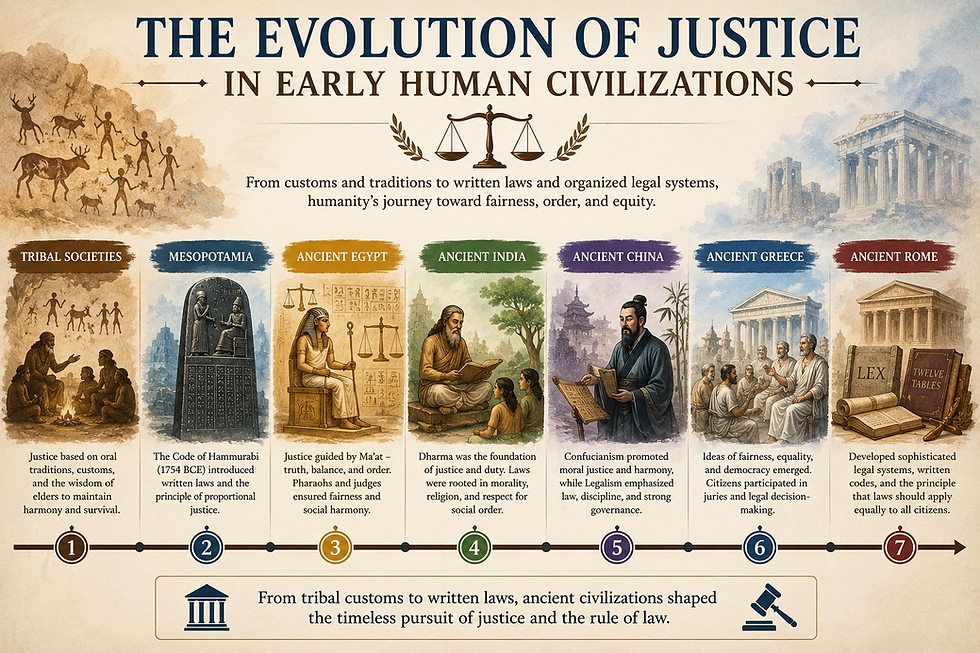
Justice has always been a fundamental part of human society. From the earliest tribal communities to the rise of powerful ancient civilizations, people developed systems of justice to maintain peace, resolve disputes, and protect social order. The origins of justice in ancient societies reveal how humanity gradually moved from simple customs and traditions toward organized legal systems and codified laws. Ancient concepts of justice were deeply influenced by religion, morality, culture, and political authority. These early systems laid the foundation for modern law, governance, and human rights. Understanding the development of justice in ancient civilizations helps explain how societies established fairness, accountability, and order long before the emergence of modern courts and constitutions.
In prehistoric societies, justice was not based on written laws or formal institutions. Early humans lived in small tribal groups where survival depended on cooperation and collective responsibility. Rules of behavior were passed orally from generation to generation and became part of the tribe’s customs and traditions. Elders, clan leaders, or respected members of the community acted as decision-makers and resolved conflicts according to shared values and social expectations. These early forms of justice focused on maintaining harmony within the group rather than protecting individual rights. Punishments were often strict because any disruption could threaten the survival of the entire community.
Justice in tribal societies was closely linked to morality and spirituality. People believed that supernatural powers or ancestral spirits punished wrongdoing and rewarded good behavior. Religious rituals and sacred traditions reinforced obedience to social rules. In many tribes, crimes committed by one individual could bring shame or punishment upon the entire family or clan. This idea of collective responsibility encouraged unity and discouraged harmful actions. Although primitive, these early justice systems introduced important principles such as accountability, social order, and the resolution of disputes through community authority.
Justice and Social Order in Ancient Mesopotamia
Ancient Mesopotamia is often regarded as the birthplace of organized legal systems. Located between the Tigris and Euphrates Rivers, Mesopotamia was home to some of the world’s earliest civilizations, including the Sumerians, Akkadians, Babylonians, and Assyrians. As cities expanded and societies became more complex, traditional tribal customs were no longer sufficient to maintain order. This created the need for written laws and formal systems of justice.
The most famous legal achievement of ancient Mesopotamia was the Code of Hammurabi, established by King Hammurabi of Babylon around 1754 BCE. This legal code consisted of nearly 282 laws carved onto stone tablets and displayed publicly. The laws covered areas such as trade, marriage, inheritance, property rights, labor, and criminal punishment. Hammurabi claimed that the gods had chosen him to deliver justice and protect the weak from oppression.
One of the key principles of the Code of Hammurabi was proportional punishment, often described through the phrase “an eye for an eye.” The punishment for a crime was meant to match the severity of the offense. Although modern societies may view some punishments as harsh, the code represented an important step toward fairness and consistency in legal judgment. It also demonstrated the idea that justice should be based on publicly known rules rather than personal revenge or arbitrary decisions.
Mesopotamian justice systems reflected social hierarchy. Different punishments applied to nobles, commoners, and slaves. Nevertheless, the existence of written laws helped establish order and strengthened the authority of the state. The legal traditions of Mesopotamia influenced future civilizations and marked the beginning of codified justice.
The Concept of Justice in Ancient Egypt
Ancient Egypt developed a highly organized society with a sophisticated understanding of justice and governance. Egyptian justice was based on the concept of “Ma’at,” which symbolized truth, balance, harmony, and order. Ma’at represented both a moral principle and a divine force that maintained stability in the universe. Pharaohs were believed to be chosen by the gods to preserve Ma’at and ensure justice throughout the kingdom.
Judges and officials in ancient Egypt were responsible for resolving disputes fairly and honestly. Courts handled cases involving property, theft, contracts, inheritance, and family matters. Egyptian legal procedures often relied on witness testimony, written evidence, and oaths. Unlike many tribal societies, Egypt developed a centralized legal system under the authority of the Pharaoh.
Religion played a central role in Egyptian justice. People believed that their actions would be judged in the afterlife by the gods. This belief encouraged honesty and moral behavior in daily life. The famous “Weighing of the Heart” ceremony symbolized the importance of truth and justice in Egyptian culture. A person’s heart was weighed against the feather of Ma’at to determine whether they had lived a righteous life.
Egyptian justice emphasized social harmony and fairness rather than harsh punishment alone. Although social status influenced legal outcomes, Egyptian society valued honesty, order, and administrative efficiency. The Egyptian model of justice influenced neighboring civilizations and contributed to the broader development of legal administration.
Justice and Morality in Ancient India
Ancient India developed a unique concept of justice based on religion, morality, and social duty. Indian legal traditions were deeply connected to the idea of “Dharma,” which referred to righteousness, moral conduct, and the responsibilities individuals owed to society. Dharma governed personal behavior, family relations, social obligations, and political authority.
The principles of justice in ancient India were outlined in religious texts and legal writings such as the Vedas, the Upanishads, and the Manusmriti. These texts established rules concerning marriage, inheritance, property, trade, and punishment. Justice was not viewed solely as a legal matter but also as a spiritual obligation connected to maintaining cosmic order.
Indian society was strongly influenced by the caste system, which affected legal rights and punishments. Different social classes had different duties and legal responsibilities. Although this system created inequality, Indian legal philosophy also emphasized compassion, ethical behavior, and peaceful conflict resolution.
Buddhism further influenced Indian ideas of justice by promoting nonviolence, mercy, and equality. Buddhist rulers encouraged fairness and tolerance within society. Emperor Ashoka, one of India’s most famous rulers, introduced policies based on moral governance, religious tolerance, and compassion for all people. His inscriptions emphasized justice, kindness, and the welfare of citizens.
The integration of morality, spirituality, and governance made ancient Indian justice systems distinct and influential throughout South Asia.
Chinese Philosophies of Justice and Law
Ancient China developed complex ideas about justice that were shaped by philosophy, politics, and social values. Two major schools of thought Confucianism and Legalism greatly influenced Chinese legal traditions.
Confucianism emphasized morality, ethical conduct, family loyalty, and respect for authority. According to Confucius, a just society depended on virtuous rulers and morally responsible citizens. Confucian thinkers believed that laws alone could not create harmony. Instead, education, moral behavior, and proper relationships were considered essential for maintaining order.
Legalism offered a different perspective on justice. Legalist philosophers argued that human beings were naturally selfish and required strict laws and severe punishments to prevent disorder. They believed that strong government control and clearly defined rules were necessary for stability. During the Qin Dynasty, Legalism became the dominant political philosophy, leading to centralized authority and codified laws.
Chinese rulers eventually combined Confucian ethics with Legalist administration. This combination created a system that emphasized both moral responsibility and legal enforcement. Courts and officials were responsible for maintaining social order and ensuring loyalty to the state.
Justice in ancient China focused heavily on preserving harmony, protecting authority, and maintaining collective stability. Chinese legal traditions influenced East Asian societies for centuries and contributed significantly to the development of bureaucratic governance and legal administration.
Greek Ideas of Justice and Democracy
Ancient Greece made important contributions to the development of legal and political thought. Greek city-states such as Athens experimented with democracy, citizen participation, and constitutional governance. Greek philosophers explored the meaning of justice, equality, and the rule of law in ways that continue to influence modern legal systems.
In early Greece, justice was often controlled by aristocratic families and local rulers. Laws could be harsh and unfair, especially toward lower social classes. However, reforms introduced by lawmakers such as Draco and Solon helped create more balanced legal systems. Draco established written laws to reduce arbitrary judgments, although his punishments were extremely severe. Solon later introduced reforms that reduced social inequality, canceled debts, and expanded political participation.
Athenian democracy allowed citizens to participate directly in legal and political decision-making. Large juries heard court cases, and ordinary citizens could vote on important legal matters. This system promoted civic involvement and encouraged the idea that justice should reflect the interests of the community rather than the desires of rulers alone.
Greek philosophers also shaped legal thought. Plato discussed justice as a form of social harmony, while Aristotle argued that laws should promote fairness and serve the common good. Aristotle emphasized the importance of constitutional government and equality before the law. These philosophical ideas became foundational principles in Western political and legal traditions.
Roman Justice and the Development of Legal Institutions
The Roman legal system remains one of the most influential achievements in the history of justice. Rome transformed legal practices into a highly organized and sophisticated system that influenced legal traditions across Europe and beyond.
One of the earliest Roman legal codes was the Twelve Tables, created around 450 BCE. These laws were publicly displayed to ensure transparency and prevent abuse by powerful elites. The Twelve Tables addressed issues such as property rights, contracts, family law, and criminal punishment.
As the Roman Republic expanded into a vast empire, Roman law evolved to govern diverse populations and complex economic relationships. Roman jurists developed advanced legal concepts involving citizenship, contracts, inheritance, and legal procedures. Courts became more professional, and judges relied on legal reasoning rather than personal opinion alone.
Roman justice emphasized the principle that laws should apply consistently and fairly to citizens. Legal procedures became more structured, and individuals gained certain rights within the legal process. The Romans also introduced the idea that people were innocent until proven guilty, a principle still central to modern legal systems.
Emperor Justinian later compiled Roman legal principles into the Corpus Juris Civilis, also known as the Justinian Code. This comprehensive collection preserved Roman legal knowledge and greatly influenced European civil law traditions. Roman concepts of justice, equality before the law, and legal professionalism continue to shape modern legal systems worldwide.
Religious Justice in Medieval Societies
During the medieval period, religion became a dominant influence on systems of justice. In Europe, the Catholic Church developed Canon Law, which governed religious behavior, marriage, morality, and church administration. Church courts handled disputes involving clergy and religious matters, often exercising significant authority over society.
At the same time, feudalism created local systems of justice controlled by kings, nobles, and landowners. Laws varied across regions, and punishments were often influenced by social status and political power. Despite these challenges, important legal developments occurred during this period.
One of the most significant milestones was the Magna Carta, signed in England in 1215. This document limited the authority of the king and established the principle that even rulers were subject to the law. The Magna Carta became a symbol of constitutional government and individual rights, influencing democratic systems worldwide.
In the Islamic world, justice was based on Sharia law, derived from the Quran and the teachings of Prophet Muhammad. Islamic legal systems emphasized fairness, charity, equality, and moral conduct. Judges known as Qadis resolved disputes according to religious principles and legal scholarship. Islamic civilization made important contributions to legal philosophy, commerce, and judicial administration.
The Lasting Legacy of Ancient Justice Systems
The justice systems of ancient societies continue to influence modern law and governance. Concepts such as written laws, legal equality, judicial procedures, and constitutional limits on power can all be traced back to ancient civilizations. Although early legal systems often reflected social inequalities and harsh punishments, they introduced important principles that shaped the evolution of justice.
Ancient societies recognized the need for rules, accountability, and organized authority to maintain stability and cooperation. Over time, justice evolved from tribal customs and religious traditions into sophisticated legal institutions designed to protect rights and resolve conflicts fairly.
Modern legal systems still reflect many ideas developed in ancient civilizations. The rule of law, democratic participation, constitutional government, and human rights all have historical roots in the legal traditions of Mesopotamia, Egypt, India, China, Greece, Rome, and medieval societies.
Conclusion
The origins of justice in ancient societies reveal humanity’s long journey toward fairness, order, and organized governance. Early tribal communities established customs and traditions to maintain harmony and resolve disputes, while ancient civilizations transformed these customs into written laws and formal legal institutions. Mesopotamia introduced codified law, Egypt emphasized balance and truth, India connected justice with morality and duty, China combined ethics with legal authority, Greece promoted democracy and civic participation, and Rome developed highly organized legal systems that continue to influence modern law.
These ancient systems of justice laid the foundation for modern legal principles and demonstrated the importance of accountability, equality, and social stability. Although justice has evolved significantly over time, the core human desire for fairness and order remains unchanged. The study of ancient justice systems not only provides insight into early civilizations but also highlights the enduring role of law in shaping human society and protecting the rights of individuals across generations.


