
How to Use Past Papers to Practice for LL.B Semester Exams

Use past papers as a feedback tool: check relevance, practice, review errors, and repeat.
Past papers are useful when they are treated as practice material, not as a prediction of the next examination. A paper can show how a topic has been framed, how much a student may need to write under time pressure, and which skills a question demands. It cannot prove that the same topic, wording, or mark distribution will appear again.
This distinction matters especially during Pakistan's transition to the four-year LL.B semester structure. The University of the Punjab currently publishes an LL.B past-papers page containing material for older three-year and five-year programs, while the university also publishes separate course-outline and examination information for the current four-year program. Students should therefore match any past question to their current syllabus before using it as exam practice.
The strongest method is: verify relevance, attempt the question under realistic conditions, mark the weaknesses in your answer, return to the law and course material, then attempt a similar question again. That turns a past paper into a feedback tool instead of a guessing game.
That is the difference between practicing questions and merely collecting them.
It also keeps revision aligned with the current course instead of letting an old examination paper quietly become the student's unofficial syllabus.
Check the paper against the current syllabus first
Write the course name, semester, and current topics beside the paper you plan to use. Then compare each question with the syllabus or teacher's current course guidance. Mark questions as direct match, partial overlap, or outside the present course.
Do not assume that an older paper belongs to the same degree structure because the subject name looks familiar. A five-year or annual-system paper may test material in a different year, combine topics differently, or use an assessment style that is not the current semester format. Use it only for the parts that genuinely overlap.
Separate topic relevance from question usefulness
A past question can be useful even when it will never be repeated. Ask what skill it tests. Does it require explanation of a rule, comparison of authorities, application to facts, statutory interpretation, case analysis, or a structured essay? Those skills can remain valuable across different papers.
This is why past-paper practice should be organized by task type as well as topic. Two questions on different subjects may expose the same weakness: poor issue spotting, weak structure, slow writing, unsupported conclusions, or failure to use authority.
Start with an open-book diagnostic
Choose one relevant question and answer it without a strict time limit but with your notes, statute, and key cases available. The goal is diagnosis. Can you identify what the question asks? Can you build a logical structure? Can you find the governing authority? Can you distinguish rule from application or evaluation?
When you finish, compare the answer with the syllabus, lecture notes, prescribed materials, and any teacher feedback available. Make an error list before you make a mark estimate. A detailed error list is more useful than telling yourself the answer was 'good' or 'bad.'
Then repeat the skill under time pressure
After you understand the task, attempt another relevant question under a realistic time limit. Use the timing guidance given by your teacher or implied by the actual exam format rather than copying timing from an old paper with a different structure.
Do not stop when the timer ends and simply move on. Review what the time pressure changed. Did the introduction become too long? Did you omit authority? Did you spend half the time on one issue? Did your handwriting or organization deteriorate? These are exam skills that ordinary reading cannot reveal.
Build an error log instead of a score collection
Create four columns: question, error, cause, next practice. Errors might include missing an issue, misremembering a section, confusing two cases, weak application, poor paragraph order, running out of time, or writing too much background.
The 'cause' column is important. If you forgot the rule, the fix is revision. If you knew the rule but could not apply it, the fix is problem-question practice. If the answer was accurate but unfinished, the fix may be planning and timing. Different problems need different study responses.
Use a traffic-light system for old papers
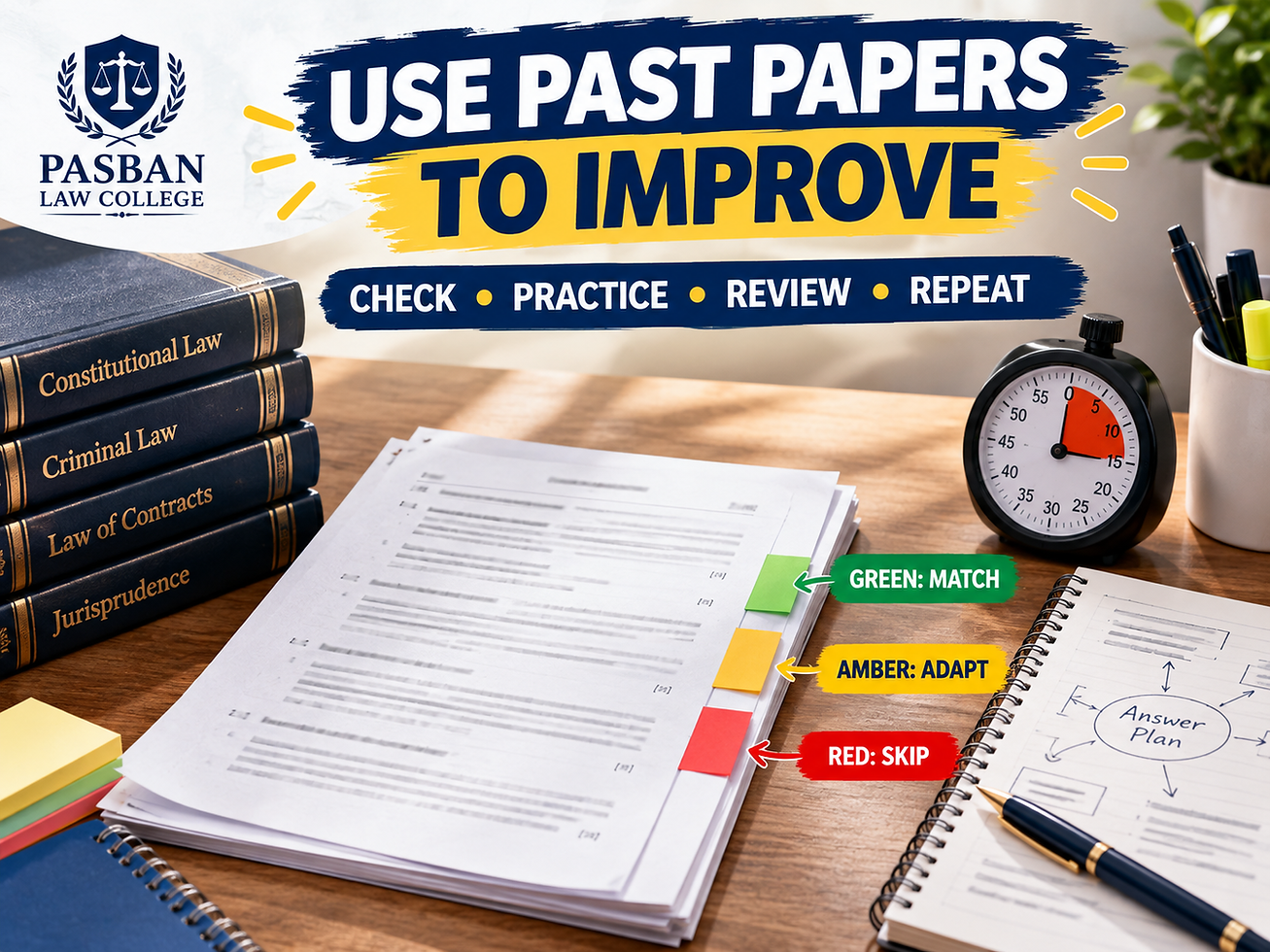
When older papers are all you have, classify them. Green questions match the current syllabus and can be used for full practice. Amber questions overlap partly and should be edited before use: answer only the relevant portion or rewrite the problem to match the current course. Red questions belong to material no longer covered, a different program structure, or an assessment format that does not serve your current exam.
This prevents older papers from quietly becoming an unofficial syllabus. The current course outline and teacher instructions remain the boundary.
Traffic-light test for a past-paper question
Color | Use it when... | How to practice |
Green | Topic and skill clearly match the current course | Attempt fully; later repeat under time |
Amber | Topic overlaps but wording, program, or depth differs | Edit the question or practice only the relevant part |
Red | Topic is outside the current syllabus or tied to an obsolete structure | Do not treat it as exam preparation |
Practice planning before full answers
Not every past question needs a complete essay. Take five questions and give yourself five to eight minutes per question to produce only an answer plan: issues, governing authority, section sequence, and one sentence for the conclusion. Planning drills improve speed and expose whether you can recognize the legal task quickly.
A strong plan also reduces exam panic because you have practiced deciding the order of the answer before writing. When a question is unfamiliar, the same planning habit helps you identify what you do know and where the legal issue sits.
Use past papers to test retrieval, not just recognition
Reading a question and thinking 'I know this topic' is recognition. Closing the notes and writing the rule, authorities, and structure from memory is retrieval. Exams require retrieval, so practice should include it.
After an open-book attempt, revisit the same topic two or three days later without notes. Write a short rule statement, key authority list, and answer skeleton. Then check against the source. This spaced return shows what actually stayed in memory.
Do not memorize model answers
A model or high-scoring answer can help you see structure, depth, and use of authority, but memorizing it creates a fragile preparation strategy. A small change in facts or wording can make a memorized paragraph irrelevant.
Instead, annotate the model: What issue did it identify? How did it use law? Where did it apply facts? How long was each section relative to marks? What did it leave out? Transfer the method, not the wording.
Integrate past papers into the weekly reading plan
Past-paper work is most effective when it starts before the last week. Once a topic has been taught and reviewed, add a short practice task: one issue-spotting exercise, one plan, or one timed paragraph. Later in the semester, combine topics into full-question practice.
PLC's weekly reading-plan guide explains how to place preparation, review, assignments, and catch-up time around real classes. Add past-paper practice as a defined task, not a vague block called 'revision.' A task such as 'plan two Contract questions and review errors' has a clear finish line.
A four-round past-paper cycle
Use four rounds. Round one: relevance check against the current syllabus. Round two: open-book answer to diagnose knowledge and structure. Round three: timed attempt to test retrieval and exam management. Round four: error review followed by a targeted second attempt.
Do not measure progress by the number of papers completed. Measure whether the same errors are disappearing. Ten rushed papers can repeat ten identical weaknesses; three carefully reviewed attempts can change the way you answer.
The four-round cycle turns each practice answer into a targeted next attempt.
How to review an answer when you have no model
You do not need a perfect model answer to learn from practice. Compare your response with the current syllabus, statute, judgments, lecture notes, and the wording of the question. Ask whether you answered every part, used the right authority, applied the law to the facts where required, and reached a conclusion proportionate to the reasoning.
If possible, take one answer to the teacher or a study session and ask for feedback on one or two specific points rather than 'Is this good?' Questions such as 'Did I identify the correct issue?' or 'Is my application too descriptive?' produce more useful feedback. Record the lesson in the error log and apply it to the next paper.
Use group practice without turning it into answer copying
A small study group can compare issue lists or answer plans after each student has attempted the question independently. Differences are useful: one person may notice an exception, another a procedural point, and another a missing authority. Return to the primary material to resolve the disagreement.
Do not circulate a single memorized 'best answer' and reproduce it. The value of group practice is the discussion about why a structure works, what authority supports it, and what the question actually asks. Each student should then write or revise their own answer.
Finish with current instructions, not historical patterns
Before the examination, return to the current course outline, teacher guidance, date sheet, and any official instructions. Confirm the actual subjects, format, timing, and permitted materials. Historical papers are practice evidence, not the controlling exam notice.
The University of the Punjab's public past-paper archive is useful historical material, but students in the current four-year semester program should be particularly careful about program labels. Use current four-year course and examination information to decide which old questions still deserve practice.
For program-level context, PLC's guide to the four-year LL.B and semester system explains the current degree structure; use the current course material rather than an old paper to decide what belongs in your revision.


