
Wildlife Protection Laws in Pakistan

Updated: Oct 1

Legal Framework, Conservation, Offences, and Enforcement
Wildlife is an essential part of Pakistan’s natural environment and ecological balance. Forests, mountains, wetlands, deserts, rivers, and protected areas provide habitats for a wide variety of birds, mammals, reptiles, and other species. Wildlife also contributes to biodiversity, tourism, agriculture, and the overall health of ecosystems.
However, hunting, illegal wildlife trade, habitat destruction, pollution, deforestation, and unlawful possession of wild animals can place serious pressure on wildlife populations. Protecting wildlife is therefore not simply an environmental responsibility; it is also a legal obligation.
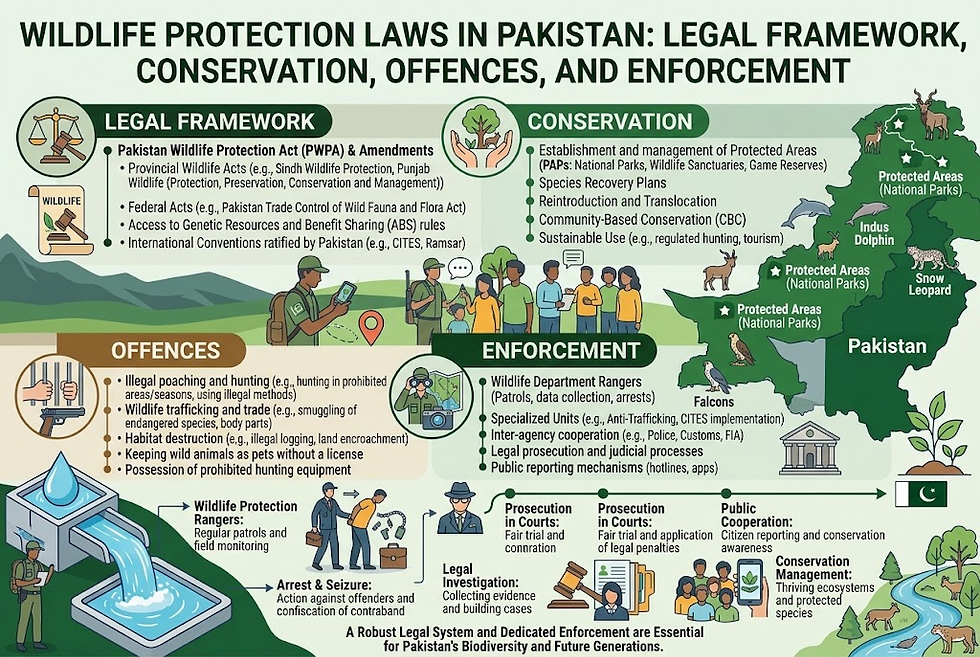
Pakistan has developed a combination of federal and provincial laws to regulate wildlife protection, hunting, trade, conservation, and protected areas. Because wildlife management is significantly influenced by provincial legislation, the precise legal requirements can differ between provinces and territories. Federal legislation also addresses matters such as international trade in wildlife and conservation within federal jurisdictions.
The legal framework aims to prevent unlawful exploitation of wildlife while allowing regulated activities where permitted by law.
Understanding Wildlife Protection Law
Wildlife protection law consists of legal rules designed to conserve wild animals, birds, habitats, and ecosystems. These laws may regulate hunting, possession, transportation, trade, breeding, captivity, and the use of wildlife products.
Wildlife legislation also provides authorities with powers to establish protected areas, issue licenses, conduct inspections, confiscate illegally held animals, and take action against offenders.
The basic objective is to ensure that wildlife resources are used responsibly and remain available for future generations.
Legal Framework for Wildlife Protection in Pakistan
Pakistan's wildlife protection system is not based on a single nationwide statute. Different legal instruments operate at federal, provincial, and territorial levels.
The Pakistan Code lists federal legislation relating to wildlife and environmental protection, including the Wild Birds and Animals Protection Act and the Pakistan Trade Control of Wild Fauna and Flora Act.
Provincial wildlife laws provide more detailed rules concerning hunting, wildlife sanctuaries, national parks, game reserves, licenses, permits, and enforcement within the relevant province.
This decentralized framework makes it important to determine which law applies to a particular location and activity.
Role of Provincial Wildlife Authorities
Provincial wildlife departments and related authorities play an important role in implementing wildlife protection laws.
Their responsibilities can include:
Managing wildlife populations and protected areas.
Issuing hunting and wildlife-related licenses where permitted.
Investigating illegal hunting and wildlife trade.
Conducting inspections and enforcement operations.
Promoting wildlife conservation and public awareness.
These authorities also work to protect habitats and encourage sustainable management of natural resources.
Protected Areas and Wildlife Conservation
Protected areas are an important part of wildlife conservation. National parks, wildlife sanctuaries, game reserves, and other protected areas can provide legal protection to habitats and species.
Restrictions within these areas may control hunting, construction, land use, wildlife capture, and other activities that could disturb natural ecosystems.
Protected-area legislation is therefore important not only for individual animals but also for preserving entire habitats.
Wildlife Hunting and Legal Restrictions
Hunting is one of the most closely regulated wildlife activities.
Wildlife laws may prohibit hunting certain species or restrict hunting to specified locations, seasons, methods, or conditions. Where hunting is legally permitted, a person may need an appropriate license or permit.
Illegal hunting can result in penalties, confiscation of weapons or wildlife, and other legal consequences depending upon the applicable law.
The purpose of regulation is to prevent uncontrolled hunting from threatening wildlife populations.
Hunting Permits and Licenses
A hunting permit or license does not provide unlimited permission to hunt wildlife. It normally operates within the conditions established by the relevant law or regulatory authority.
Restrictions may concern the species, number of animals, location, method, or other conditions.
A person who hunts outside the scope of a valid authorization may still be liable for an offence.
It is therefore important for hunters to understand the specific conditions attached to any license.
Illegal Hunting and Poaching
Poaching refers broadly to the unlawful hunting, killing, capture, or taking of wildlife.
Poaching can have serious ecological consequences, particularly when endangered or vulnerable species are targeted.
Wildlife authorities may conduct patrols, inspections, investigations, and enforcement operations to prevent illegal hunting.
Where sufficient evidence exists, offenders may face proceedings under the applicable wildlife legislation.
Protection of Endangered Species
Certain species face greater risks because of habitat loss, illegal hunting, pollution, climate pressures, and wildlife trade.
Wildlife laws can provide enhanced protection to species whose populations require conservation measures.
Restrictions may apply to hunting, capture, possession, transportation, breeding, and commercial trade.
The legal protection of endangered species is important because the disappearance of a species can permanently affect an ecosystem.
Illegal Wildlife Trade
Illegal wildlife trade is a major conservation concern. Animals, birds, skins, trophies, meat, feathers, and other wildlife products may be unlawfully captured or sold.
The legal framework seeks to control such activities through licensing requirements, prohibitions, inspections, confiscation, and penalties.
Pakistan also has federal legislation concerning the trade control of wild fauna and flora, which is relevant to international wildlife trade.
Wildlife Trafficking
Wildlife trafficking may involve capturing animals from their natural habitats, transporting them to another location, and selling or transferring them unlawfully.
Trafficking can involve several participants, including hunters, intermediaries, traders, transporters, and buyers.
Effective enforcement therefore requires cooperation between wildlife authorities, law-enforcement agencies, customs authorities, and other relevant institutions.
Keeping Wild Animals in Captivity
Keeping wild animals as pets or in private collections can create legal and welfare concerns.
Wildlife legislation may restrict the possession or captivity of certain wild animals unless the person has appropriate authorization.
The Islamabad Nature Conservation and Wildlife Management Act, for example, prohibits injuring, hunting, killing, or capturing wild animals and also restricts keeping wild animals in captivity, subject to exceptions provided by law.
This demonstrates the importance of distinguishing between domesticated animals and protected wildlife.
Wildlife Breeding and Rehabilitation
Wildlife breeding and rehabilitation can contribute to conservation when conducted through properly regulated facilities.
However, breeding wild animals without appropriate authorization may create risks involving illegal trade, improper captivity, and genetic or ecological concerns.
The relevant legal framework may require licensing for certain breeding, rescue, rehabilitation, research, or commercial activities.
Regulation helps ensure that conservation facilities operate according to appropriate standards.
Wildlife Trade and Commercial Activities
Commercial dealings involving wildlife can create significant legal risks.
Depending upon the applicable law, businesses may require licenses to deal in wildlife, trophies, meat, skins, or other wildlife products.
Unauthorized commercial activity can result in confiscation, penalties, and prosecution.
Businesses involved in wildlife-related activities should therefore verify the legal status of their products and obtain all required permissions.
Wildlife Trophies and Animal Products
Wildlife trophies and animal products can include skins, horns, feathers, meat, bones, and other parts of wild animals.
Such products may be subject to strict legal controls because trade in wildlife parts can encourage illegal hunting.
A person cannot necessarily claim lawful ownership merely because a wildlife product has already been obtained from another person.
The legality of possession may depend upon its origin and the relevant documentation.
International Wildlife Trade
Wildlife protection also has an international dimension. Animals and wildlife products can be transported across national borders, creating opportunities for illegal trafficking.
Pakistan's federal legal framework includes legislation concerning trade in wild fauna and flora.
International wildlife protection requires cooperation between domestic authorities and international conservation mechanisms.
Customs controls and documentation requirements can help prevent illegal movement of protected species and wildlife products.
Wildlife and Environmental Protection
Wildlife protection cannot be separated completely from environmental protection.
Pollution, deforestation, water contamination, uncontrolled development, and destruction of habitats can threaten wildlife even where no animal is directly hunted.
Environmental laws can therefore complement wildlife legislation by controlling activities that damage ecosystems.
Protecting habitats is often one of the most effective ways to protect wildlife populations.
Habitat Destruction
Habitat destruction is a major threat to wildlife. Construction, agricultural expansion, deforestation, mining, pollution, and other activities can reduce the areas available to wild species.
Environmental and land-use regulations may require assessments, approvals, or restrictions for activities that could significantly affect protected areas.
Where development takes place near wildlife habitats, legal compliance becomes particularly important.
Environmental Impact Assessment and Wildlife
Certain development projects may require environmental assessment before implementation.
Environmental assessment can help identify potential effects on ecosystems, habitats, and wildlife.
Where a project threatens a sensitive habitat, mitigation measures may be required.
This approach helps integrate wildlife conservation into broader development planning.
Wildlife Crime and Legal Enforcement
Wildlife offences require effective enforcement to make conservation laws meaningful.
Authorities may investigate suspected violations, seize illegally held animals or wildlife products, inspect premises, and initiate legal proceedings where appropriate.
The effectiveness of enforcement depends upon adequate resources, trained personnel, scientific evidence, and cooperation among relevant agencies.
Penalties for Wildlife Offences
Wildlife laws provide penalties for different offences depending upon the applicable legislation.
Consequences can include fines, imprisonment in appropriate cases, confiscation of wildlife or equipment, cancellation of licenses, and other enforcement measures.
The severity of the penalty may depend upon the species involved, nature of the offence, quantity of wildlife, commercial purpose, and other circumstances.
Confiscation and Seizure
Wildlife authorities may have legal powers to seize illegally possessed animals, wildlife products, hunting equipment, or other relevant items.
Confiscation can prevent illegally obtained wildlife from returning to the market.
The treatment and rehabilitation of confiscated animals may also involve specialized wildlife authorities and rescue facilities.
Role of Courts in Wildlife Protection
Courts can play an important role in enforcing wildlife laws and reviewing disputes involving wildlife authorities.
Cases may involve illegal hunting, wildlife possession, commercial trade, protected areas, environmental damage, or challenges to administrative decisions.
Judicial oversight helps ensure that wildlife laws are applied according to legal requirements and procedural safeguards.
Public Interest and Wildlife Conservation
Wildlife is a public environmental resource, and its protection can affect entire communities.
Public-interest litigation and other legal mechanisms may become relevant where unlawful activities threaten protected habitats or important wildlife populations.
Community participation can also improve conservation because local residents are often directly connected with natural resources.
Responsibilities of Businesses and Landowners
Businesses and landowners operating near protected habitats should identify potential wildlife-related legal obligations.
Development activities may require environmental approvals or compliance with restrictions applicable to protected areas.
Businesses should avoid activities that unlawfully disturb wildlife or damage protected habitats.
Responsible environmental management can reduce both legal and reputational risks.
Challenges in Wildlife Protection
Pakistan faces several challenges in implementing wildlife protection laws. These may include habitat loss, illegal hunting, wildlife trafficking, limited enforcement resources, lack of public awareness, and conflicts between development and conservation.
Wildlife protection can also be difficult in remote areas where monitoring and enforcement are challenging.
Effective conservation therefore requires strong institutions, community participation, scientific research, and consistent enforcement.
Role of Public Awareness
Laws alone cannot fully protect wildlife. Public awareness is essential.
People should understand that purchasing illegally captured animals, wildlife products, or trophies can contribute to the destruction of wildlife populations.
Educational programs can encourage communities to report illegal activities and support conservation efforts.
Wildlife Conservation and Sustainable Development
Wildlife conservation does not necessarily conflict with economic development. Sustainable tourism, responsible land management, ecological research, and conservation-based economic activities can support both environmental protection and local communities.
The objective should be to ensure that development does not permanently destroy natural ecosystems.
A balanced legal framework can encourage economic activity while protecting important wildlife resources.
Future of Wildlife Protection in Pakistan
The future of wildlife conservation depends upon stronger enforcement, improved habitat management, better scientific monitoring, and greater public participation.
Technology can also support conservation through digital wildlife records, remote monitoring, camera systems, geographic information systems, and other modern tools.
Legal institutions must continue adapting to emerging threats such as organized wildlife trafficking, habitat fragmentation, and environmental degradation.
Conclusion
Wildlife protection laws in Pakistan provide an important legal foundation for conserving wild animals, birds, habitats, and natural ecosystems. The framework includes federal legislation as well as provincial and territorial wildlife laws dealing with hunting, protected areas, captivity, licensing, wildlife trade, and enforcement.
The legal protection of wildlife is particularly important because the loss of a species or habitat can have consequences that cannot easily be reversed. Effective conservation therefore requires prevention of illegal hunting and trafficking as well as protection of the environments in which wildlife lives.
For individuals and businesses, compliance with wildlife laws is essential when dealing with wild animals, wildlife products, protected areas, or development activities that may affect habitats. For authorities, consistent enforcement and effective monitoring are necessary to make legal protections meaningful.
Ultimately, wildlife conservation is a shared responsibility. Strong laws, responsible enforcement, community participation, public awareness, and sustainable development can help ensure that Pakistan's wildlife and natural ecosystems remain protected for future generations.


