Commercial Law in Pakistan: Emerging Trends, Legal Reforms, and Future Legal Landscape

Updated: Oct 1

Understanding the Scope of Commercial Law in Pakistan
Commercial law in Pakistan forms the backbone of business regulation, governing everything from contracts and corporate structures to banking, trade, taxation, intellectual property, and digital commerce. In today’s fast-changing economic environment, this branch of law is no longer static. Instead, it is evolving rapidly in response to globalization, technological innovation, and increasing integration with international financial systems.
The modern legal framework is shifting from traditional paper-based regulations toward digital governance, transparency, investor protection, and compliance-driven systems. As Pakistan continues to expand its economic footprint, commercial law plays a critical role in ensuring stability, fairness, and sustainable business growth.
Historical Development of Commercial Law in Pakistan
The foundation of commercial law in Pakistan originates from British colonial legislation. Core statutes such as the Contract Act 1872, Sale of Goods Act 1930, Partnership Act 1932, and Negotiable Instruments Act 1881 still influence modern commercial practices.
After independence in 1947, Pakistan initially retained these laws with minimal modifications. For several decades, commercial legal development remained slow, resulting in outdated frameworks that did not fully reflect modern business realities.
However, economic liberalization in the 1990s marked a turning point. Pakistan began aligning its commercial laws with international standards, particularly those influenced by WTO regulations and UNCITRAL model laws. This shift laid the foundation for modern reforms that continue today.
Core Structure of Commercial Law in Pakistan
Commercial law in Pakistan is a multi-dimensional system consisting of several interconnected legal domains. These include:
Contract Law, which ensures enforceability of business agreements and obligations. Corporate Law, which governs company formation, management, and compliance under the Companies Act 2017. Banking and Financial Law, which regulates financial institutions, lending practices, and monetary systems. Taxation Law, which defines corporate tax obligations and revenue compliance frameworks. Competition Law, which ensures fair market practices and prevents monopolistic behavior under the Competition Act 2010. Intellectual Property Law, which protects trademarks, copyrights, patents, and trade secrets. Cyber and E-Commerce Law, which governs digital transactions, electronic contracts, and online consumer rights.
Together, these legal pillars form a structured ecosystem for business regulation in Pakistan.
Emerging Trends in Commercial Law in Pakistan
Digital Transformation of Legal and Commercial Systems
One of the most significant developments is the rapid digitization of commercial transactions. Businesses increasingly rely on electronic contracts, digital signatures, cloud-based documentation, and online payment systems.
The Electronic Transactions Ordinance 2002 legally recognizes digital records and signatures, enabling electronic commerce to operate within a valid legal framework. However, continued updates are required to address blockchain technology, artificial intelligence-based contracts, and cross-border digital trade.
Expansion of E-Commerce and Online Business Regulation
E-commerce has become a major driver of Pakistan’s economy. Online marketplaces, freelance platforms, and digital service providers are reshaping traditional business models.
This growth has created new legal challenges such as consumer protection, return policies, taxation of digital goods, and jurisdictional issues in cross-border trade. Regulatory bodies are gradually developing frameworks to ensure fair competition and protect online consumers.
Rise of Fintech and Digital Banking Regulation
Fintech innovation is transforming Pakistan’s financial landscape through mobile wallets, online banking, peer-to-peer payment systems, and digital lending platforms.
The State Bank of Pakistan has introduced regulatory frameworks to ensure security, prevent money laundering, and promote financial inclusion. These reforms aim to balance innovation with financial stability, especially as digital banking becomes more widespread.
Strengthening Corporate Governance and Compliance Standards
Corporate governance has become a central focus of commercial law reform. The Companies Act 2017 introduced stricter compliance rules, enhanced transparency requirements, and improved shareholder protection mechanisms.
Listed companies are required to follow governance codes issued by the Securities and Exchange Commission of Pakistan (SECP), ensuring accountability, ethical business conduct, and accurate financial reporting.
Growth of Alternative Dispute Resolution Mechanisms
Pakistan’s traditional court system is often burdened with delays and procedural inefficiencies. As a result, Alternative Dispute Resolution (ADR) methods such as arbitration and mediation are gaining popularity.
ADR provides faster, cost-effective, and confidential solutions for commercial disputes. It is especially beneficial for international investors who prefer neutral and efficient dispute resolution systems.
Increasing Role of Foreign Investment and Trade Liberalization
Pakistan has introduced multiple legal reforms to attract foreign direct investment. Investment protection laws, simplified business registration processes, and tax incentives have improved the business environment.
Special Economic Zones (SEZs) have been established to promote industrial development by offering tax exemptions and regulatory flexibility. These reforms aim to strengthen investor confidence and integrate Pakistan into global trade networks.
Major Legal Reforms in Commercial Law
Companies Act 2017: A Modern Corporate Framework
The Companies Act 2017 replaced the outdated Companies Ordinance 1984, introducing modern corporate governance practices. It emphasizes digital compliance, minority shareholder protection, corporate transparency, and stricter reporting standards.
This reform is considered one of the most significant milestones in Pakistan’s corporate legal history.
Competition Law Enforcement and Market Regulation
The Competition Act 2010 established the Competition Commission of Pakistan (CCP), which ensures fair competition and prevents anti-competitive practices.
Recent enforcement actions against cartels, price manipulation, and abuse of dominant market positions have strengthened market integrity and improved consumer welfare.
Banking Sector Reforms and Financial Stability
Pakistan’s banking laws have evolved to align with international Basel standards. These reforms focus on risk management, capital adequacy, and financial transparency.
Islamic banking has also expanded significantly, offering Sharia-compliant financial services alongside conventional banking systems.
Tax System Digitalization and Reform Initiatives
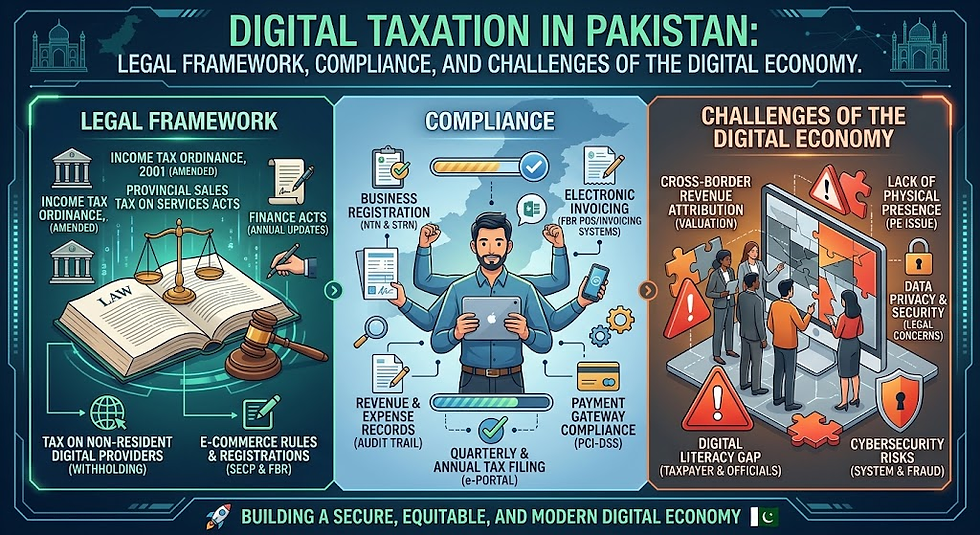
The taxation system in Pakistan is undergoing digital transformation through online filing systems, electronic invoicing, and automated audit processes.
The Federal Board of Revenue (FBR) is working to broaden the tax base, reduce evasion, and improve compliance through technology-driven solutions.
Cybersecurity and Data Protection Legal Development
With the growth of digital business, cybersecurity has become a major legal concern. The Prevention of Electronic Crimes Act (PECA) 2016 addresses cybercrime, online fraud, and digital harassment.
However, Pakistan still requires comprehensive data protection legislation aligned with global standards such as GDPR to ensure stronger privacy protection.
Challenges Facing Commercial Law in Pakistan
Judicial Delays and Case Backlogs
One of the biggest challenges is the slow judicial process, which delays contract enforcement and dispute resolution. This creates uncertainty for businesses and investors.
Regulatory Overlap and Institutional Complexity
Multiple regulatory bodies often operate with overlapping jurisdictions, creating confusion for businesses trying to comply with legal requirements.
Limited Legal Awareness Among SMEs
Small and medium enterprises often lack legal awareness, resulting in compliance failures and avoidable disputes.
Weak Enforcement Mechanisms
Although laws are in place, enforcement remains inconsistent due to administrative limitations and institutional inefficiencies.
Impact of International Trade and Global Legal Integration
Pakistan’s participation in international trade agreements has significantly influenced its commercial legal framework. WTO compliance, bilateral investment treaties, and regional agreements require Pakistan to maintain transparency, non-discrimination, and fair trade practices.
These global obligations are pushing Pakistan toward harmonized legal standards that enhance investor confidence and economic integration.
Role of Regulatory Institutions in Commercial Law
Several institutions regulate commercial activity in Pakistan. The Securities and Exchange Commission of Pakistan (SECP) oversees corporate governance and capital markets. The State Bank of Pakistan regulates banking and monetary policy. The Federal Board of Revenue manages taxation, while the Competition Commission ensures fair market practices.
Together, these institutions form a regulatory ecosystem that supports economic stability and legal compliance.
Future Outlook of Commercial Law in Pakistan
The future of commercial law in Pakistan is expected to be shaped by digital innovation, international integration, and regulatory modernization. Key developments include:
Expansion of AI-driven legal compliance system stronger data protection and privacy laws growth of Islamic finance and ethical business frameworks Increased adoption of virtual courts and e-justice systems enhanced cross-border trade regulations greater automation in tax and corporate compliance systems
These trends indicate a shift toward a more transparent, technology-driven, and investor-friendly legal environment.
Conclusion
Commercial law in Pakistan is undergoing a major transformation driven by technological advancement, globalization, and institutional reforms. While traditional legal frameworks still provide the foundation, modern reforms are reshaping the system to meet the demands of a digital and interconnected economy.
Emerging trends such as fintech regulation, corporate governance reforms, e-commerce expansion, and alternative dispute resolution are redefining the business environment. Despite challenges such as judicial delays and enforcement gaps, Pakistan is steadily moving toward a more efficient, transparent, and globally aligned commercial legal system.
The continued evolution of commercial law will play a decisive role in strengthening economic growth, attracting foreign investment, and ensuring long-term business stability in Pakistan.