
Digital Taxation in Pakistan

Updated: Oct 1
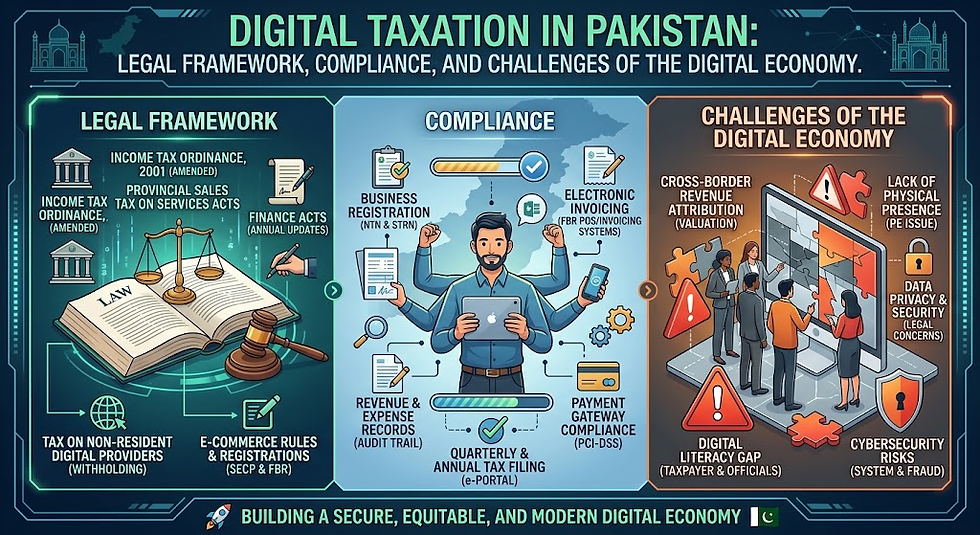
Legal Framework, Compliance, and Challenges of the Digital Economy
The rapid growth of digital technology has transformed the way businesses operate and consumers purchase goods and services. Online businesses, digital marketplaces, software services, social media platforms, online advertising, electronic payments, and remote professional services have created new forms of economic activity.
This transformation has also created important questions for taxation. Traditional tax systems were largely designed around businesses with identifiable physical locations, offices, shops, and other conventional forms of commercial presence. Digital businesses can operate across borders while serving customers in Pakistan without maintaining the same type of physical presence.
Digital taxation refers broadly to the application of tax laws and administrative systems to economic activities carried out through digital technologies. In Pakistan, digital taxation is developing through existing income tax and sales tax legislation, electronic filing systems, digital invoicing, payment records, and regulatory measures addressing the digital economy.
The increasing use of digital records also provides tax authorities with greater opportunities to identify transactions and improve compliance. At the same time, digital taxation raises important legal concerns involving privacy, electronic evidence, consumer rights, cybersecurity, cross-border transactions, and the responsibilities of online businesses.
Understanding Digital Taxation
Digital taxation does not necessarily mean the creation of a completely separate tax on every digital activity. In many cases, existing tax laws are applied to income, sales, services, and transactions that happen through digital platforms.
The main challenge is determining how traditional tax principles apply when commercial activity takes place electronically.
An online business may have customers in Pakistan while its owners, payment providers, or other operations are located elsewhere. This creates questions about taxable income, jurisdiction, reporting responsibilities, and tax collection.
Digital taxation therefore requires a combination of tax law, technology, regulatory oversight, and effective administration.
Legal Framework of Digital Taxation in Pakistan
Pakistan's digital taxation framework operates through existing taxation legislation and regulatory mechanisms. Income tax and sales tax laws may apply to relevant digital transactions depending upon their nature and the applicable legal provisions.
Tax authorities increasingly use electronic systems for registration, filing, reporting, invoicing, and monitoring.
The digitalization of tax administration allows authorities to process information electronically and improve monitoring of taxable activity.
At the same time, businesses must understand that digital operations do not automatically remove ordinary tax obligations.
Taxation of Digital Business Income
Income earned through digital business activities may be subject to taxation according to the applicable income tax framework.
Digital businesses can include online stores, software companies, digital marketing agencies, technology providers, online service businesses, and other enterprises operating through electronic platforms.
The tax treatment depends upon the nature and source of income, the taxpayer's status, the structure of the business, and other relevant legal factors.
Businesses should therefore determine their tax obligations based on the actual nature of their activities rather than assuming that online income falls outside the tax system.
Digital Services and Tax Liability
Digital services can include software-related services, online consultancy, advertising, subscription platforms, cloud-based services, and other electronically delivered products or services.
The tax treatment may differ depending upon the type of service and the applicable federal or provincial tax rules.
This creates an important compliance responsibility for businesses that provide or purchase digital services.
Proper classification of a transaction is essential because the applicable tax treatment may depend on the legal character of the service.
E-Commerce and Taxation
E-commerce has significantly expanded the digital economy in Pakistan. Online marketplaces allow businesses and individuals to sell products to customers without operating a traditional physical shop.
From a taxation perspective, online sales can create questions concerning registration, income reporting, sales tax, invoicing, payment records, and documentation.
Businesses operating online should maintain proper records of sales and expenses and ensure that their tax filings accurately reflect digital transactions.
The fact that a transaction occurs through a website or mobile application does not necessarily remove the taxpayer's legal obligations.
Digital Invoicing
Digital invoicing is becoming an important part of modern tax administration. Electronic invoices can create clearer records of commercial transactions and help reduce opportunities for under-reporting.
For businesses covered by applicable electronic invoicing requirements, compliance may involve maintaining appropriate digital systems and ensuring that invoices contain the required information.
Digital invoicing also helps businesses maintain organized financial records and can make tax reporting more efficient.
Electronic Tax Filing
Digital taxation also includes the electronic filing of tax returns and other documents. Online tax systems allow taxpayers to register, submit returns, communicate with tax authorities, and manage various tax-related processes electronically.
Electronic filing can reduce paperwork and improve administrative efficiency.
However, taxpayers must ensure that information submitted electronically is accurate. An electronic filing system does not reduce the taxpayer's responsibility for truthful declarations and proper documentation.
Digital Records as Tax Evidence
Digital transactions generate substantial amounts of electronic information. Invoices, payment confirmations, bank records, electronic communications, accounting software, and transaction histories can all become relevant to tax administration.
These records may assist taxpayers in demonstrating the accuracy of their declarations.
They may also assist tax authorities in identifying inconsistencies between reported income and other available information.
Businesses should therefore maintain reliable digital records and ensure that their accounting systems are properly organized.
Digital Payments and Tax Compliance
The growth of electronic payments has made financial transactions increasingly traceable. Bank transfers, digital wallets, payment gateways, and other electronic payment systems can generate records that may be relevant for taxation.
For businesses, proper reconciliation between sales records and payment records is particularly important.
Differences between declared sales and digital payment records may result in questions from tax authorities.
Accurate accounting and regular reconciliation can help businesses identify errors before they develop into tax disputes.
Online Platforms and Tax Administration
Digital marketplaces and online platforms may involve multiple parties, including sellers, buyers, payment providers, and platform operators.
This can make tax compliance more complicated because the person receiving payment may not always be the same person responsible for the underlying commercial activity.
Clear records are therefore important for establishing who earned the income and what tax obligations arise.
Businesses using third-party platforms should understand the contractual and financial relationship between themselves and the platform.
Taxation of Freelancers and Remote Workers
The digital economy has created significant opportunities for freelancers and remote professionals. Individuals can provide services to clients located in Pakistan or abroad without maintaining a conventional office.
Income earned through freelancing or remote services may have tax implications depending upon the nature and source of the income and the taxpayer's circumstances.
Freelancers should maintain records of contracts, invoices, payments, bank receipts, and business expenses.
Proper documentation can be particularly important where income is received from foreign clients.
Cross-Border Digital Transactions
Cross-border digital transactions present some of the most difficult taxation issues.
A business may provide digital services to Pakistani customers while operating from another jurisdiction. Determining where income should be taxed can depend upon domestic law, applicable tax treaties, the nature of the service, and the structure of the business.
International taxation principles are increasingly important as digital commerce becomes more global.
Businesses engaged in cross-border digital activity should carefully examine their tax position rather than assuming that the absence of a physical office eliminates local tax considerations.
Digital Economy and Tax Jurisdiction
Traditional taxation often relies on concepts such as residence, source of income, and physical business presence. Digital business models can make these concepts more difficult to apply.
A company may have substantial economic interaction with customers in a country while having limited physical presence there.
This creates legal questions about the appropriate basis for taxation.
Digital taxation therefore requires careful consideration of both domestic legislation and international tax principles.
Taxpayer Rights in Digital Taxation
Digital tax administration should not eliminate taxpayer rights.
Taxpayers should have appropriate opportunities to understand their obligations, respond to notices, correct errors, challenge assessments, and use available legal remedies.
Electronic systems should make tax administration more accessible rather than creating unnecessary procedural difficulties.
Where a digital system produces an incorrect result, taxpayers should have appropriate mechanisms for seeking correction or review.
Data Privacy and Digital Taxation
Tax authorities increasingly rely on digital information. Taxpayers may be required to submit financial, business, identification, and transaction-related information through electronic systems.
This creates important privacy and data-security concerns.
Tax administration must balance the need for accurate information with appropriate safeguards for confidential taxpayer data.
Businesses also have responsibilities to protect customer information and maintain secure digital systems.
Cybersecurity and Tax Administration
As tax systems become increasingly digital, cybersecurity becomes an important legal concern.
Taxpayer accounts may contain sensitive financial information, identification details, business records, and other confidential material.
Unauthorized access can result in financial fraud, identity theft, or misuse of confidential information.
Strong authentication, access controls, cybersecurity procedures, and responsible data management are therefore essential components of digital tax administration.
Challenges for Small Businesses
Digital taxation can create particular challenges for small businesses and individual entrepreneurs.
Some businesses may lack specialized accounting staff or technical systems needed to comply with electronic invoicing and digital reporting requirements.
Businesses may also struggle to understand complex tax provisions.
Simplified procedures, taxpayer education, and accessible compliance systems can help smaller enterprises participate in the formal economy without facing unnecessary administrative burdens.
Digital Tax Compliance for Businesses
Businesses operating in the digital economy should develop appropriate internal compliance systems.
Important practices include:
Maintaining accurate digital sales and expense records.
Reconciling payment records with accounting records.
Issuing invoices according to applicable requirements.
Filing tax returns accurately and on time.
Preserving electronic evidence and supporting documents.
A structured compliance system can reduce the risk of penalties and tax disputes.
Challenges in Digital Taxation
Digital taxation presents several legal and practical challenges. Technology develops rapidly, while legislation and administrative systems may take longer to adapt.
Other challenges include cross-border transactions, classification of digital services, electronic evidence, privacy, cybersecurity, platform-based commerce, and determining the appropriate jurisdiction for taxation.
Another concern is ensuring that digital tax measures do not discourage innovation or place excessive burdens on legitimate businesses.
Effective regulation therefore requires a balance between revenue collection and economic growth.
Role of Technology in Tax Enforcement
Technology provides tax authorities with powerful tools for improving compliance.
Electronic records can help identify inconsistencies, detect unusual transactions, compare reported information, and improve tax administration.
Digital systems can also reduce manual errors and make taxpayer services more efficient.
However, technological enforcement should operate within legal safeguards. Automated systems should not replace appropriate legal procedures or prevent taxpayers from challenging incorrect decisions.
Future of Digital Taxation in Pakistan
The future of taxation in Pakistan is likely to become increasingly digital. Electronic filing, digital invoicing, online payments, data analysis, and automated compliance systems will continue to influence the relationship between taxpayers and tax authorities.
The challenge will be to develop a system that combines effective revenue collection with transparency, privacy, cybersecurity, and taxpayer rights.
As digital businesses continue to expand, tax laws may also need to respond to new business models and cross-border economic activities.
A modern tax system should encourage innovation while ensuring that businesses operating in the digital economy meet their lawful tax responsibilities.
Conclusion
Digital taxation in Pakistan represents an important development in the modernization of the country's tax system. The expansion of e-commerce, digital services, online businesses, electronic payments, and remote work has created new economic opportunities while also introducing complex taxation issues.
For businesses and taxpayers, the key to successful digital tax compliance is accurate reporting, proper record-keeping, timely filing, and awareness of applicable legal requirements. Digital businesses should not assume that operating online places them outside the ordinary tax framework.
At the same time, digital taxation must respect taxpayer rights. Privacy, data security, due process, access to remedies, and transparent administration should remain important elements of the system.
A well-designed digital tax framework can improve revenue collection, reduce tax evasion, increase transparency, and make tax administration more efficient. With appropriate legal safeguards and continued modernization, digital taxation can contribute to a stronger, more transparent, and more inclusive tax system in Pakistan.


