Common Mistakes That Make Contracts Unenforceable

Updated: Oct 1
Avoiding Legal Pitfalls Under Pakistani Contract Law
Contracts are the foundation of personal, commercial, and business relationships. They establish legally enforceable rights and obligations, reduce uncertainty, and provide a structured framework for resolving disputes. Whether individuals are entering into employment agreements, business partnerships, property transactions, service contracts, or online commercial arrangements, a properly drafted contract protects the interests of all parties involved.
However, not every agreement becomes legally enforceable. Many contracts fail because essential legal requirements are overlooked during drafting or negotiation. Even when parties genuinely intend to create a binding agreement, mistakes relating to consent, consideration, legality, capacity, unclear terms, or improper documentation may render the contract unenforceable. Such errors often lead to unnecessary disputes, financial losses, and lengthy legal proceedings.
Under Pakistani contract law, an enforceable contract must satisfy certain legal requirements before courts will recognise and enforce its provisions. Businesses and individuals should therefore understand the common mistakes that weaken contractual validity and learn how to avoid them. A carefully prepared agreement not only protects legal rights but also promotes commercial certainty and long-term business relationships.
As commercial transactions increasingly move towards digital platforms and electronic contracting, understanding the legal principles governing enforceable contracts has become more important than ever. Careful drafting, transparent negotiations, and compliance with legal requirements remain essential for creating valid and reliable agreements.

Understanding an Enforceable Contract
An enforceable contract is a legally binding agreement that creates rights and obligations recognised by law. When a valid contract exists, courts may require the parties to fulfil their contractual commitments or provide appropriate legal remedies if a breach occurs.
For a contract to be enforceable, it should generally contain essential legal elements such as a lawful offer, valid acceptance, lawful consideration, free consent, legal capacity, and a lawful object. If one or more of these elements is missing, the agreement may become unenforceable or vulnerable to legal challenge.
Understanding these legal requirements helps parties avoid costly contractual mistakes.
Mistake One: Unclear or Ambiguous Contract Terms
One of the most common reasons contracts become unenforceable is the use of vague or ambiguous language. If important terms are unclear, courts may find it difficult to determine the true intentions of the parties.
Contracts should clearly define the rights, duties, payment obligations, timelines, performance standards, and procedures for resolving disputes. Ambiguous wording often results in different interpretations, increasing the likelihood of disagreement.
Simple, precise, and well-organised drafting significantly improves contractual certainty.
Mistake Two: Absence of Valid Consideration
Consideration is one of the essential elements of contract formation. It represents the exchange of something of legal value between the parties.
If one party promises something without receiving or expecting any lawful consideration in return, the agreement may not create legally enforceable obligations. Consideration may consist of money, goods, services, promises, or legal responsibilities.
Clearly identifying the consideration exchanged strengthens the legal validity of the agreement.
Mistake Three: Lack of Free Consent
Contracts should be entered into voluntarily. Consent obtained through fraud, misrepresentation, coercion, undue influence, or mistake may affect the validity of the agreement.
Each party should understand the contractual terms before acceptance and make decisions independently without unlawful pressure. Genuine consent reflects the mutual intention to establish legal obligations.
Transparent negotiations reduce disputes and strengthen enforceability.
Mistake Four: Contracting with a Party Lacking Legal Capacity
Not every individual or organisation possesses the legal capacity to enter into binding contracts. Capacity is an essential legal requirement because parties must be legally competent to assume contractual obligations.
Businesses should verify that individuals signing contracts possess the necessary authority and legal competence. Failure to confirm capacity may create uncertainty regarding the enforceability of the agreement.
Proper verification protects both parties from future legal complications.
Mistake Five: Unlawful Purpose or Illegal Object
A contract cannot generally be enforced if its purpose or subject matter violates the law or public policy.
Even where parties willingly agree to contractual terms, courts will not usually enforce agreements involving unlawful activities or prohibited conduct. Every contract should pursue a lawful objective consistent with applicable legal principles.
Lawful agreements promote commercial certainty and preserve the integrity of the legal system.
Mistake Six: Failure to Properly Record the Agreement
Although some agreements may be legally valid without written documentation, relying solely on verbal arrangements often creates evidentiary difficulties if disputes arise.
Written contracts provide clear evidence of the parties' intentions, contractual obligations, payment arrangements, timelines, and agreed procedures. Proper documentation significantly reduces uncertainty and simplifies dispute resolution.
Maintaining complete contractual records benefits both businesses and individuals.
Mistake Seven: Ignoring Essential Contract Clauses
Many disputes arise because contracts omit important provisions that govern the relationship between the parties.
Important contractual clauses may include payment obligations, confidentiality, intellectual property ownership, limitation of liability, dispute resolution procedures, termination rights, governing law, and force majeure provisions.
Including these clauses improves clarity while reducing future legal uncertainty.
Mistake Eight: Poorly Drafted Digital Contracts
Electronic contracts have become increasingly common in modern business. However, digital agreements may become vulnerable if online acceptance procedures, electronic signatures, authentication methods, or contractual terms are not properly implemented.
Businesses should ensure that digital contracts clearly present their terms before acceptance and maintain reliable electronic records demonstrating consent.
Proper digital contracting strengthens legal recognition and enforceability.
Mistake Nine: Failure to Comply with Legal Requirements
Certain types of contracts may require compliance with specific legal formalities depending upon their subject matter. Ignoring statutory requirements can affect enforceability even where the parties intended to create a binding agreement.
Businesses should ensure that contractual arrangements comply with applicable legal and regulatory requirements before execution.
Legal compliance reduces unnecessary litigation and protects commercial interests.
Mistake Ten: Inadequate Record Keeping
Contract management does not end once an agreement is signed. Poor record keeping often creates practical difficulties when enforcing contractual rights.
Organisations should securely maintain copies of agreements, correspondence, invoices, payment records, amendments, electronic communications, and supporting documents. Proper documentation assists in demonstrating contractual performance if disputes arise.
Effective record management strengthens legal certainty throughout the contractual relationship.
The Importance of Professional Contract Drafting
Well-drafted contracts minimise legal uncertainty while protecting the interests of every party involved. Professional drafting ensures that contractual language remains clear, consistent, and legally compliant.
A carefully prepared agreement helps parties understand their obligations, reduces misunderstandings, and provides effective legal protection if disagreements occur. Investing time in contract preparation is often far less costly than resolving contractual disputes through litigation.
Quality drafting remains one of the most valuable safeguards against unenforceable agreements.
Common Practices That Strengthen Contract Enforceability
Businesses and individuals can significantly reduce legal risks by following sound contractual practices.
Some important measures include:
Clearly defining the rights and obligations of each party.
Using simple and precise contractual language.
Confirming legal capacity before signing.
Ensuring lawful consideration exists.
Recording agreements in writing whenever possible.
Reviewing contracts carefully before acceptance.
Maintaining complete contractual records.
Seeking legal advice for significant commercial agreements.
These practical steps improve both legal certainty and commercial confidence.
Building Strong and Reliable Contracts
Creating enforceable contracts requires more than simply preparing a written document. Effective agreements should reflect careful negotiation, accurate drafting, legal compliance, and proper documentation throughout the contractual relationship.
Key priorities include:
Drafting clear and unambiguous contractual provisions.
Verifying the authority of contracting parties.
Protecting confidential information.
Incorporating fair dispute resolution mechanisms.
Maintaining secure records for digital contracts.
Reviewing contracts periodically where long-term relationships exist.
Ensuring compliance with applicable laws.
Encouraging transparency throughout negotiations.
These practices strengthen business relationships while reducing legal disputes.
The Future of Contract Drafting in Pakistan
As Pakistan's economy continues embracing digital commerce, electronic transactions, and technology-driven business models, contract drafting will increasingly involve electronic signatures, digital records, artificial intelligence, and automated contracting systems. Despite these technological developments, the fundamental principles of contract law remain unchanged.
Future legal practice will continue emphasising clarity, transparency, lawful consideration, informed consent, and responsible digital governance. Businesses that combine modern technology with sound legal drafting will be better positioned to minimise disputes and protect their commercial interests.
A strong contractual culture supports investment, innovation, and sustainable economic development while reinforcing confidence in Pakistan's legal and commercial framework.
Conclusion
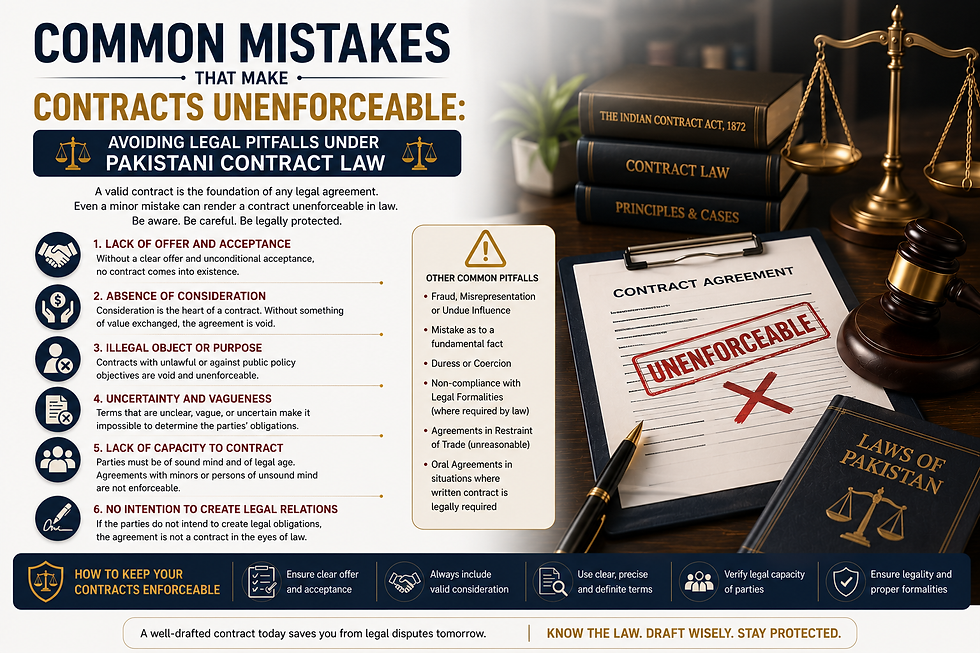
Contracts are only valuable when they are legally enforceable. Common mistakes such as unclear language, absence of consideration, lack of free consent, unlawful objectives, inadequate documentation, poor digital contracting, and failure to comply with legal requirements can undermine otherwise legitimate agreements. Understanding these issues enables individuals and businesses to prepare contracts that are legally sound, commercially effective, and capable of protecting their rights.
For Pakistan, promoting better contract drafting and legal awareness will strengthen commercial certainty, encourage investment, and reduce avoidable disputes. By following established principles of contract law and adopting careful drafting practices, businesses and individuals can create reliable agreements that support long-term relationships, protect legal interests, and contribute to a more secure and efficient business environment.