
Criminal Liability in the Age of Technology

Updated: Oct 1
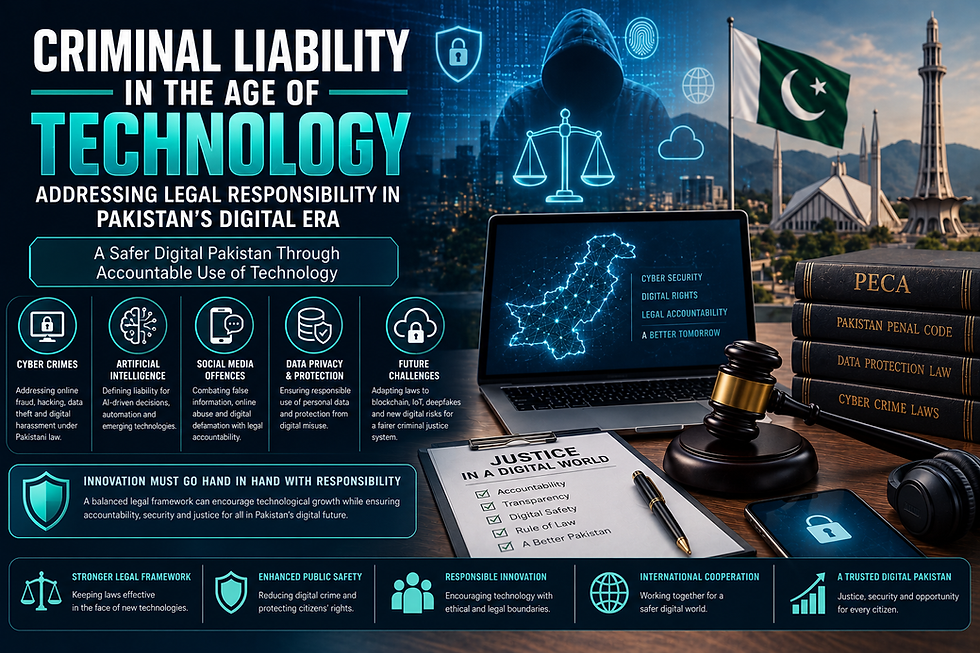
Addressing Legal Responsibility in Pakistan’s Digital Era
Technological advancement has transformed nearly every aspect of modern life, reshaping communication, commerce, education, and governance. The widespread use of smartphones, social media platforms, cloud computing, artificial intelligence, and digital financial systems has created unprecedented opportunities for innovation and economic growth. At the same time, these developments have introduced new forms of criminal activity and complex legal questions regarding responsibility and accountability.
Criminal liability refers to the legal responsibility imposed on individuals or organizations for conduct prohibited by law. Traditionally, criminal law focused on physical acts such as theft, assault, and property crimes. However, the rise of technology has expanded the scope of criminal behavior to include cybercrimes, digital fraud, identity theft, online harassment, data breaches, and the misuse of emerging technologies. As criminal activities increasingly occur in virtual environments, legal systems must adapt to ensure that offenders remain accountable.
In Pakistan, technological progress has accelerated the need for modern legal frameworks capable of addressing crimes committed through electronic devices and digital networks. Law enforcement agencies, prosecutors, and courts face the challenge of applying traditional legal principles to conduct that often transcends geographical boundaries and involves sophisticated technological methods.
The digital age has also raised important concerns about privacy, cybersecurity, electronic evidence, and the role of technology companies in preventing unlawful conduct. Balancing innovation with public safety requires legal systems to develop effective mechanisms for investigation, prosecution, and the protection of fundamental rights.
This article examines the concept of criminal liability in the age of technology, explores the challenges posed by digital crime, and discusses the legal responses necessary for strengthening accountability in Pakistan’s evolving technological landscape.
Understanding Criminal Liability
Criminal liability arises when an individual or organization engages in conduct that violates criminal law and is subject to legal punishment.
The concept is based on the principle that unlawful actions should carry consequences to protect society and maintain public order.
Legal accountability strengthens the rule of law.
Criminal responsibility promotes social stability.
Justice depends on effective enforcement.
The Impact of Technology on Criminal Activity
Technology has changed the methods through which crimes are committed and investigated.
Electronic communication, online platforms, and digital financial systems have created opportunities for both legitimate activities and unlawful conduct.
Modern criminals increasingly rely on technological tools.
Digital environments require updated legal responses.
Innovation presents new legal challenges.
Cybercrime and Emerging Offenses
Cybercrime has become one of the most significant concerns of contemporary criminal law.
Activities such as unauthorized access to computer systems, online fraud, identity theft, cyberstalking, and digital extortion demonstrate the diverse forms of crime that technology has enabled.
Cyber offenses often cross national borders.
Technological crimes require specialized investigation.
Digital security protects public interests.
Electronic Evidence and Criminal Investigations
The growth of digital technology has increased the importance of electronic evidence in criminal proceedings.
Emails, text messages, financial records, social media activity, and surveillance footage frequently play a crucial role in establishing criminal liability.
Reliable evidence strengthens judicial decision-making.
Proper procedures support fair trials.
Technology enhances investigative capacity.
The Role of Intent in Digital Crimes
Criminal liability traditionally depends upon proving intention, knowledge, or negligence.
In technology-related offenses, determining the mental state of an accused person may present unique challenges because digital actions can involve automation, anonymous communication, and complex technical systems.
Legal analysis remains essential in modern prosecutions.
Intent continues to shape criminal responsibility.
Fairness requires careful evaluation.
Corporate Responsibility and Technological Misuse
Businesses and digital platforms increasingly influence the way technology is used within society.
Organizations must establish internal safeguards, cybersecurity measures, and compliance systems to reduce the risk of unlawful conduct.
Responsible corporate practices strengthen public confidence.
Accountability supports sustainable innovation.
Legal compliance protects institutional integrity.
Artificial Intelligence and Future Legal Questions
The growing use of artificial intelligence has introduced new debates concerning criminal responsibility and legal accountability.
Automated systems can assist decision-making, process large amounts of information, and perform complex tasks, but they also create questions regarding oversight and liability.
Legal systems must adapt to emerging technologies.
Human supervision remains essential.
Innovation requires responsible governance.
Only Bullet Section: Key Challenges in Determining Criminal Liability in the Digital Age
Investigating cybercrime and digital offenses
Preserving and authenticating electronic evidence
Protecting privacy and personal data
Determining intent in technology-related crimes
Regulating emerging technologies and digital platforms
Strengthening cybersecurity and legal compliance
Cross-Border Crimes and Jurisdictional Issues
Technology has enabled criminal activities to extend beyond national boundaries.
Online fraud, cyberattacks, and digital financial crimes often involve individuals and systems located in different jurisdictions, creating challenges for investigators and courts.
International cooperation strengthens enforcement efforts.
Legal coordination improves accountability.
Cross-border crimes require collaborative solutions.
Balancing Security and Fundamental Rights
Efforts to combat digital crime must respect constitutional principles and individual freedoms.
Governments and law enforcement agencies must ensure that investigations are conducted lawfully and that technological surveillance does not undermine fundamental rights.
Legal safeguards protect personal liberties.
Balanced regulation promotes public trust.
Justice requires accountability and fairness.
Challenges Facing the Criminal Justice System
Rapid technological change continues to test the ability of legal institutions to respond effectively.
Limited resources, evolving criminal techniques, and the complexity of digital investigations require continuous adaptation and professional development.
Modern institutions must remain flexible.
Continuous reform strengthens criminal justice.
Innovation demands effective regulation.
The Future of Criminal Liability in Pakistan
The future of criminal liability in Pakistan will depend upon stronger cybercrime laws, improved forensic capabilities, enhanced institutional cooperation, and greater public awareness of digital risks.
Courts and law enforcement agencies will increasingly rely on technology to investigate offenses while ensuring that legal protections remain intact.
Future-ready legal systems strengthen public confidence.
Technological advancement supports effective justice.
Responsible governance promotes social stability.
Conclusion
Criminal liability in the age of technology presents both challenges and opportunities for Pakistan’s legal system. The rise of cybercrime, electronic evidence, and emerging technologies has expanded the scope of criminal law and required legal institutions to rethink traditional approaches to accountability.
Effective responses depend upon strong legal frameworks, modern investigative methods, and a careful balance between security and individual rights. By investing in technological capacity and strengthening regulatory mechanisms, Pakistan can better address the realities of digital crime.
As technology continues to evolve, the law must remain adaptable, ensuring that innovation contributes to progress while preserving justice, accountability, and the rule of law.


