
The Regulation of Fintech and Digital Banking

Updated: Oct 1
Strengthening Innovation and Financial Security in Pakistan
Financial technology has transformed the modern banking sector by introducing innovative methods of payment, investment, lending, and financial management. Digital banking platforms, mobile payment systems, electronic wallets, and online financial services have changed the way individuals and businesses interact with financial institutions. These technological developments have increased financial accessibility, improved efficiency, and created new opportunities for economic growth.
Fintech, commonly known as financial technology, combines digital innovation with traditional financial services to provide consumers with faster and more convenient methods of conducting transactions. From online banking applications to digital payment solutions, fintech companies have become important participants in the financial market. Their growing influence has encouraged governments and regulators to develop legal frameworks capable of balancing innovation with financial stability.
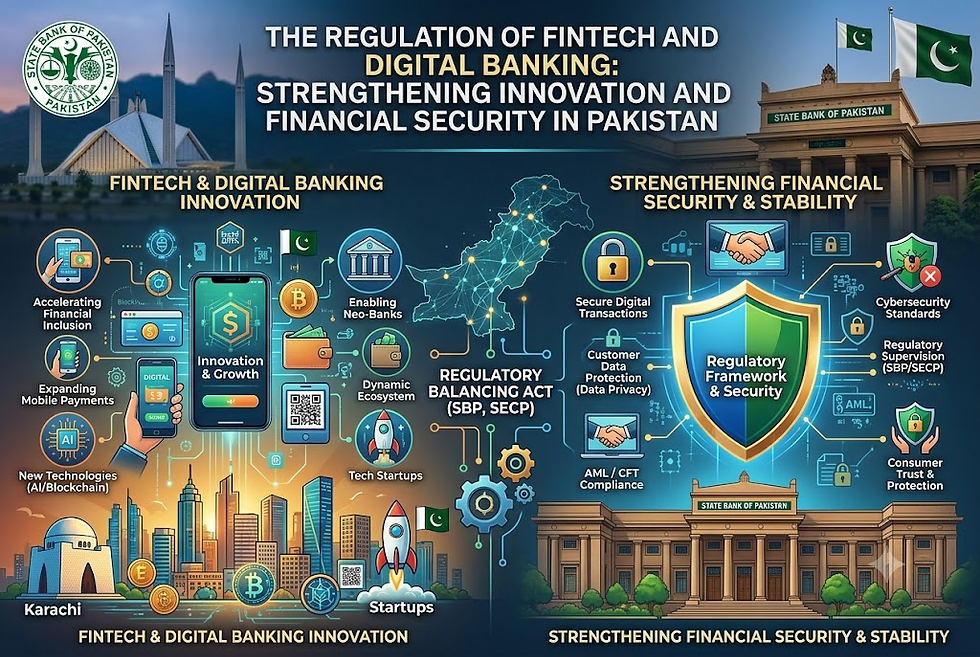
In Pakistan, the expansion of digital banking and fintech services has accelerated due to increasing internet access, smartphone usage, and the growing demand for efficient financial solutions. Digital payment platforms, branchless banking services, and financial applications are contributing to economic inclusion by bringing financial services to individuals who previously had limited access to traditional banking institutions.
However, the rapid growth of fintech also presents important legal and regulatory challenges. Questions relating to consumer protection, cybersecurity, data privacy, financial fraud, and regulatory compliance require careful consideration. Policymakers and regulatory authorities must ensure that innovation occurs within a legal framework that protects consumers and preserves confidence in the financial system.
The regulation of fintech and digital banking therefore represents a crucial aspect of modern financial governance. Effective regulation not only safeguards the interests of consumers and businesses but also promotes sustainable economic development and technological progress.
This article examines the legal framework governing fintech and digital banking in Pakistan, explores the challenges created by technological innovation, and discusses the future of financial regulation in the digital era.
Understanding Fintech and Digital Banking
Fintech refers to the use of technology to improve and modernize financial services.
Digital banking enables customers to access financial products and conduct transactions through electronic platforms without relying exclusively on traditional banking methods.
Technology has reshaped financial services.
Innovation improves efficiency and accessibility.
Digital solutions support economic growth.
The Rise of Digital Financial Services in Pakistan
Pakistan's financial sector has experienced significant transformation through the expansion of online banking, electronic payments, and mobile financial services.
These developments have increased financial inclusion and created new opportunities for businesses and consumers.
Digital finance promotes economic participation.
Modern banking strengthens commercial activity.
Technological progress supports financial development.
The Importance of Regulatory Frameworks
The success of fintech depends upon effective legal and regulatory systems.
Regulatory frameworks establish rules that govern financial transactions, protect consumers, and maintain confidence in banking institutions.
Clear regulations promote legal certainty.
Responsible oversight strengthens public trust.
Effective governance supports innovation.
Consumer Protection in Digital Banking
Consumers increasingly rely on digital platforms to manage financial transactions and personal information.
Financial institutions and fintech companies must ensure transparency, fairness, and security in their operations.
Consumer confidence strengthens the financial sector.
Legal safeguards protect users from abuse.
Responsible practices support sustainable growth.
Cybersecurity and Data Privacy
The expansion of digital financial services has increased concerns regarding cybersecurity and data protection.
Unauthorized access, identity theft, and cyberattacks can undermine confidence in financial systems and create significant legal risks.
Strong security measures protect financial integrity.
Privacy remains a fundamental concern.
Technological innovation requires effective safeguards.
Licensing and Compliance Requirements
Fintech companies and digital banking institutions must comply with various legal and regulatory obligations.
Licensing procedures, reporting requirements, and compliance mechanisms help maintain accountability and ensure that financial services operate within the law.
Regulatory compliance strengthens institutional credibility.
Transparent operations reduce financial risks.
Effective supervision promotes stability.
Electronic Transactions and Digital Payments
Electronic transactions have become a central feature of modern commerce.
Digital payment systems enable businesses and consumers to transfer funds quickly and efficiently, contributing to economic growth and commercial development.
Technology simplifies financial transactions.
Digital payments increase convenience.
Modern commerce depends on secure financial systems.
Only Bullet Section: Key Challenges in Fintech Regulation
Protecting consumer rights and financial data
Preventing fraud and cybercrime
Ensuring compliance with financial regulations
Strengthening cybersecurity measures
Promoting transparency and accountability
Adapting legal frameworks to technological change
Financial Inclusion and Economic Development
One of the most important benefits of fintech is its ability to expand access to financial services.
Digital banking platforms allow individuals and small businesses to participate more actively in the economy, particularly in areas where traditional banking services are limited.
Financial inclusion strengthens economic growth.
Technology creates new commercial opportunities.
Accessible services promote social development.
The Role of Regulatory Institutions
Regulatory authorities play a vital role in overseeing digital banking and fintech operations.
Their responsibilities include maintaining market stability, protecting consumers, and ensuring that financial innovation remains consistent with legal standards.
Strong institutions promote investor confidence.
Regulatory oversight supports sustainable development.
Accountability strengthens the financial system.
Emerging Technologies and Future Challenges
Artificial intelligence, blockchain technology, and automated financial systems continue to reshape the financial sector.
These innovations offer significant opportunities but also create legal and ethical questions regarding accountability, security, and regulatory adaptation.
Innovation requires responsible governance.
Legal systems must evolve with technology.
Modern challenges demand proactive regulation.
The Future of Fintech and Digital Banking in Pakistan
The future of fintech and digital banking in Pakistan will depend upon strong legal frameworks, effective regulatory oversight, and continued technological development.
Governments, financial institutions, and technology companies must work together to create a financial environment that encourages innovation while protecting consumers and maintaining public confidence.
Future-ready financial systems strengthen economic resilience.
Digital transformation supports national development.
Responsible regulation promotes long-term stability.
Conclusion
The regulation of fintech and digital banking has become an essential aspect of modern financial governance. As digital technologies continue to transform financial services, legal systems must ensure that innovation is accompanied by transparency, accountability, and consumer protection.
In Pakistan, the growth of fintech presents significant opportunities for economic development, financial inclusion, and technological advancement. At the same time, regulators must address challenges relating to cybersecurity, privacy, and compliance to preserve confidence in the financial sector.
As financial technology continues to evolve, effective regulation will remain critical to building a secure, inclusive, and sustainable digital economy founded upon the principles of accountability and the rule of law.


