
Law Degree Scope in Pakistan

Updated: May 9
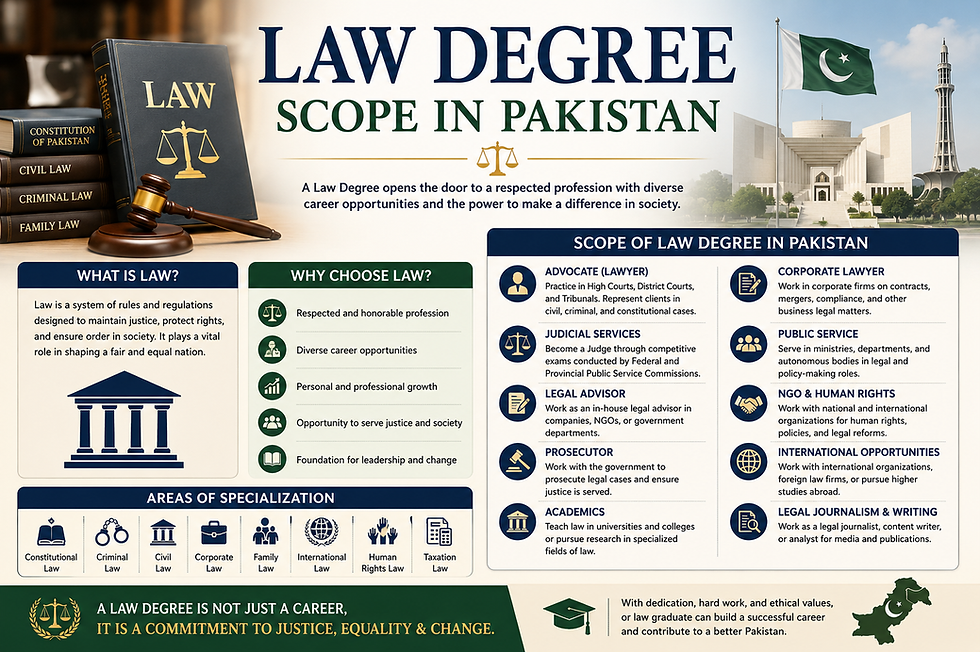
The Expanding Legal Profession and Future Opportunities:
The legal profession in Pakistan is entering a new phase of transformation and growth. Over the last few years, rapid social changes, economic development, technological advancement, and legal reforms have significantly increased the demand for qualified legal professionals. A law degree is no longer limited to traditional courtroom practice. Today, graduates of LLB programs are finding opportunities in corporate organizations, multinational companies, government departments, legal consultancy firms, academia, human rights organizations, media houses, and digital legal platforms.
Students who are planning their future careers are now considering law as one of the most prestigious and promising fields in Pakistan. The legal sector continues to evolve as the country experiences constitutional developments, commercial expansion, international investments, and increasing public awareness regarding legal rights. As a result, law graduates are becoming essential contributors to Pakistan’s judicial, corporate, and social systems.
The scope of a law degree in Pakistan is broader than ever before. Modern legal education prepares students not only to understand statutes and constitutional provisions but also to develop analytical thinking, communication skills, advocacy techniques, legal drafting expertise, and problem-solving abilities. A law graduate today is expected to understand both traditional legal systems and emerging legal challenges linked with technology, international trade, cybercrime, environmental protection, and human rights.
Students pursuing an LLB degree are entering a profession that offers respect, financial stability, intellectual development, and opportunities for public service. Whether someone dreams of becoming a successful advocate, a judge, a corporate legal adviser, a researcher, or an international legal consultant, the legal field offers multiple career pathways.
This article explores the expanding scope of a law degree in Pakistan, discusses the importance of modern legal education, and explains why the legal profession remains one of the strongest career choices for students in Faisalabad.
Evolution of Legal Education in Pakistan
Legal education in Pakistan has undergone major reforms during the last decade. Previously, many law colleges focused mainly on theoretical teaching methods. Students often graduated with limited practical exposure to court procedures, legal drafting, and advocacy techniques. However, the modern legal environment demands lawyers who are not only academically capable but also professionally trained.
The Higher Education Commission and Pakistan Bar Council have introduced various reforms to improve the quality of legal education. The introduction of the five-year LLB program replaced the old three-year structure and aimed to align Pakistan’s legal education with international standards. Universities are now emphasizing research-based learning, moot court competitions, internships, legal writing, and practical training.
Students are increasingly being trained in constitutional law, criminal law, civil law, corporate law, cyber law, intellectual property law, and international legal systems. Law schools are also focusing on communication skills, critical thinking, negotiation techniques, and courtroom ethics.
The modernization of legal education has opened doors for graduates to work in diverse professional sectors. Today’s legal graduates are not limited to litigation alone. They are contributing to policy-making, corporate governance, international business transactions, digital compliance, and social justice initiatives.
Why Law is Becoming a Popular Career Choice
The growing popularity of law as a career choice is directly linked to the changing economic and social structure of Pakistan. Students are increasingly recognizing that legal education offers flexibility, influence, and long-term career growth.
One major reason behind the increasing interest in legal education is the growing awareness of legal rights among the public. Individuals and businesses now require professional legal assistance in matters related to contracts, property disputes, family law, taxation, banking, cybercrime, and employment rights.
The expansion of Pakistan’s business sector has also increased the need for legal professionals. Corporate organizations require lawyers to handle compliance issues, contracts, mergers, acquisitions, taxation matters, labour regulations, and intellectual property rights.
Another reason why law is attracting students is the respect associated with the profession. Lawyers, judges, legal scholars, and legal consultants play a vital role in shaping society and protecting justice. Many students view the legal profession as an opportunity to create social change while building a stable and successful career.
Legal education also develops transferable skills. Graduates learn public speaking, argumentation, research techniques, drafting skills, and analytical reasoning. These abilities are valuable not only in law but also in business, politics, journalism, civil services, and academia.
The Expanding Scope of Advocacy in Pakistan
Advocacy remains one of the most recognized career paths for law graduates in Pakistan. After completing an LLB degree and fulfilling the licensing requirements of the Pakistan Bar Council, graduates can begin practicing law as advocates.
The legal profession offers opportunities in various branches of law including civil law, criminal law, constitutional law, family law, taxation law, labour law, and corporate law. Each specialization provides unique professional experiences and challenges.
Civil lawyers deal with property disputes, contractual disagreements, inheritance matters, and commercial litigation. Criminal lawyers represent clients in criminal proceedings and contribute to the justice system by defending legal rights.
Constitutional lawyers participate in matters related to constitutional interpretation, fundamental rights, and legal reforms. Family lawyers handle issues related to marriage, divorce, child custody, maintenance, and inheritance.
Corporate lawyers are increasingly in demand due to the expansion of business activities in Pakistan. Companies require legal professionals to prepare contracts, ensure regulatory compliance, and manage commercial transactions.
Advocacy also offers financial growth opportunities. While fresh graduates may initially work under senior lawyers to gain practical experience, successful advocates can eventually establish independent legal practices and build strong reputations.
Opportunities in the Judiciary
The judiciary remains one of the most respected career options for law graduates in Pakistan. Students who wish to serve the justice system directly can prepare for judicial examinations and become civil judges or judicial magistrates.
Judicial careers provide stability, authority, and public respect. Judges are responsible for interpreting laws, resolving disputes, protecting constitutional rights, and ensuring justice within society.
Provincial judicial examinations require strong knowledge of legal subjects, procedural laws, constitutional principles, and analytical reasoning. Candidates who successfully pass these examinations receive appointments within the judicial system.
Working in the judiciary also offers opportunities for professional growth. Judicial officers can progress to higher judicial positions through experience and performance.
Law graduates who aspire to become judges must develop discipline, impartiality, integrity, and strong legal reasoning abilities. Modern universities are increasingly preparing students for judicial careers through mock trials, legal workshops, and specialized examination preparation programs.
Corporate Law and Business Opportunities
Corporate law has emerged as one of the fastest-growing sectors for legal professionals in Pakistan. As businesses expand nationally and internationally, organizations require lawyers who understand commercial transactions, regulatory frameworks, and financial laws.
Banks, multinational companies, telecommunications firms, insurance companies, and technology startup regularly hire legal professionals. These organizations require legal advisers to draft agreements, review contracts, manage disputes, and ensure compliance with government regulations.
Corporate lawyers often work as in-house counsel, meaning they provide legal guidance directly within a company rather than representing clients in court. Their responsibilities may include negotiating business contracts, advising on labour laws, handling intellectual property issues, and managing corporate governance matters.
The rise of e-commerce and digital business has also created new legal challenges. Companies now require legal experts who understand data protection, cybersecurity regulations, and digital transactions.
Corporate legal practice offers attractive salaries, professional development opportunities, and exposure to modern business environments. Graduates with strong communication skills, commercial understanding, and legal drafting expertise can build highly successful careers in this field.
International Law and Global Opportunities
Globalization has expanded opportunities for Pakistani law graduates in international legal sectors. Students with expertise in international law, human rights law, trade law, and arbitration are increasingly finding opportunities in international organizations and multinational institutions.
International legal practice involves dealing with treaties, trade agreements, diplomatic laws, and cross-border legal disputes. Lawyers specializing in international law may work with international organizations, embassies, multinational corporations, and global advocacy groups.
Students interested in global legal careers often pursue advanced studies such as LLM programs abroad. International education provides exposure to comparative legal systems and specialized areas of law.
Pakistan’s increasing involvement in international trade and investment projects has further increased the demand for lawyers familiar with international commercial laws and arbitration procedures.
Human Rights and Social Justice Careers
Many law graduates choose careers focused on social justice, human rights, and public welfare. Human rights organizations, legal aid institutions, and non-governmental organizations require legal professionals who can advocate for marginalized communities and protect constitutional freedoms.
Human rights lawyers work on issues related to women’s rights, minority rights, labour rights, child protection, refugee assistance, and environmental justice. These professionals contribute to legal awareness campaigns, policy reforms, and public interest litigation.
The increasing focus on social justice in Pakistan has strengthened the importance of public interest law. Graduates who are passionate about helping vulnerable communities often find meaningful careers in this field.
Working in human rights organizations may not always provide the same financial rewards as corporate practice, but it offers professional satisfaction and opportunities to contribute positively to society.
Legal Journalism and Media Careers
Legal journalism has become another emerging career path for law graduates. News channels, newspapers, digital media platforms, and legal publications increasingly require professionals who understand legal systems and can analyzes legal developments.
Legal journalists report on court proceedings, constitutional matters, criminal cases, policy reforms, and legislative changes. Their legal background enables them to explain complex legal issues to the public in an understandable manner.
Law graduates working in media may serve as legal analysts, policy commentators, or investigative journalists. They often contribute to public discussions on constitutional rights, governance, and judicial reforms.
The rise of digital media platforms has created additional opportunities for lawyers interested in writing, public speaking, and legal analysis.
Importance of Communication and Advocacy Skills
Success in the legal profession depends heavily on communication abilities. Lawyers must present arguments clearly, draft legal documents accurately, negotiate effectively, and communicate confidently with clients and courts.
Modern law schools are increasingly emphasizing oral advocacy, legal writing, and interpersonal communication skills. Moot court competitions, presentations, seminars, and internships help students build professional confidence.
Strong communication skills also benefit graduates working outside traditional legal practice. Corporate organizations, government departments, media institutions, and academic organizations all value individuals who can think critically and communicate effectively.
Legal education teaches students how to analyzes facts, identify legal issues, and present logical arguments. These skills remain useful throughout professional life regardless of the specific career path chosen.
Technology and the Future of Law
Technology is transforming legal systems worldwide, and Pakistan is also experiencing the impact of digital transformation. Law firms, courts, and businesses are increasingly adopting digital tools for case management, documentation, communication, and legal research.
The emergence of legal technology has created new professional opportunities for law graduates. Areas such as cyber law, data privacy, artificial intelligence regulation, digital compliance, and online dispute resolution are becoming increasingly important.
Legal professionals who understand technology and digital systems are likely to remain highly competitive in the future job market. Universities are gradually incorporating technology-related legal subjects into their academic programs.
Students who combine legal expertise with technological awareness can contribute to the modernization of Pakistan’s legal and business sectors.
Career Opportunities After LLB in Pakistan: Professional Pathways for Law Graduates
An LLB degree in Pakistan opens the door to numerous professional opportunities across public, private, and international sectors. The legal profession is no longer confined to litigation and courtroom advocacy alone. Today, law graduates are actively contributing to business organizations, government institutions, research center, media industries, non-governmental organizations, and digital legal services.
The professional landscape for law graduates is changing rapidly due to technological advancement, increasing public awareness regarding legal rights, globalization, and economic development. As businesses grow and legal systems evolve, the demand for competent legal professionals continues to rise.
Students pursuing legal education often ask an important question: what can they do after completing an LLB degree? The answer is that modern legal education provides access to diverse career paths, each offering unique opportunities for growth, learning, and success.
This article explores the major career opportunities available for law graduates in Pakistan It explains how different sectors require legal expertise and how students can build successful careers according to their interests and abilities.
Becoming an Advocate in Pakistan
Advocacy remains one of the most prestigious and popular career choices for law graduates. After completing an LLB degree and fulfilling bar council requirements, graduates can obtain a license to practice law.
The journey of becoming an advocate usually begins with apprenticeship under a senior lawyer. This practical training allows young graduates to understand court procedures, legal drafting, client interaction, and litigation strategies.
Advocates represent clients before courts, tribunals, and legal authorities. Their role involves preparing legal documents, presenting arguments, examining evidence, negotiating settlements, and protecting legal rights.
Lawyers in Pakistan can specialize in different branches of law according to their interests and expertise.
Civil Law Practice
Civil lawyers handle disputes related to property, contracts, inheritance, business transactions, and family matters. Civil litigation remains one of the busiest legal sectors in Pakistan due to the increasing number of property and commercial disputes.
Successful civil lawyers develop strong drafting and negotiation skills. They often deal with complex documentation and long-term litigation matters.
Criminal Law Practice
Criminal lawyers defend individuals accused of criminal offenses and ensure fair legal proceedings. They may also represent victims in criminal cases.
Criminal litigation requires confidence, analytical reasoning, and courtroom advocacy abilities. Criminal lawyers often work in sessions courts, high courts, and specialized tribunals.
Constitutional Law Practice
Constitutional lawyers focus on matters related to constitutional interpretation, governmental authority, and fundamental rights. They often appear before higher courts in significant public interest cases.
Constitutional practice is intellectually demanding and highly respected within the legal community.
Family Law Practice
Family lawyers handle issues such as marriage, divorce, maintenance, guardianship, child custody, and inheritance. Family disputes require sensitivity, communication skills, and practical problem-solving abilities.
Taxation and Corporate Litigation
Tax lawyers assist businesses and individuals in dealing with tax regulations and disputes with taxation authorities. Corporate litigators manage commercial disputes involving companies and financial institutions.
These specialized areas of practice are becoming increasingly profitable due to the growth of the corporate sector.
Career Opportunities in the Judiciary
Judicial services offer stable and respected careers for law graduates who wish to become part of the justice system directly.
After completing an LLB degree, graduates can prepare for judicial examinations conducted by provincial public service commissions. Successful candidates may become civil judges or judicial magistrates.
Judges are responsible for interpreting laws, hearing disputes, evaluating evidence, and delivering judgments according to legal principles.
Benefits of Judicial Careers
A career in the judiciary provides professional dignity, job security, authority, and opportunities for advancement.
Judicial officers often enjoy structured career growth, professional training opportunities, and public respect.
Skills Required for Judicial Services
Candidates preparing for judicial careers must possess strong legal knowledge, impartiality, discipline, integrity, and analytical reasoning.
Judicial examinations usually include constitutional law, procedural laws, civil law, criminal law, evidence law, and legal writing.
Students who prepare seriously for judicial services can build highly rewarding careers within Pakistan’s justice system.
Corporate Sector Careers for Law Graduates
The corporate sector has become one of the largest employers of law graduates in Pakistan. Modern businesses require legal experts to handle commercial operations, regulatory compliance, and contractual obligations.
Corporate lawyers may work as in-house counsel within organizations or as legal consultants for multiple clients.
Banking Sector Opportunities
Banks regularly hire law graduates to handle documentation, loan agreements, recovery matters, compliance issues, and regulatory affairs.
Banking lawyers play an essential role in ensuring that financial institutions operate according to legal requirements.
Telecommunications and Technology Companies
Telecommunications companies require lawyers to manage licensing agreements, data protection issues, consumer rights matters, and regulatory compliance.
Technology companies also need legal professionals familiar with digital laws, intellectual property rights, and cybersecurity regulations.
Multinational Companies
Multinational corporations operating in Pakistan hire legal advisers to manage international contracts, labour regulations, taxation matters, and commercial disputes.
Law graduates working in multinational organizations often receive exposure to international legal systems and modern business practices.
Startup and Entrepreneurship
Pakistan’s growing startups ecosystem has increased demand for lawyers who understand business registration, investment agreements, intellectual property protection, and digital commerce laws.
Law graduates with entrepreneurial skills may even establish independent legal consultancy firms or legal technology platforms.
Government Sector Opportunities
Government institutions offer numerous employment opportunities for law graduates.
Civil Services
Law graduates frequently appear in CSS and PMS examinations to join Pakistan’s administrative services.
A legal background provides significant advantages in subjects related to constitutional law, governance, public administration, and international relations.
Civil servants contribute to policymaking, governance, and public administration.
Legal Officers in Government Departments
Various ministries and government departments hire legal officers to manage legal matters, draft regulations, review policies, and represent institutions before courts.
Government legal officers often work in departments related to finance, education, labour, taxation, and foreign affairs.
Public Prosecutors
Public prosecutors represent the state in criminal proceedings. They work closely with law enforcement agencies and courts.
This role requires strong legal analysis, advocacy skills, and dedication to justice.
Academia and Teaching Careers
Teaching law is an excellent option for graduates interested in education, research, and intellectual development.
Universities and law colleges require qualified faculty members who can teach legal subjects and guide future lawyers.
Becoming a Law Lecturer
Graduates who wish to teach law often pursue higher studies such as LLM or PhD programs.
Law lecturers teach constitutional law, criminal law, jurisprudence, international law, and other legal subjects.
Teaching careers allow professionals to contribute to legal education while engaging in academic research and scholarly writing.
Legal Research Opportunities
Research institutions, think tanks, and policy organizations also hire legal researchers.
Legal researchers analyzes laws, study judicial decisions, evaluate policy impacts, and contribute to legal reforms.
Research work often influences legislation, governance, and public policy.
Human Rights and Non-Governmental Organizations
Many law graduates choose careers focused on social justice and public welfare.
Non-governmental organizations and human rights institutions require lawyers who can advocate for marginalized communities and protect constitutional freedoms.
Areas of Human Rights Practice
Human rights lawyers may work on women’s rights, child protection, minority rights, refugee assistance, labour rights, prison reforms, and environmental justice.
These professionals often participate in awareness campaigns, legal aid projects, and public interest litigation.
International Organizations
International organizations such as the United Nations, ICRC, and international development agencies also hire legal experts.
Law graduates working in international organizations may contribute to humanitarian projects, policy development, and international legal initiatives.
Media and Legal Journalism
The media industry offers another exciting career option for law graduates.
Television channels, newspapers, and digital platforms increasingly require legal analysts and journalists who can explain legal developments accurately.
Legal Analysts
Legal analysts comment on constitutional matters, court decisions, criminal cases, and legislative developments.
Their expertise helps the public understand complex legal issues.
Investigative Journalism
Law graduates working in investigative journalism often focus on corruption cases, governance issues, legal reforms, and public accountability.
Their legal training allows them to analyzes documents, evaluate evidence, and understand legal procedures.
Freelance Legal Consultancy
Digital transformation has created opportunities for independent legal consultancy.
Law graduates can now provide online legal services related to contracts, legal drafting, documentation, intellectual property, and business registration.
Freelance consultants often work with startup, small businesses, freelancers, and international clients.
Benefits of Freelance Practice
Freelancing offers flexibility, independence, and access to global markets.
Legal professionals can build online reputations through digital platforms and social media presence.
Legal Drafting Services
Many clients require assistance in drafting agreements, policies, partnership deeds, employment contracts, and legal notices.
Strong writing and research skills are essential for success in freelance legal consultancy.
Cyber Law and Digital Legal Careers
The rise of digital technology has created entirely new legal fields.
Cyber law specialists deal with issues related to data privacy, digital fraud, hacking, online harassment, artificial intelligence, and electronic commerce.
Importance of Cyber Law
As businesses increasingly rely on digital systems, the need for legal protection against cyber threats continues to grow.
Governments and organizations require legal experts who understand both technology and law.
Opportunities in Digital Compliance
Companies handling customer data must comply with privacy regulations and cybersecurity standards.
Law graduates specializing in digital compliance can work with technology firms, financial institutions, and international organizations.
Intellectual Property Law
Intellectual property law is another growing field in Pakistan.
Businesses, artists, software developers, and inventors require legal protection for their creations and innovations.
Areas of Intellectual Property Practice
Intellectual property lawyers handle trademarks, patents, copyrights, industrial designs, and licensing agreements.
They help clients protect their brands and creative work.
Importance for Businesses
As Pakistani businesses expand internationally, intellectual property protection is becoming increasingly important.
Law graduates specializing in this field can work with corporate organizations, media companies, and technology firms.
Essential Skills for Career Success
Regardless of the career path chosen, certain skills remain essential for law graduates.
Communication Skills
Lawyers must communicate clearly through speaking and writing.
Strong communication skills improve advocacy, negotiation, and client interaction.
Research and Analytical Abilities
Legal professionals regularly analyzes laws, judicial decisions, contracts, and evidence.
Strong research skills help lawyers solve complex legal problems.
Professional Ethics
Integrity, honesty, and confidentiality are fundamental principles of the legal profession.
Clients and institutions trust legal professionals who maintain high ethical standards.
Adaptability
The legal field continues to evolve with technological and social changes.
Graduates who remain adaptable and willing to learn new skills are more likely to succeed.
Why Modern Universities Matter for Legal Education in Pakistan
The quality of legal education plays a crucial role in shaping successful lawyers, judges, legal scholars, and policy experts. As the legal profession in Pakistan becomes increasingly competitive and specialized, students must choose universities that provide modern, practical, and professionally relevant education.
A university is not simply a place where students memorize legal definitions and complete examinations. Modern legal institutions are responsible for developing analytical thinking, advocacy skills, research abilities, ethical values, and professional confidence.
In Pakistan, the transformation of legal education has highlighted the importance of universities that combine academic excellence with practical exposure. Students today require more than textbooks. They need internships, moot courts, legal clinics, digital research facilities, experienced faculty, and career guidance.
The future success of law graduates depends significantly on the quality of their legal education and the opportunities provided during their academic journey.
This article explains why modern universities are essential for legal education in Pakistan and how students can benefit from choosing institutions that focus on practical learning, professional development, and career preparation.
The Changing Demands of the Legal Profession
The legal profession is changing rapidly due to technological development, globalization, economic expansion, and evolving social needs.
Traditional legal practice focused mainly on courtroom litigation. However, modern lawyers must also understand corporate transactions, international regulations, cyber law, digital compliance, intellectual property rights, and business governance.
Clients now expect lawyers to possess both legal expertise and professional efficiency. Companies require legal advisers who can solve practical business problems. Courts demand advocates who are well-prepared and professionally disciplined.
As legal systems become more complex, universities must adapt their educational methods accordingly.
Importance of Modern Curriculum
A modern law curriculum is essential for preparing students for contemporary legal challenges.
Universities should provide comprehensive education in constitutional law, criminal law, civil law, corporate law, international law, jurisprudence, labour law, taxation law, and cyber law.
Practical Learning Approach
Modern legal education emphasizes practical understanding rather than rote memorization.
Students benefit from case studies, legal drafting exercises, courtroom simulations, and research assignments.
Practical learning helps students understand how legal principles operate in real-life situations.
Inclusion of Emerging Legal Fields
Modern universities are increasingly introducing subjects related to digital law, artificial intelligence regulations, intellectual property, environmental law, and international arbitration.
These emerging fields are becoming highly important within both national and international legal markets.
Students exposed to these subjects gain competitive advantages in professional careers.
Role of Experienced Faculty
Faculty members play a central role in legal education.
Experienced teachers not only explain legal concepts but also guide students regarding professional ethics, advocacy techniques, and career development.
Academic and Professional Expertise
Universities benefit greatly from faculty members who possess both academic qualifications and practical legal experience.
Teachers with courtroom experience can provide valuable insights into litigation strategies, judicial behaviors, and client management.
Mentorship and Guidance
Students often require mentorship regarding internships, judicial examinations, legal practice, and higher studies.
Supportive faculty members help students build confidence and prepare for professional challenges.
Importance of Moot Courts
Moot courts are one of the most valuable components of modern legal education.
In moot court competitions, students simulate real court proceedings by presenting legal arguments before judges or panels.
Benefits of Moot Court Participation
Moot court activities improve public speaking, legal research, drafting, analytical thinking, and advocacy skills.
Students learn how to structure arguments, respond to legal questions, and perform confidently under pressure.
Professional Confidence
Participating in moot courts helps students develop courtroom confidence before entering professional practice.
Graduates with moot court experience often adapt more quickly to litigation environments.
Legal Internships and Professional Exposure
Internships provide students with practical exposure to the legal profession.
Modern universities actively arrange internships with law firms, courts, corporate organizations, government departments, and non-governmental organizations.
Learning Through Experience
Internships allow students to observe legal procedures, interact with professionals, and understand workplace expectations.
Students gain experience in drafting documents, attending court hearings, conducting research, and communicating with clients.
Networking Opportunities
Professional internships also help students build relationships within the legal community.
Strong professional networks often contribute to future employment opportunities.
Research and Legal Writing Skills
Research and writing remain essential components of legal practice.
Lawyers regularly prepare petitions, contracts, legal opinions, policy papers, and research articles.
Importance of Legal Research
Universities must train students to analyzes statutes, judicial precedents, and scholarly literature.
Strong research skills improve legal reasoning and problem-solving abilities.
Academic Publications
Students who participate in research projects and legal publications develop intellectual discipline and professional credibility.
Legal writing experience also benefits students pursuing higher studies or academic careers.
Technology in Legal Education
Technology is transforming legal systems across the world.
Modern universities must prepare students for digital legal environments.
Digital Legal Research
Students should learn how to use online legal databases, digital libraries, and electronic case management systems.
Digital research skills improve efficiency and professional competence.
Online Legal Services
The growth of digital legal consultancy and remote legal services requires lawyers to understand online communication and virtual legal platforms.
Universities introducing technology-based legal education are helping students adapt to future professional environments.
Importance of Communication Skills
Effective communication is essential for legal professionals.
Lawyers must communicate clearly through speaking, writing, negotiation, and advocacy.
Public Speaking Training
Modern universities encourage students to participate in seminars, debates, presentations, and advocacy competitions.
These activities improve confidence and professional communication abilities.
Legal Drafting Skills
Students should receive practical training in drafting contracts, legal notices, petitions, agreements, and legal opinions.
Strong drafting skills remain highly valuable in both litigation and corporate practice.
Career Counselings and Student Support
Career guidance is becoming increasingly important in modern universities.
Many students remain uncertain about career options after completing their LLB degree.
Guidance for Competitive Examinations
Universities can support students preparing for judicial examinations, CSS, PMS, and bar licensing requirements.
Mock interviews, workshops, and preparatory sessions improve students’ chances of success.
Placement Opportunities
Career development offices help students connect with employers, internships, and professional mentors.
Effective career counselings enables graduates to transition smoothly into professional life.
Ethical Training and Professional Responsibility
Legal education is not limited to technical knowledge alone.
Lawyers hold positions of trust and responsibility within society.
Importance of Ethics
Universities must teach professional ethics, honesty, confidentiality, and respect for the rule of law.
Ethical lawyers contribute positively to the justice system and public confidence.
Social Responsibility
Modern legal education should encourage students to contribute to social justice and public welfare.
Legal professionals play important roles in protecting human rights and ensuring access to justice.
Opportunities for Higher Studies
Strong universities also prepare students for higher education opportunities.
Graduates may pursue LLM, PhD, or specialized international legal programs.
International Exposure
Higher studies abroad expose students to comparative legal systems and international legal standards.
Students with advanced qualifications often secure leadership roles within legal institutions and academia.
Research-Based Careers
Higher education also opens opportunities in policy research, legal consultancy, and international organizations.
Building Professional Confidence
Confidence is an essential quality for legal professionals.
Modern universities help students build confidence through practical activities, presentations, competitions, and internships.
Leadership Development
Student societies, legal aid clinics, and organizational activities encourage leadership skills.
Graduates who develop leadership abilities often perform well in professional environments.
Personality Development
Professional grooming, communication training, and teamwork activities contribute to personality development.
Employers often prefer graduates who demonstrate confidence, professionalism, and adaptability.
Importance of Campus Environment
A positive educational environment contributes significantly to student development.
Universities should provide secure, supportive, and intellectually stimulating campuses.
Learning Atmosphere
Students perform better in environments that encourage academic discussion, collaboration, and critical thinking.
Modern facilities such as libraries, research center, and digital labs improve learning experiences.
Student Engagement
Extracurricular activities, seminars, conferences, and legal awareness campaigns increase student engagement and professional growth.
Future of Legal Education in Pakistan
The future of legal education in Pakistan appears highly promising.
As the legal profession expands into new areas such as digital law, international business, environmental protection, and artificial intelligence regulation, universities will continue adapting their programs.
Innovation in Teaching Methods
Online learning platforms, virtual moot courts, and digital legal research tools are likely to become increasingly common.
Students who embrace innovation and continuous learning will remain competitive in future legal markets.
Expanding Career Opportunities
The growing economy, increasing international investment, and evolving governance systems will continue generating demand for qualified legal professionals.
Universities that focus on practical education and professional development will play major roles in preparing future legal leaders.
Conclusion
The scope of a law degree in Pakistan is broader, stronger, and more promising than ever before. The legal profession now offers opportunities far beyond traditional courtroom practice. Graduates can pursue careers in advocacy, judiciary, corporate law, international organizations, academia, human rights institutions, media platforms, and digital legal consultancy.
The future of the legal profession in Pakistan is filled with opportunities for ambitious, hardworking, and skilled individuals who are ready to contribute to justice, governance, and national development.
An LLB degree in Pakistan provides access to a wide variety of professional opportunities. Graduates can pursue careers in advocacy, judiciary, corporate law, government services, academia, human rights organizations, media industries, digital consultancy, and international institutions.
The legal profession continues to evolve as society changes and new legal challenges emerge.
Students who pursue law with dedication, discipline, and a willingness to learn can build successful and meaningful careers in multiple sectors.
The future of legal professionals in Pakistan is filled with opportunities for growth, influence, financial stability, and public service.
Students require more than theoretical knowledge to succeed in today’s competitive legal environment. They need practical exposure, communication skills, research abilities, technological awareness, ethical training, and career guidance.
Universities that combine academic excellence with professional development help students build successful careers in advocacy, judiciary, corporate law, academia, international organizations, and public service.
The future belongs to legal professionals who are knowledgeable, adaptable, ethical, and committed to continuous learning. Modern universities provide the foundation necessary for achieving those goals and building meaningful careers in the legal field.


