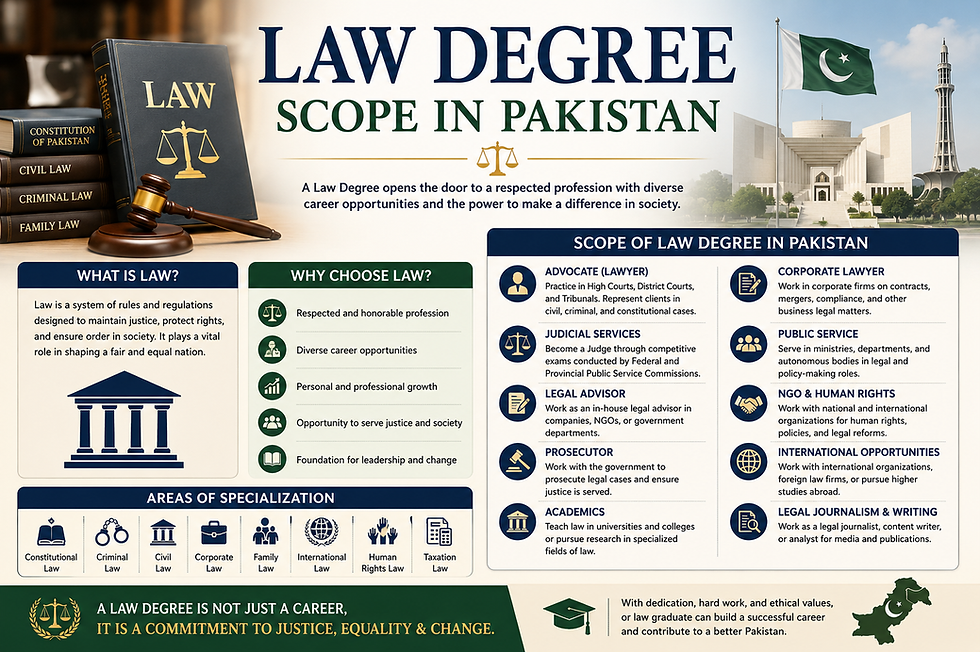
Legal Consultancy in Pakistan: From LL.B to a Consultancy Career

Updated: Oct 8
Courtroom work is the best-known path for law graduates in Pakistan, but it is not the only one. Many graduates are drawn to advisory work: helping individuals, businesses and organizations understand their legal position, meet their obligations and reduce legal risk before problems grow.
This guide explains how to become a legal consultant in Pakistan: what the work involves, what the law requires before you can advise clients independently, and how to build the knowledge, experience and habits that advisory work depends on, starting during your LL.B.

What Legal Consultants Do
Legal consultancy usually centers on advice rather than courtroom advocacy. Typical work includes:
advising on compliance with labor, tax, corporate and regulatory requirements;
drafting and reviewing contracts, agreements and internal policies;
researching statutes, regulations and judgments, and applying them to a client's facts;
identifying legal risks and explaining the options for managing them.
The line between advisory and contentious work is not fixed. Consultants often advise on disputes that have already begun, and litigators regularly give preventive advice to keep clients out of court. Both rely on the same core skill: understanding a client's problem and finding a workable legal solution.
A Hypothetical Example: Reviewing a Supply Agreement
Suppose a small Faisalabad textile business is about to sign an agreement to buy yarn from a supplier and asks for help reviewing it. This example is hypothetical. The work would usually involve:
Clarifying the transaction: what is being bought, in what quantities, at what price and over what period.
Reviewing payment and delivery terms: advance payments, delivery dates, and what happens if goods arrive late or defective.
Identifying risks: for example, unlimited liability, an unclear right to end the agreement, or no agreed way to resolve disputes.
Explaining the options: in plain language, such as proposing revised wording, negotiating a change, or accepting a risk knowingly.
The client makes the business decision. The adviser's job is to make sure that decision is an informed one.
Qualifications and Professional Requirements in Pakistan
Section 22(1) of the Legal Practitioners and Bar Councils Act 1973 provides: "Save as otherwise provided in this Act, no person shall be entitled to practise the profession of law unless he is an advocate." The Act defines an advocate as a person entered on a roll under the Act, and section 58 sets penalties for practicing without that entitlement.
An LL.B does not, on its own, make you an advocate. In Punjab, you apply for Punjab Bar Council enrollment once you meet the council's requirements.
What this means in practice depends on the kind of work:
Students on internships or placements work under the supervision of an advocate or employer and do not advise clients in their own name.
Employed roles, such as contracts or compliance officer, involve work for an employer. Whether a particular role requires enrollment depends on the role and the employer, so check before you accept it.
Independent practice, meaning offering legal advice or representation to clients in your own name, should only begin once you are enrolled as an advocate.
If you are already enrolled and later take up another profession, business or service, rule 108-O of the Pakistan Legal Practitioners and Bar Councils Rules 1976 requires you to seek suspension of your enrollment certificate within one month. Failing to do so is professional misconduct.
Knowledge and Skills to Build During the LL.B
Advisory work draws most heavily on contract law, company law, labor law and tax law, so give those subjects extra attention. Alongside them, practice three skills:
Research: finding the relevant statute, rule or judgment and checking that it is current.
Drafting: writing clauses, letters and short opinions that say exactly what is meant.
Plain-language explanation: telling a non-lawyer what the law means for them, without jargon.
Moot court competitions build the same skills under pressure: you research a problem, build an argument and defend it under questioning. Debates, research projects and workshops add to them.
Turn your practice into a small portfolio you can show an employer:
a short research memorandum on a narrow legal question;
an annotated sample contract, with notes on the risks in each key clause;
a compliance checklist for one type of business;
a plain-language summary of a hypothetical legal issue.
Use fictional or properly anonymized material only. Never include real client documents or details from an internship, which must stay confidential.
Gaining Supervised Practical Experience
Internships at law firms, chambers and corporate legal departments are the main way to see advisory work done well. Corporate placements show how contracts, compliance and internal policies are handled inside a business. Firms and chambers show how advice is researched, drafted and given to clients.
During a placement, aim to:
observe client interviews, with permission, and note how the facts are gathered;
assist with research and summarize what you find;
learn how documents are reviewed, and ask why a clause was changed.
Legal aid and volunteer work, also under supervision, give exposure to real legal problems and to clients from many backgrounds.
Entry-Level Roles and Routes Into Advisory Work
Graduates usually move into advisory work through:
junior positions in law firms or chambers that handle corporate and commercial work;
contracts, legal or compliance roles in companies, banks and other organizations;
research and drafting roles that support senior lawyers.
Requirements differ from employer to employer. For each opening, check whether enrollment, a period of practice or specific subject knowledge is expected.
Independent consultancy usually comes later, once you are enrolled and have the competence to take responsibility for your own advice.
Specialization, Professional Development and Ethics
Specializing in an area such as corporate and commercial law, technology law, intellectual property or regulatory compliance lets you build deeper expertise. Keep that expertise current by following new legislation, regulatory notices and judgments in your area, and by attending seminars and workshops.
Ethics applies from the start. Confidentiality, honest advice and avoiding conflicts of interest matter in every advisory role, whether or not you are enrolled. Once enrolled, you are also bound by the professional ethics rules for advocates in Pakistan.
Those rules limit publicity. Rule 135 of the Pakistan Legal Practitioners and Bar Councils Rules 1976 states that an advocate "shall not solicit professional employment by advertisement or by any other means". It allows "ordinary professional cards, name plates or conventional listing in directories", as long as they are limited to professional and academic qualifications and public offices currently held, and contain nothing that "savours of personal advertisement". Rule 136 also bars paying others to bring in work.
Online activity is not automatically exempt. A professional profile or article that is used to seek clients or promote your services may breach these rules, so check with the Bar Council or a senior advocate before using social media in a way that could look like advertising.
Frequently Asked Questions
Do I need to be an advocate to work as a legal consultant in Pakistan? To offer legal advice or representation to clients in your own name, yes. Section 22(1) of the Legal Practitioners and Bar Councils Act 1973 limits the practice of law to advocates. Employed roles, such as contracts or compliance officer, work differently: whether a particular role requires enrollment depends on the role and the employer.
Can a fresh LL.B graduate do advisory work? Yes, in supervised or employed roles: junior positions in firms or chambers that handle corporate and commercial work, contracts or compliance roles in companies and banks, or research and drafting roles that support senior lawyers. Independent consultancy usually comes later, once you are enrolled as an advocate.
Which LL.B subjects matter most for legal consultancy? Contract law, company law, labor law and tax law, together with three skills: legal research, precise drafting and explaining the law in plain language.
Can I promote my legal services on LinkedIn? Be careful. Rule 135 of the Pakistan Legal Practitioners and Bar Councils Rules 1976 bars advocates from soliciting work by advertisement. Sharing legal insight is different from advertising your services, so check with the Bar Council or a senior advocate before using social media in a way that could look like advertising.
Practical Next Steps for Students
Give contract, company, labor and tax law extra attention in your studies.
Take part in moot court competitions and other practical activities.
Build the four portfolio pieces above, using fictional material.
Seek a supervised internship in a firm, chambers or corporate legal department.
Before applying for a role, check that employer's requirements.
Before advising clients independently, confirm your enrollment and professional obligations.
If you are still choosing where to study, start with the LL.B program at Pasban Law College.