Product Liability and Consumer Protection

Updated: Oct 1
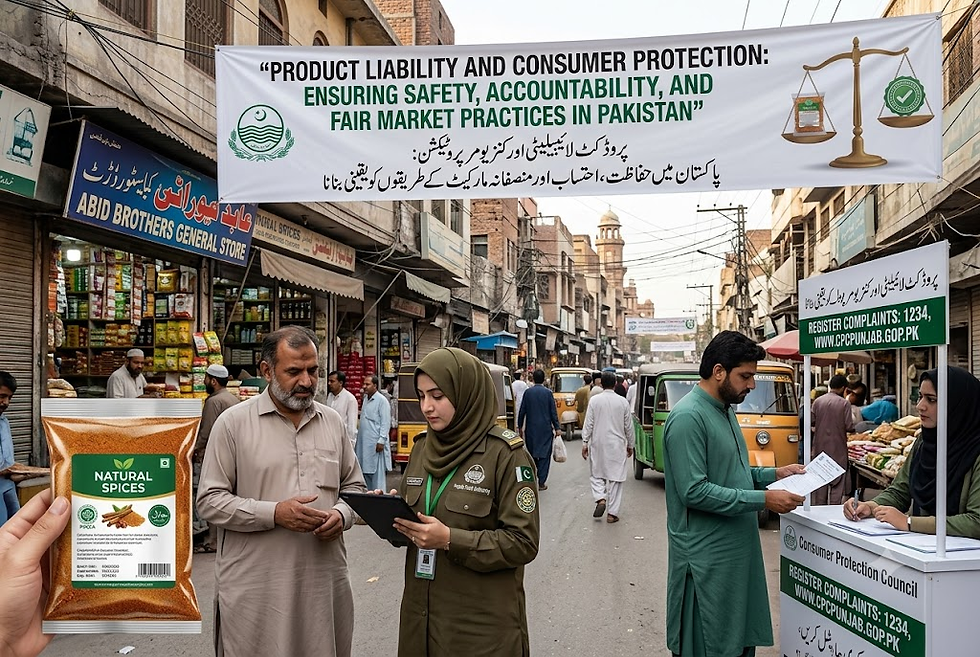
Ensuring Safety, Accountability, and Fair Market Practices in Pakistan
Consumer markets play a vital role in economic development by connecting businesses with individuals who purchase goods and services for personal, professional, and household needs. As commercial activities expand, ensuring the safety and protection of consumers has become an essential responsibility of modern legal systems. Product liability and consumer protection laws provide mechanisms to hold businesses accountable when defective, unsafe, or misleading products cause harm to consumers.
In a competitive marketplace, manufacturers, suppliers, distributors, and retailers have important responsibilities to ensure that products meet acceptable standards of quality, safety, and reliability. Consumers often rely upon information provided by businesses and may not have the technical expertise required to identify hidden defects or potential risks. Therefore, legal protection is necessary to create fairness between businesses and consumers.
In Pakistan, consumer protection has gained increasing importance as markets continue to expand and digital commerce becomes more common. The growth of online shopping, imported products, technological goods, pharmaceuticals, food items, and industrial products has created new challenges regarding product safety, quality control, warranties, and legal accountability.
Product liability laws aim to establish responsibility when defective products cause injury, financial loss, or damage to consumer interests. At the same time, consumer protection frameworks promote transparency, fair business practices, and confidence in commercial transactions. A balanced legal approach protects consumers while encouraging businesses to maintain high standards of production and service delivery.
Understanding product liability and consumer protection is therefore essential for consumers, businesses, legal professionals, regulators, and policymakers working toward a safer and more trustworthy marketplace.
Understanding Product Liability
Product liability refers to the legal responsibility of manufacturers, suppliers, distributors, or sellers for harm caused by defective or unsafe products. The principle behind product liability is that businesses involved in the supply chain should ensure that products reaching consumers are reasonably safe and suitable for their intended use.
Unlike ordinary contractual disputes, product liability focuses on protecting consumers from harm caused by defective goods, even where the consumer may not have directly negotiated with the manufacturer. The law recognises that consumers often depend upon businesses for product quality and safety.
A product liability claim may arise when a product contains manufacturing defects, design defects, inadequate warnings, or misleading information that results in injury or loss.
The Importance of Consumer Protection Laws
Consumer protection laws are designed to safeguard individuals from unfair commercial practices and ensure that businesses operate responsibly. These laws create legal standards regarding product quality, advertising, warranties, pricing transparency, and dispute resolution.
Consumers are often considered the weaker party in commercial transactions because businesses generally possess greater information, resources, and technical knowledge. Consumer protection laws help correct this imbalance by providing rights and remedies against unfair treatment.
Consumer Rights in Pakistan
Consumer protection frameworks recognise several important rights that enable individuals to make informed and safe purchasing decisions. These rights form the foundation of fair commercial relationships between businesses and consumers.
Key consumer rights include:
The right to receive safe and quality products.
The right to accurate information about goods and services.
The right to protection against unfair business practices.
The right to seek legal remedies for defective products.
The right to fair treatment in commercial transactions.
The right to make informed purchasing decisions.
Protecting these rights strengthens consumer confidence and encourages businesses to maintain ethical market practices.
Legal Framework of Consumer Protection in Pakistan
Pakistan has developed consumer protection laws through provincial legislation and regulatory mechanisms designed to address consumer complaints and commercial unfairness. These legal frameworks provide procedures for consumers to seek remedies where businesses fail to meet required standards.
Consumer protection laws generally address issues such as defective products, misleading advertisements, poor service quality, unfair contractual terms, and failure to provide promised goods or services.
The effectiveness of consumer protection depends not only on legislation but also on public awareness, efficient enforcement institutions, and accessible dispute resolution mechanisms.
Types of Product Defects
Product liability commonly arises from different categories of defects. Understanding these categories helps determine whether a manufacturer or seller may be legally responsible for consumer harm.
Manufacturing Defects
A manufacturing defect occurs when a product differs from its intended design due to an error during production. The product may become unsafe because of poor-quality materials, improper assembly, or manufacturing mistakes.
For example, a consumer product that becomes dangerous because of an error in the production process may create liability for the responsible business.
Design Defects
A design defect exists when the product's original design creates unnecessary risks even when manufactured correctly. The issue is not a mistake in production but a problem with the product concept itself.
Businesses are expected to consider consumer safety during product development and design processes.
Failure to Provide Adequate Warnings
Products that involve potential risks must include appropriate instructions, safety information, and warnings. Failure to communicate important risks may result in liability if consumers suffer harm because they were not properly informed.
Clear warnings help consumers use products safely and reduce preventable injuries.
Responsibilities of Manufacturers and Sellers
Manufacturers and sellers have significant responsibilities throughout the product supply chain. Their legal obligations extend beyond simply producing and selling goods.
Businesses should ensure that products:
Meet applicable safety standards.
Contain accurate descriptions and instructions.
Are free from avoidable defects.
Include necessary warnings and usage information.
Are supported by proper quality control procedures.
Provide effective complaint and warranty mechanisms.
Responsible business practices reduce legal risks while improving consumer trust and brand reputation.
Product Liability in Digital Commerce
The expansion of online shopping has created new challenges for product liability and consumer protection. Digital marketplaces allow consumers to purchase goods from sellers located in different regions, making issues of responsibility and enforcement more complex.
Online consumers may face problems involving counterfeit products, inaccurate descriptions, defective goods, delayed delivery, and unclear return policies. Digital platforms, sellers, and payment providers must adopt transparent practices to protect consumer interests.
Strong legal frameworks for e-commerce are necessary to ensure that digital marketplaces remain safe and reliable.
Consumer Protection and Advertising Practices
Advertising plays an important role in influencing consumer decisions. Businesses use advertisements to communicate information about products, prices, benefits, and features. However, misleading or deceptive advertising can result in consumer harm.
Consumer protection laws require businesses to provide truthful information and avoid false claims that may mislead buyers. Accurate advertising allows consumers to make informed choices and promotes fair competition among businesses.
Responsible marketing practices contribute to stronger relationships between companies and consumers.
Warranties and Product Guarantees
Warranties and guarantees provide consumers with additional protection by establishing commitments regarding product quality and performance. They assure consumers that businesses will address certain defects or failures within a specified period.
Clear warranty terms help prevent disputes by explaining repair, replacement, or refund responsibilities. Businesses that provide reliable warranties demonstrate confidence in their products and commitment to customer satisfaction.
However, warranty limitations must be fair and clearly communicated to consumers.
Role of Regulatory Authorities
Regulatory authorities play an important role in maintaining product safety and enforcing consumer protection standards. They monitor market practices, establish safety requirements, investigate complaints, and take action against businesses that violate consumer rights.
Effective regulation ensures that businesses compete fairly while maintaining appropriate standards of quality and safety. Strong enforcement also discourages negligent practices and protects vulnerable consumers.
Regulatory institutions must continuously adapt to technological developments and changing market conditions.
Challenges in Product Liability and Consumer Protection
Despite the existence of consumer protection mechanisms, several challenges continue to affect effective enforcement. Consumers may face difficulties in understanding their rights, collecting evidence, accessing legal remedies, or pursuing claims against large businesses.
Major challenges include:
Limited consumer awareness regarding legal rights.
Complex procedures for filing complaints.
Difficulty proving product defects.
Lack of effective enforcement in certain markets.
Growth of counterfeit and unsafe products.
Challenges in regulating online marketplaces.
Limited access to specialised legal assistance.
Addressing these issues requires stronger institutions, public education, and continuous improvement of legal procedures.
Strengthening Consumer Protection Through Legal Reform
Modern markets require consumer protection systems that respond effectively to technological, commercial, and social changes. Legal reforms should focus on improving enforcement mechanisms, simplifying complaint procedures, and increasing awareness among consumers and businesses.
Important areas of improvement include strengthening product safety standards, improving digital commerce regulation, encouraging alternative dispute resolution, enhancing regulatory coordination, and promoting responsible business practices.
A stronger consumer protection framework benefits both consumers and businesses by creating a more trustworthy marketplace.
The Role of Alternative Dispute Resolution
Consumer disputes do not always require lengthy court proceedings. Alternative dispute resolution methods such as mediation and negotiation can provide faster and more cost-effective solutions.
These mechanisms allow consumers and businesses to resolve disagreements efficiently while reducing pressure on courts. Effective dispute resolution systems encourage businesses to address consumer concerns promptly and maintain positive customer relationships.
Alternative dispute resolution is therefore an important component of modern consumer protection.
The Future of Product Liability Law in Pakistan
As markets continue to evolve, product liability and consumer protection laws will face new challenges related to technology, artificial intelligence, digital products, and global supply chains. Future legal frameworks must address emerging risks while encouraging innovation and business growth.
Consumers will increasingly expect greater transparency, safety, and accountability from businesses. Companies that adopt responsible production methods, ethical marketing practices, and strong quality control systems will be better positioned in competitive markets.
A modern product liability framework should protect consumers while supporting responsible entrepreneurship and economic development.
Conclusion
Product liability and consumer protection are essential components of a fair and efficient marketplace. They ensure that businesses remain accountable for the safety and quality of their products while providing consumers with legal protection against defective goods, misleading practices, and unfair treatment.
In Pakistan, strengthening consumer protection requires effective legislation, improved enforcement, greater public awareness, and responsible business practices. As commercial activities and digital markets continue to expand, legal frameworks must continue evolving to address new challenges and protect consumer interests.
A balanced approach to product liability promotes trust between businesses and consumers, encourages ethical commercial practices, and contributes to sustainable economic growth. By ensuring accountability throughout the supply chain, Pakistan can develop a marketplace where consumer rights are respected and businesses compete through quality, transparency, and innovation.