
What Happens During the Final 15 Minutes Before a PLC Moot Court Round?

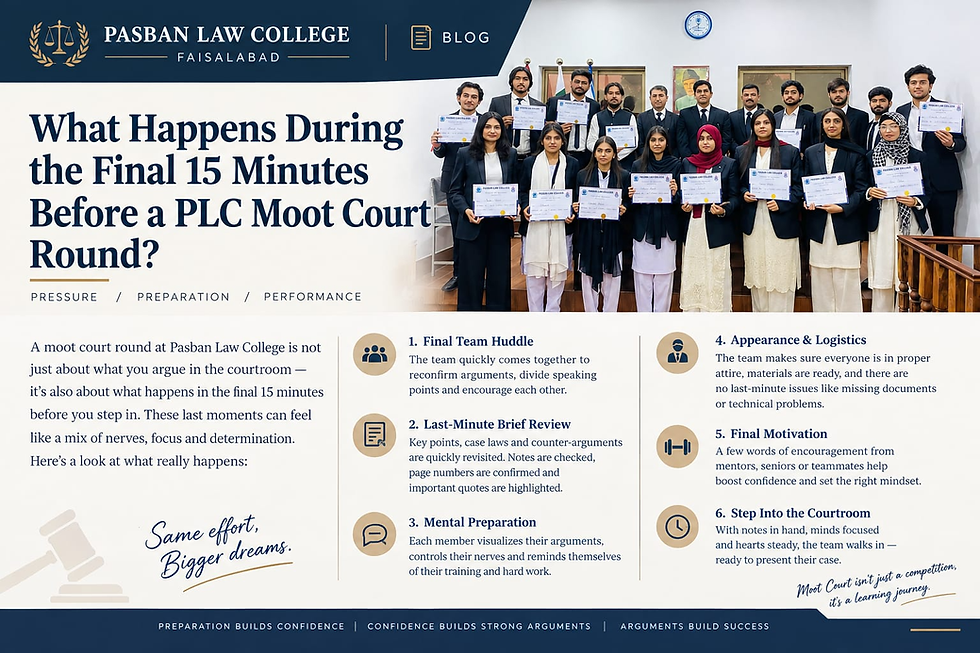
There is a unique atmosphere in a moot court room just before a round begins. From outside, everything may appear calm and organized, but for the students participating in the round, the final fifteen minutes can be filled with concentration, nervousness, teamwork, and last-minute preparation. At Pasban Law College Faisalabad, Moot court activities provide law students with an opportunity to experience the practical side of legal advocacy and understand what it means to present a legal argument before a bench.
A moot court is much more than a competition. It is a practical academic exercise in which students study a legal problem, conduct research, identify relevant laws and authorities, prepare arguments, and present their submissions before judges. It allows students to move beyond textbook learning and develop skills that can become valuable throughout their legal careers.
The final fifteen minutes before a moot court round are particularly important because this is when preparation turns into performance. By this stage, students have already spent hours researching the case and practicing their arguments. They are no longer trying to learn the entire case. Instead, they are reviewing the most important points, checking authorities, preparing for questions, coordinating with teammates, and mentally preparing themselves to enter the courtroom.
For students at Pasban Law College Faisalabad, these final moments can become an important part of their academic journey. They teach lessons about preparation, confidence, discipline, communication, and professional responsibility that extend far beyond a single moot court competition.
The Countdown Begins
When only fifteen minutes remain, the atmosphere among the team often changes. Conversations become more focused, notes are reviewed carefully, and unnecessary discussions are reduced. Every student knows that the round is about to begin.
One student may be checking the main legal arguments, another may be reviewing case authorities, while another may be quietly rehearsing the opening submission. The team may also discuss the order of arguments and remind each other about specific issues that could attract questions from the bench.
This is not the time for completely new research. The most important preparation should already have been completed. The final minutes are about organization and focus.
For a law student, this is an important lesson. Effective advocacy does not begin when the student enters the courtroom. It begins much earlier through research, preparation, practice, and understanding.
The First Step Is Staying Calm
One of the biggest challenges before a moot court round is managing nervousness. Even students who have prepared thoroughly may feel anxious as the round approaches.
A student may wonder whether the judges will ask difficult questions, whether an important point will be forgotten, or whether the arguments will be presented effectively. These feelings are natural, particularly when students are participating in a formal moot court for the first time.
The goal is not to eliminate nervousness completely. Instead, students need to learn how to manage it.
Taking a few quiet moments, breathing slowly, reviewing only the essential points, and avoiding unnecessary last-minute discussions can help students remain focused. Confidence does not mean believing that nothing can go wrong. It means knowing that one has prepared sufficiently to deal with unexpected situations.
This is one of the practical lessons that moot court activities can provide to students at Pasban Law College Faisalabad.
Reviewing the Main Legal Issues
During the final fifteen minutes, students normally return to the central legal issues of the case.
A moot problem can contain numerous facts and legal questions. However, not every detail will have the same importance. Students need to identify the strongest issues and understand exactly how they support their position.
A quick final review may focus on:
The main legal issues
The strongest arguments
Important statutory provisions
Key judicial authorities
The opposing side's strongest argument
The relief being requested from the court
This type of focused review is more useful than attempting to read the entire memorial again.
The student should be able to explain the case in simple terms: what the dispute is, what the legal question is, what the law says, and why the court should accept the student's position.
Checking Important Authorities
Legal advocacy depends heavily on authorities. A strong argument should be supported by relevant legislation, constitutional provisions, judicial decisions, or other appropriate legal sources.
Before the round begins, students may check the authorities they intend to rely upon most heavily. They may confirm case names, legal principles, relevant provisions, and page numbers.
This is particularly important because the bench may ask a student to explain the authority or identify where a particular proposition comes from.
A student should not merely know the name of a case. The student should understand why the case is relevant and how its reasoning applies to the moot problem.
This distinction between memorizing a case and understanding a case is an important part of legal education.
Preparing for Questions from the Bench
One of the most challenging parts of a moot court is answering questions from the judges.
A student may prepare a detailed submission, but the bench can interrupt and ask a question at any time. The student therefore needs to be prepared to think beyond a memorized speech.
During the final minutes, students may consider possible questions such as:
Why should this legal provision apply to the present facts?
What authority supports this interpretation?
How is your case different from the authority relied upon by the opposing side?
What would happen if the court accepts the other interpretation?
Why should the court grant the relief you are requesting?
Thinking about such questions helps students understand their own arguments more deeply.
At Pasban Law College Faisalabad, practical activities such as moot court can encourage students to develop this ability to think critically and respond under pressure.
Understanding the Opposing Side
Good advocates do not prepare only their own arguments. They also study the arguments likely to be presented by the opposing side.
During the final fifteen minutes, team members may remind one another about the strongest counterarguments they are likely to face.
This preparation can make a significant difference. If a student understands the opposing position, an unexpected question is less likely to cause confusion.
It also encourages students to approach legal disputes objectively. The purpose of advocacy is not simply to repeat one's own position. A capable advocate must understand competing interpretations and explain why one position should be preferred.
The Final Team Discussion
Moot court is generally a collaborative exercise. Even when one student is speaking, the preparation behind that submission is often the result of teamwork.
Before the round, the team may confirm which student will address each issue, which authorities will be used, and how the arguments will be divided.
A short final discussion can help ensure that every member understands the strategy.
However, this discussion should remain focused. Introducing a large number of new arguments immediately before the round can create unnecessary confusion.
The purpose of the final team discussion is to strengthen preparation, not completely redesign the case.
Checking the Memorial and Notes
Organization is another important part of the final preparation.
Students should make sure that their memorial, notes, authorities, and other permitted materials are arranged properly. Important pages may be marked so they can be located quickly.
This can be especially helpful when the bench asks about a particular authority or legal provision.
The ability to organize documents efficiently is not only useful in moot court. It is also relevant to professional legal practice, where lawyers may have to work with large amounts of legal material.
Moot court therefore gives students an opportunity to develop professional habits while still in an academic environment.
The Importance of the Opening
The opening moments of oral advocacy can strongly influence a student's confidence.
During the final minutes, the speaker may review the first part of the submission. The objective should not necessarily be to memorize every sentence. Instead, the student should understand the structure of the opening and know exactly how to begin.
A confident opening can help the student settle into the round.
Once the first few sentences are delivered, the speaker may become more comfortable and begin focusing on the substance of the argument.
This is why practice is important. Students should have enough familiarity with their opening to begin confidently without sounding as though they are simply reciting memorized material.
Managing Time
Time management is another concern during a moot court round.
Students usually have a limited amount of time to present their submissions. If too much time is spent explaining one issue, there may not be enough time for the remaining arguments.
The final fifteen minutes provide an opportunity to remind oneself of the available time and decide which points deserve the most attention.
A student should understand which arguments are essential and which details can be left out if time becomes limited.
This teaches an important professional skill: lawyers often have to communicate complex legal matters within limited periods.
Avoiding Last-Minute Panic
One of the biggest mistakes students can make is trying to change everything immediately before the round.
A student may suddenly discover a new argument or become concerned about an issue that was previously considered minor. While last-minute observations can sometimes be useful, completely changing the strategy can make the presentation less organized.
The final fifteen minutes should therefore be used to strengthen the existing preparation.
Students should focus on clarity rather than attempting to become perfect at the last moment.
A well-understood argument presented clearly is often more effective than a complicated argument that the student has only recently introduced.
The Role of Confidence
Confidence is an important part of advocacy, but genuine confidence comes from preparation.
A student who understands the case, knows the authorities, has practiced the arguments, and has considered possible questions is more likely to remain composed before the bench.
At the same time, confidence should not become arrogance. Professional advocacy requires respect for the bench, careful listening, and the ability to accept challenging questions.
Moot court helps students learn this balance.
When the Student Enters the Courtroom
Eventually, the fifteen-minute preparation period comes to an end.
The students collect their materials and enter the moot court room. The atmosphere becomes more formal. The team takes its position and waits for the round to begin.
At this point, preparation has to become performance.
The student must speak clearly, listen carefully, answer questions respectfully, manage time, and present legal reasoning in an organized manner.
The transition from preparation to performance can be one of the most memorable parts of the experience.
For many students, especially those participating in their early moot court activities, this moment can provide a new level of confidence.
When the Bench Interrupts
A major difference between ordinary public speaking and legal advocacy is that the speaker may be interrupted by the bench.
A student may be halfway through an argument when a judge asks a question.
This can initially feel intimidating, but it is an essential part of the learning experience.
The student must stop, listen carefully, understand the question, provide a direct answer, and then return to the argument.
This teaches students that advocacy is not simply about speaking. It is also about listening and responding.
These skills can later become valuable in court proceedings, client meetings, negotiations, and professional legal discussions.
Learning Through Mistakes
Not every moot court round will go perfectly.
A student may forget an authority, answer a question poorly, speak too quickly, exceed the allocated time, or fail to explain an argument clearly.
These mistakes should not be viewed only as failures. They can become valuable learning opportunities.
After the round, students can review their performance and identify areas for improvement.
Perhaps the research needs to be stronger. Perhaps the argument needs to be simplified. Maybe the student needs more practice answering questions. Or perhaps time management needs improvement.
The ability to identify weaknesses and work on them is one of the most important aspects of professional development.
The Student Experience Behind the Round
A moot court round represents much more than the few minutes spent before the judges.
Behind every presentation are hours of research, team meetings, discussions, practice sessions, revisions, and preparation.
Students may spend time reading legal authorities, discussing interpretations with classmates, practicing questions, and improving their written submissions.
The final fifteen minutes therefore represent the conclusion of a much longer journey.
This human side of moot court is what makes the activity particularly meaningful for law students. It combines academic learning with teamwork, pressure, excitement, and personal growth.
How Moot Court Supports Legal Education
Legal education is most effective when students can connect theoretical knowledge with practical application.
Classroom lectures can provide the foundation, but practical activities allow students to test their understanding.
Moot court requires students to take a legal principle and apply it to a particular factual situation. It requires them to research, reason, write, speak, listen, and respond.
For students at Pasban Law College Faisalabad, such experiences can contribute to a broader understanding of what it means to study law and prepare for a legal career.
The activity also helps students recognize that becoming a lawyer requires continuous learning and practice.
The Final Lesson of the Final 15 Minutes
The most important lesson from the final fifteen minutes is that successful advocacy is rarely created at the last moment.
The confidence a student displays before the bench is the result of preparation that began much earlier.
Research, teamwork, practice, understanding legal principles, reviewing authorities, and learning from mistakes all contribute to the final performance.
The last fifteen minutes simply bring that preparation into focus.
Conclusion
The final fifteen minutes before a PLC moot court round can be some of the most focused and memorable moments in a law student's academic experience. Students review their central arguments, check important authorities, anticipate questions from the bench, coordinate with their teammates, organize their materials, manage nervousness, and prepare themselves to present their case professionally.
At Pasban Law College Faisalabad, moot court activities can provide students with an opportunity to transform legal knowledge into practical advocacy. They can learn how to research legal issues, construct arguments, communicate clearly, respond to difficult questions, manage time, work as a team, and remain composed under pressure.
Most importantly, the experience teaches students that confidence in the courtroom does not appear suddenly. It is developed through preparation, practice, discipline, and repeated exposure to practical legal situations.
When the final fifteen minutes end and the student walks into the moot court room, the real performance begins. But the foundation for that performance has already been built. Every note reviewed, every case studied, every argument practiced, and every question anticipated contributes to the student's development as a future legal professional.
For students at Pasban Law College Faisalabad, each moot court round can therefore be more than a competition. It can be another step toward becoming a confident, analytical, responsible, and professionally prepared member of the legal community.


